
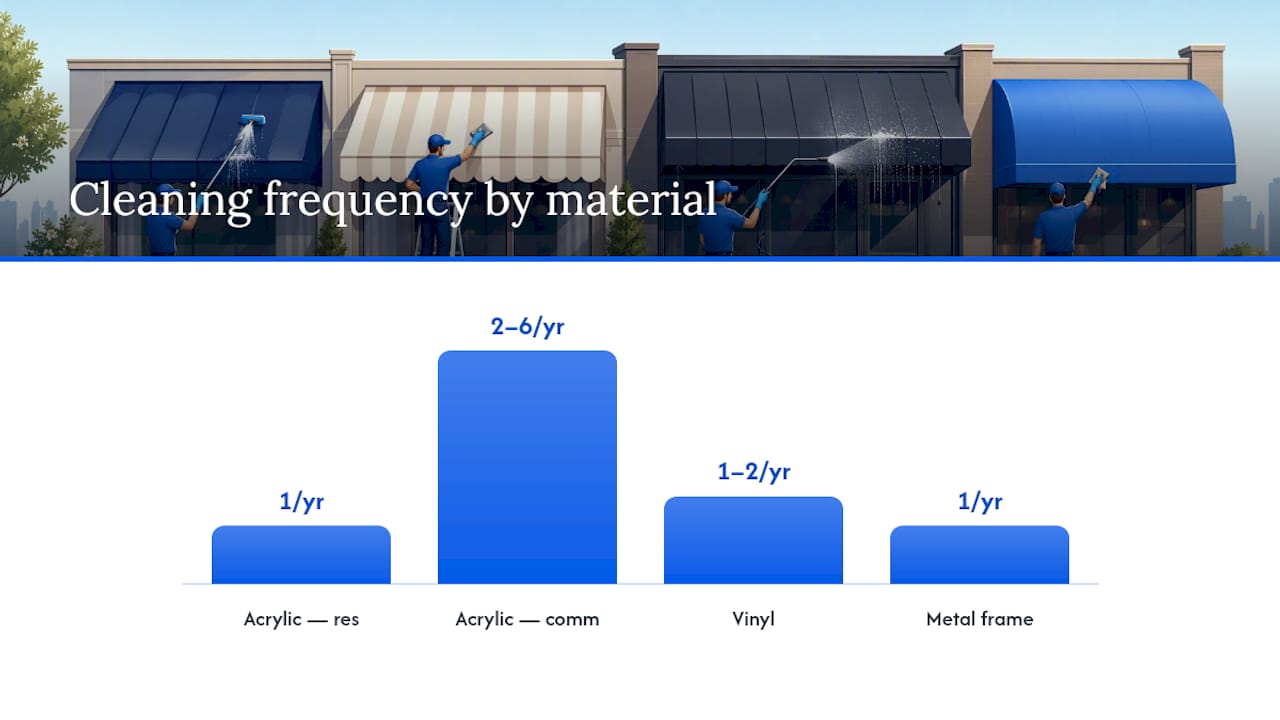
Most residential fabric awnings typically need a few deep cleans annually, while commercial awnings under heavy foot traffic often require more frequent cleaning. Vinyl awnings hold up well on an annual to biannual cycle, and metal frames mainly need a yearly inspection rather than a scrub. Mildew, bird droppings, heavy pollen, coastal salt, or constant foot traffic all push that schedule tighter. One rule overrides everything else: never retract a wet awning, and always check your manufacturer’s care instructions before choosing a cleaner.
TL;DR:
- Regular deep cleaning should be done at least once a year for residential awnings, but more frequent cleaning is necessary in high-exposure environments.
- Commercial awnings with heavy traffic may require up to six deep cleans annually to prevent grime and grease buildup.
- Vinyl awnings resist mildew better and need cleaning every year or two, while metal frames should be inspected annually for rust and mechanical issues.
- Moisture, mildew, bird droppings, sap, and dirt triggers demand immediate cleaning regardless of the schedule to prevent damage.
- Reapplication of water-repellent protectants is needed every two to three years, with more frequent retreatment in coastal or high-UV climates.
Table of Contents
- How Often to Clean Awnings by Material and Exposure
- What’s the Safest Way to Clean Different Awning Materials?
- When Does Fabric Protectant Need to Be Reapplied?
- Should You Clean Your Awning Yourself or Hire a Pro?
- Building a Seasonal Awning Maintenance Calendar
- Why Bros Window Cleaning Built This Schedule Around Real Properties
- Get Your Awning on a Professional Cleaning Schedule
- Sources
- FAQ
How Often to Clean Awnings by Material and Exposure
Awning cleaning frequency isn’t one number. It shifts based on what the awning is made of, where it lives, and how hard it works.
- Solution-dyed acrylic (residential): Periodic deep cleans each year, with regular brushing and hosing in between.
- Solution-dyed acrylic (commercial, storefronts, restaurants): Two to six deep cleans per year, since grease, foot traffic, and street grime build up fast.
- Vinyl: Annual to biannual cleaning; vinyl resists mildew better than woven fabric but still needs rinsing to prevent grime from baking into the surface.
- Metal frames and hardware: A yearly inspection at minimum, checking for rust, loose bolts, and stiff joints.
Location changes the math. Manufacturer guidance notes that cleaning frequency depends heavily on installation location, weather exposure, and the type of soiling involved. Coastal properties deal with salt spray that eats into fabric fibers and metal fasteners. Urban buildings collect diesel soot and airborne grime. Anything near trees gets sap and pollen dusted across the fabric every spring.
Some triggers matter more than the calendar. Visible mildew spots, bird droppings, sticky sap residue, or a fabric surface that no longer beads water all mean it’s time to clean now, regardless of when the last deep clean happened. Waiting for rain to do the job is a mistake. Rain often carries pollutants that stain fabric rather than rinse it clean.
What’s the Safest Way to Clean Different Awning Materials?
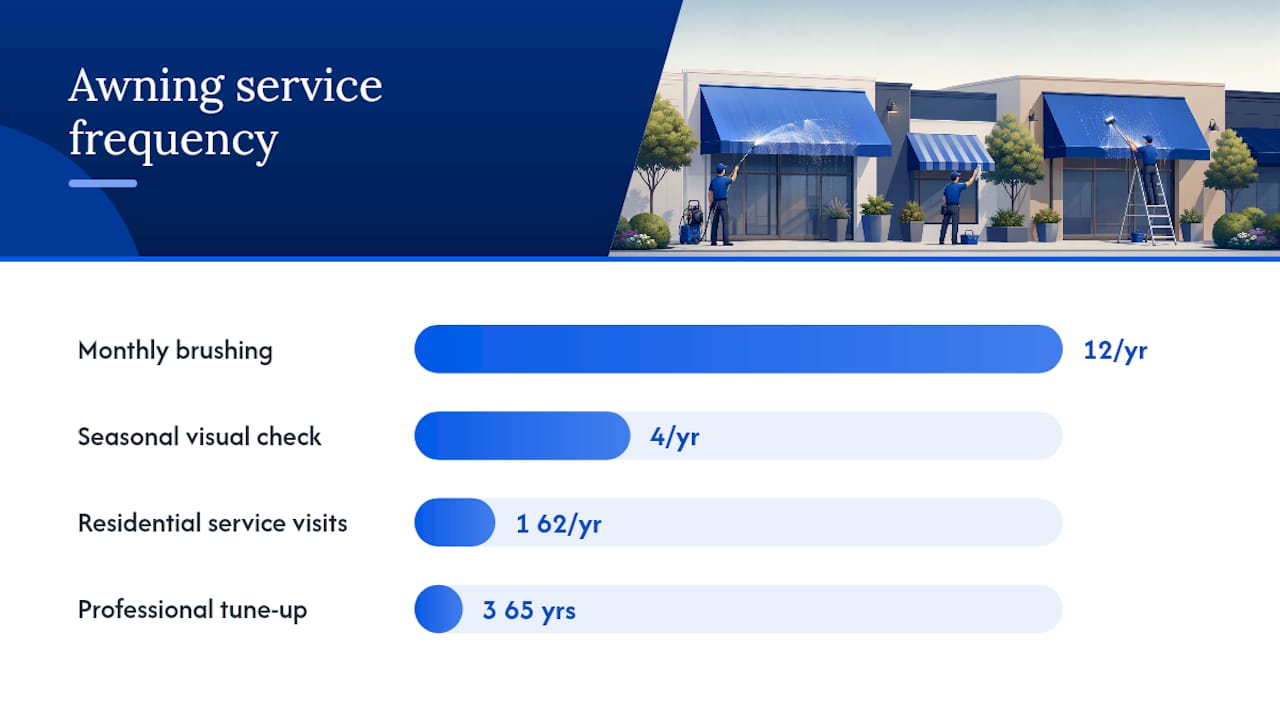
Light, frequent maintenance beats occasional heavy scrubbing. Sunbrella recommends brushing off debris and hosing down fabric monthly, noting that a thorough cleaning is typically only needed every few years in most environments when that monthly habit is kept up. Skipping the light maintenance is usually what forces a full deep clean sooner than necessary.
For the deep clean itself, follow these steps:
- Sweep loose debris off the fabric with a soft broom before adding any water.
- Mix a mild soap solution; for mildew on suitable solution-dyed acrylics, some manufacturers permit a diluted bleach mix, roughly one cup of bleach with a quarter cup of mild soap per gallon of water.
- Let the solution soak briefly on stained areas, then scrub gently with a soft brush, working with the fabric weave rather than against it.
- Rinse thoroughly from top to bottom until no suds remain.
- Let the fabric air-dry completely before retracting it.
That last step matters more than people think. Retracting damp fabric is one of the most common causes of mildew reappearing, along with hidden rot forming around the roller tube where nobody checks.
Hardware needs its own care. Use a dry silicone spray on hinges, arms, and roller mechanisms. Avoid heavy grease or WD-40, which attracts dust and grit that turns into an abrasive paste over time. If arms are stuck or a motor grinds when opening, that’s a mechanical issue, not a cleaning one. Call a professional rather than forcing it.
Pro Tip: Keep a soft-bristle brush and a garden hose attachment dedicated to awning maintenance. Grabbing the same stiff brush you use on concrete will scratch coated fabric and shorten its life.
When Does Fabric Protectant Need to Be Reapplied?
Fabric protectants don’t last forever, even on high-quality acrylic. Most need retreatment on a cycle rather than a one-time application:
- Reapply water-repellent treatment roughly every two to three years for most fabric protectants, sooner in coastal or high-UV climates.
- Test it yourself: splash a little water on the fabric. If it beads and rolls off, the coating is still working. If it soaks in, it’s time to retreat.
- Harsh detergents and aggressive scrubbing strip protectant along with dirt, so a fabric that’s been deep-cleaned several times in a row may need retreatment earlier than the typical cycle.
- Check your warranty terms before choosing a protectant spray. Some manufacturers require specific products or professional application to keep coverage valid.
Reapplying protectant yourself works fine for small residential awnings. For larger commercial units, a professional application ensures even coverage and keeps warranty documentation intact.
Should You Clean Your Awning Yourself or Hire a Pro?
Light cleaning, debris removal, and spot-treating a fresh stain are all DIY-safe tasks that fit into a normal maintenance routine. Mechanical repairs, heavy mildew remediation, and any fabric work tied to a warranty claim belong to a professional.
- DIY tasks: monthly brushing, hosing, spot cleaning, checking for beading water.
- Professional tasks: motor or gearbox issues, deep mildew removal on large commercial units, fabric replacement, warranty-sensitive repairs.
For inspections, a seasonal visual check plus a professional mechanical tune-up every few years keeps small issues from turning into expensive ones. That tune-up interval, cited consistently by awning specialists, covers checking tension springs, motor function, and frame alignment.
Budgeting is straightforward once you know the cadence; property managers can benefit from streamline maintenance strategies proven for service businesses to standardize seasonal service windows and log condition data effectively. A single residential awning typically needs one or two service visits a year plus occasional protectant reapplication. Commercial property managers overseeing multiple units should build a maintenance contract around seasonal deep cleans, hardware lubrication, and the three to five year tune-up, then log condition notes at each visit to catch wear before it becomes a bigger repair.
Building a Seasonal Awning Maintenance Calendar
A workable maintenance schedule breaks the year into four simple checkpoints rather than trying to track every awning on an ad hoc basis. Industry guides commonly recommend two deep cleans a year, spring and fall, bracketing the season when the awning sees the most use.
- Spring: Full deep clean, hardware inspection, silicone spray on moving parts, and a fabric beading test to check protectant condition.
- Summer: Light touch-ups every few weeks in high-traffic or high-pollen locations; hose down and brush off debris as needed.
- Fall: Second deep clean before the awning gets less use, with full air-dry before retraction and storage.
- Winter: Visual-only check for frost damage, loose fasteners, or fabric sagging; no cleaning needed unless visible soiling shows up.
At each visit, record what you cleaned, note hardware condition, confirm the fabric dried fully before retracting, and log anything that looked off. Light monthly touch-ups run 15 to 30 minutes per unit. A full deep clean, done right with rinse and dry time factored in, takes closer to an hour or two per awning, plus drying time before retraction.
Why Bros Window Cleaning Built This Schedule Around Real Properties
This schedule reflects what actually shows up on Orange County properties: salt haze on coastal awnings, sap under trees, grime near busy sidewalks. Manufacturer guidance sets the baseline; site conditions adjust it. Insured professional tune-ups fill the gap between what a property owner can safely handle and what needs trained hands.
— nolan
Get Your Awning on a Professional Cleaning Schedule
A fully insured alternative is available to property owners for awning cleaning schedules. Instead of researching cleaner ratios and hoping your ladder work is safe, you get a punctual, quality-checked visit that fits your property’s exposure, whether that’s a storefront on a busy street or a backyard patio near the coast.
Awning cleaning is one piece of a broader exterior maintenance routine. Bros Window Cleaning also handles window cleaning, pressure washing, and gutter cleaning for residential and commercial properties, so a single scheduled visit can cover more than just the awning. If you’re weighing whether a mildew stain needs professional attention, our guide on safe DIY mildew removal walks through when it’s fine to handle it yourself and when it’s not.
Request an estimate through our main services page to get a seasonal cleaning visit scheduled around your property’s specific exposure and use.
Sources
- Tips for cleaning your Sunbrella fabric awning
- How to Clean & Maintain Your Awning | AwningTown
- Awnings — Textiles / manufacturer guidance
- How to lubricate your awning | WD-40 guidance
FAQ
What Is the Best Way to Clean an Outdoor Awning?
A mild soap and water solution applied with a soft brush, followed by a thorough rinse and full air-dry before retracting, works safely on most fabric awnings. For mildew, a diluted bleach solution is sometimes appropriate on solution-dyed acrylics, but always rinse completely afterward.
What Time of Year Should I Deep Clean My Awning?
Spring and fall are the standard windows, bracketing the season of heaviest use with a deep clean before and after. Light monthly brushing and hosing between those two visits keeps grime from building up in the meantime.
Can You Clean an Awning Without Taking It Down?
Yes. Most cleaning happens with the awning extended, using a hose, soft brush, and mild detergent while it’s still mounted. Removal is usually only necessary for major repairs or full fabric replacement, not routine cleaning.
What’s the Best Cleaner for Outdoor Awning Fabric?
A mild dish soap diluted in water handles most dirt and grime safely. For mildew on fabrics that tolerate it, a light bleach and soap mix works, but always check your awning’s specific care instructions first since some coated or vinyl fabrics react poorly to bleach.
How Much Does Professional Awning Cleaning Cost?
Pricing varies by awning size, material, and condition, so current rates are listed directly on the Bros Window Cleaning services page rather than as a flat quote here.