
Cleaning your solar panels can be done safely, but only if you treat the array as live electrical equipment, not a dirty window. Run a job hazard analysis before you touch anything, never walk on the panels, and if the array sits above a single story or the wiring looks questionable, hire a trained, insured professional instead of climbing up yourself.
TL;DR:
- Live DC voltage from solar panels exists whenever light hits the cells, even if the inverter is off or disconnected, requiring caution during cleaning.
- Wet connectors, damaged wiring, or junction boxes can cause shock or arc faults when water exposure occurs, especially in compromised systems.
- Using a non-conductive water-fed pole with a soft brush and deionized water while avoiding roof access offers the safest cleaning method and reduces electrical and fall hazards.
- Walking or kneeling on solar panels significantly increases microcracking risk, which can void warranties and reduce energy output over time.
- Any system with complex wiring, damage, or difficult access should be cleaned by trained, insured professionals rather than DIY to prevent accidents.
Table of Contents
- Why Solar Panel Cleaning Safety Matters More Than You’d Think
- What PPE and Fall Protection Do You Actually Need?
- Safe Methods and Tools for Cleaning Solar Panels
- What Not to Do When Cleaning Solar Panels
- Building a Pre-Clean Safety Checklist
- How Trained Crews Handle This Job
- A Safety-First Take on Solar Cleaning
- Get Safe, Insured Solar Panel Cleaning Without the Rooftop Risk
- Where This Guidance Comes From
- Sources
- FAQ
Why Solar Panel Cleaning Safety Matters More Than You’d Think
A solar module generates direct current the instant light hits its cells, whether the inverter is on, off, or pulled from the wall entirely. That single fact is why treating this as ordinary rooftop chores is a mistake. Flipping the inverter off disconnects the array from your home’s electrical system, but it does not de-energize the modules themselves. In some cases, isolating the inverter actually raises the open-circuit voltage at the module level, according to ISCA’s analysis of solar cleaning as energized electrical maintenance.
Add water to that equation and the risk compounds. Wet connectors, degraded insulation, or a cracked junction box can turn a routine rinse into a ground fault or arc fault. PV Magazine USA’s coverage of solar cleaning as an emerging safety field documents these exact failure modes showing up on residential and commercial jobs alike.
Then there’s the fall risk, which is arguably more likely to hurt someone than the electrical hazard. Glass gets slick when wet, roof pitches vary wildly, and a rushed weekend cleaning job rarely accounts for loose footing or unstable ladders.
The real hazards stacked together:
- Live DC voltage present anytime light hits the cells, inverter status aside
- Hidden wiring damage that water exposure can turn into a shock or arc fault
- Wet glass and steep or fragile roofing that multiply slip-and-fall risk
- Reduced visibility and judgment when cleaning during bright midday glare
Dust and soiling do cut into output. Research on cleaning method performance has found efficiency losses reaching roughly 15 to 20% under certain soiling conditions, according to a PLOS ONE comparative study on cleaning methods. That’s real money walking off your roof, but it’s not a reason to skip the safety steps that follow.
What PPE and Fall Protection Do You Actually Need?
The gear you need depends entirely on where you’re standing and what you’re touching. Ground-level cleaning with a water-fed pole calls for different protection than climbing onto a pitched roof.
For anyone near the array’s electrical components, electrically rated gloves and insulating footwear are the baseline, not an upgrade. OSHA’s guidance on PPE and fall protection treats these as standard requirements for work near energized equipment, and solar arrays qualify even when the inverter reads “off.”
Fall protection is where most DIY attempts fall short, often literally. If the job requires getting onto the roof at all:
- A full-body harness with a rated anchor point is non-negotiable above a single story.
- Mobile elevated work platforms (MEWPs) or ground-based extension tools eliminate the need to go up at all, which OSHA lists as the preferred option whenever it’s practical.
- Rubber electrical gloves rated for the voltage class of your system matter more once any wiring, connector, or junction box is exposed.
- Inspect every piece of PPE before each use, following safety practices similar to how to clean air conditioning filters safely at home to prevent hazards. A harness with frayed webbing or gloves with a pinhole tear are both worse than no PPE, because they create false confidence.
Pro Tip: If you can reach every panel from the ground with an extension pole, do that. Skipping the roof entirely is the single best fall-protection decision you can make, and it costs nothing.
Matching PPE to the task sounds obvious until you’re standing on a ladder with dish gloves on. Rubber electrical gloves rated at 500V or higher belong in your kit if you’re doing anything beyond a ground-level rinse.
Safe Methods and Tools for Cleaning Solar Panels
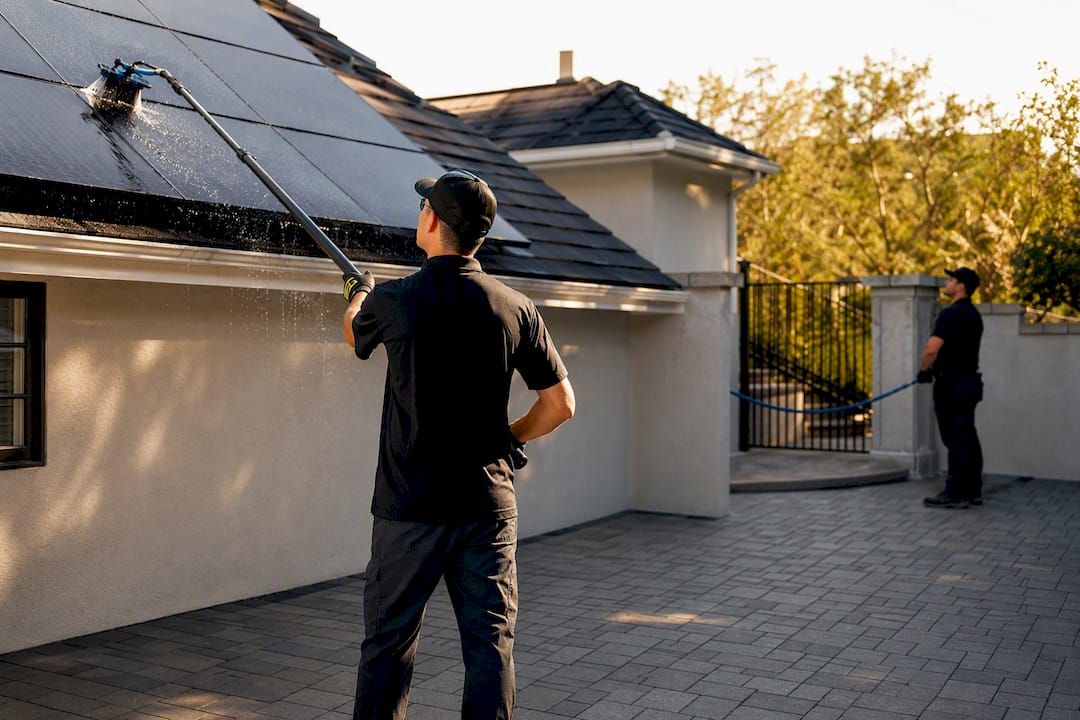
The safest residential cleaning method for most homes doesn’t involve going up top at all. A non-conductive, telescoping water-fed pole with a soft brush head lets you clean an entire array from the ground or a stable single step, which removes both the fall risk and most of the electrical exposure in one move. This is the same approach detailed in guidance on water-fed pole cleaning systems, and it’s become the standard for a reason.
The method that actually protects your panels and your safety:
- Rinse with deionized (DI) or purified water first to loosen dust without leaving mineral spots behind.
- Agitate stubborn grime gently with a soft, non-abrasive brush attached to the pole, never scrubbing hard enough to stress the glass.
- Rinse a second time with the same DI water to carry off loosened debris.
- Let panels air dry; do not towel-dry or use anything abrasive on the surface.
First Solar’s own cleaning documentation specifically recommends DI water and soft-contact tools while warning against anything that could compromise the anti-reflective coating.
Some methods are flatly wrong for this job:
- Pressure washers, full stop. The force can drive water past seals and into junction boxes, and it can crack the anti-reflective coating outright.
- Hot water. Sudden temperature shifts on cold glass risk thermal shock and micro-fracturing.
- Abrasive pads, stiff brushes, or scouring tools. These scratch coatings designed to be scratch-free.
Robotic or ground-based cleaning systems make sense for larger commercial arrays or ground-mounted installations where manual access is impractical, but most residential systems don’t need that level of investment.
What Not to Do When Cleaning Solar Panels
Walking on your panels tops this list, and it’s not close. Foot traffic on tempered glass creates microcracks that are often invisible to the naked eye but measurably reduce output over time, and manufacturers frequently point to foot traffic as grounds to deny a warranty claim. Kneeling on panels to reach a far corner does the same damage, just more slowly.
Skip these every time:
- Walking, standing, kneeling, or laying boards across panels to reach farther sections
- Pressure washers, hot water, or any high-force spray near the array
- Harsh detergents, ammonia-based cleaners, or anything abrasive
- Cleaning during direct midday sun, which bakes water into spots and raises the risk of thermal shock
- Working in heavy wind or on a wet, slippery roof surface, both of which turn a manageable task into a fall hazard
None of these prohibitions are about being overly cautious. Each one maps directly to a documented failure: cracked cells, voided coverage, or a trip to the emergency room.
Building a Pre-Clean Safety Checklist
A five-minute walk-around before you touch a hose catches most of the problems that turn cleaning into an incident. This is the job hazard analysis (JHA) that ISCA and industry safety coverage both point to as the foundation of safe practice, whether a homeowner or a licensed crew does the work.
- Check roof access, pitch, and surface condition. Steep or fragile roofing (older tile, aging composite shingle) is a hire-a-pro situation.
- Note skylight locations, existing anchor points, and clearance from overhead power lines.
- Visually inspect panels and visible wiring for cracks, discoloration, loose connectors, or exposed conductors. Anything questionable means calling a licensed electrician before cleaning proceeds.
- Schedule the work for dawn, dusk, or an overcast morning, which First Solar recommends to minimize live voltage and reduce water-spotting from rapid evaporation.
- Decide DIY versus professional based on what steps one through four turned up.
Pro Tip: If step three raises any doubt at all about wiring condition, stop there. A five-minute call to an electrician is cheaper than a repair bill or a hospital visit.
Ground-level cleaning with a pole system on a simple, accessible array is a reasonable DIY task. Anything involving roof access, an older or unfamiliar electrical setup, or visible damage belongs with a trained, insured operator.
How Trained Crews Handle This Job
Professional crews run a documented JHA on every visit, use non-conductive water-fed poles with DI water, and set up fall protection before anyone approaches roof edge. Insurance and job documentation protect the homeowner’s warranty coverage as much as the crew. If your array has complex wiring, visible damage, or a roof that’s steep or aging, that’s the point where a professional handles it, not a ladder and a garden hose.
A Safety-First Take on Solar Cleaning
Most homeowners treat solar cleaning like gutter work: a chore, not a hazard. That framing gets people hurt. Voltage doesn’t care whether you meant to touch a live wire. Ground-level cleaning with the right pole is fine. Anything involving a roof, uncertain wiring, or bad weather is where judgment beats ambition. When in doubt, hire it out.
— nolan
Get Safe, Insured Solar Panel Cleaning Without the Rooftop Risk
Some professional crews handle solar panel cleaning as part of a broader exterior cleaning approach, using safety-first standards such as job hazard analysis, non-conductive tools, and avoiding foot traffic on solar modules.
If your array sits above ground level, has visible wear, or you’d simply rather not gamble with live DC voltage on a Saturday morning, book a solar panel cleaning with Broswindowcleaningoc and get it handled by a team that treats the job as the electrical maintenance it actually is.
Where This Guidance Comes From
This article draws on First Solar’s module cleaning guidelines, ISCA’s safety framework, OSHA, NREL, and PV Magazine USA.
Sources
- First Solar — Module Cleaning Guidelines
- Solar panel cleaning: Energised electrical maintenance — ISCA
- OSHA
- PV Magazine USA — Solar panel cleaning: Emerging field in EHS
- PLOS ONE — comparative performance analysis of cleaning methods (dust impact study)
FAQ
Is Dawn Dish Soap Safe to Clean Solar Panels?
No. Dish soap can leave residue and streaking on the anti-reflective coating, and manufacturers like First Solar recommend plain deionized or purified water with a soft brush instead.
What Not to Do When Cleaning Solar Panels?
Never walk, kneel, or stand on the panels, and skip pressure washers, hot water, and abrasive pads. Each of these risks microcracks, voided warranties, or damage to the protective coating.
Do You Need to Turn Off Solar Panels Before Cleaning?
Turning off the inverter disconnects the array from your home, but the modules still generate voltage in sunlight, so treat the entire system as live regardless of inverter status.
How Do I Safely Clean My Solar Panels?
Use a non-conductive water-fed pole with a soft brush and deionized water, clean during dawn, dusk, or overcast conditions, and stay off the roof if you can reach every panel from the ground. If the array requires roof access or shows any wiring damage, a trained, insured crew is the safer call.