
Window cleaning myths debunked correctly show that most widely held beliefs about glass care are outdated, ineffective, or quietly damaging your property. Homeowners and business owners across Orange County repeat the same misconceptions year after year, from using vinegar and newspaper to skipping cleanings because “it’s just cosmetic.” The result is streaky glass, etched coatings, and expensive replacements that proper technique would have prevented. This article corrects the record with industry standards, professional methods, and the kind of practical advice that actually protects your windows long term.
1. Rain does not ruin freshly cleaned windows
Rain makes windows appear streaky only when the glass is already dirty. Properly cleaned windows allow rainwater to bead up and evaporate cleanly without leaving streaks. The streaks you see after a storm come from pollutants, dust, and residue already sitting on the glass before the rain arrived.
Think of it this way: rain is essentially distilled water. It is the contaminants on an uncleaned surface that mix with rainwater and leave marks. A professionally cleaned window sheds rain the same way a freshly waxed car does.
- Dirty glass holds mineral deposits and airborne pollutants that bond with water
- Clean glass has no residue for rainwater to pick up and redistribute
- Post-rain streaks are a sign your windows needed cleaning before the storm, not after
Pro Tip: Schedule a cleaning before rainy season in Orange County, not after. Clean glass handles rain far better than glass that has gone months without attention.
2. Vinegar and newspaper are outdated and damaging
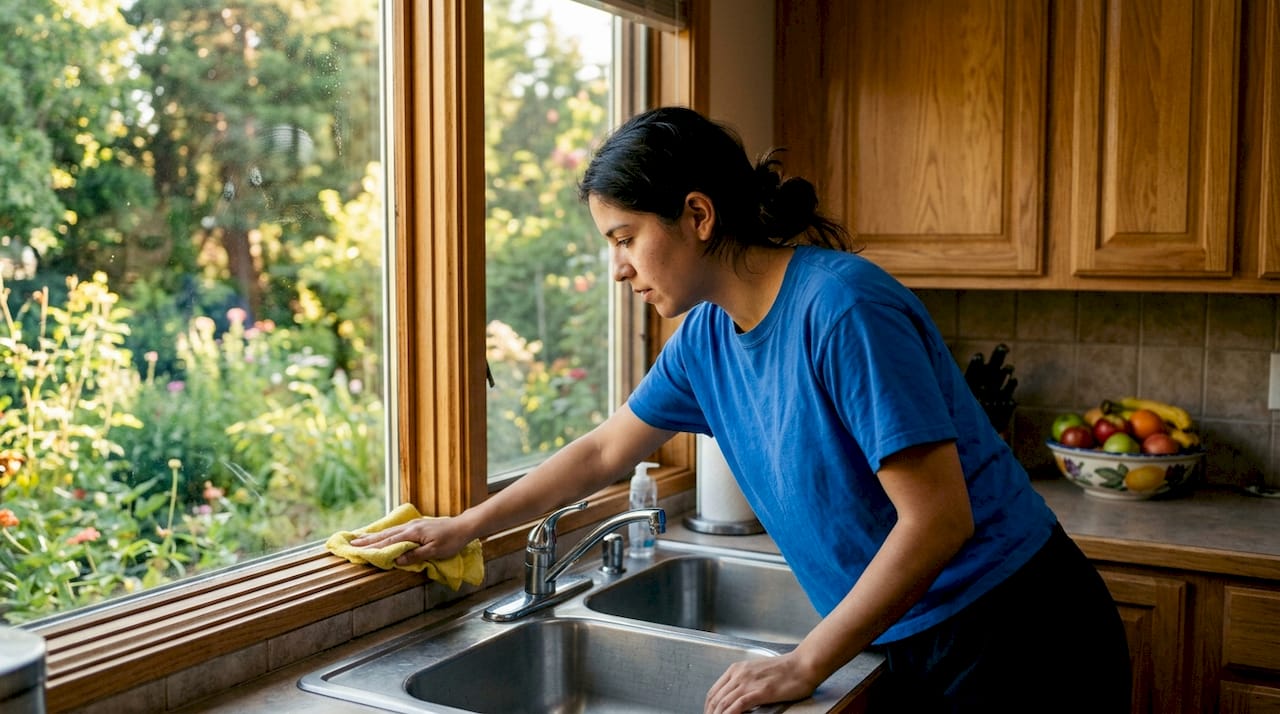
Vinegar and newspaper are two of the most repeated DIY window cleaning recommendations, and both cause real problems. Vinegar’s acidity can etch glass coatings over time, especially on windows with low-emissivity (Low-E) coatings designed to regulate heat. Newspaper ink transfers onto window frames and seals, and the paper itself can scratch glass microscopically with repeated use.
The industry standard is simpler and safer. A nickel-sized amount of dish soap per gallon of hot water provides effective cleaning with minimal residue risk. This mixture is pH-balanced enough to lift grime without attacking coatings or seals.
- Vinegar degrades Low-E coatings and rubber seals around window frames
- Newspaper ink stains white or light-colored frames and leaves a gray film on glass
- Dish soap solution is the professional standard for residential and commercial glass
Pro Tip: Check your windows for a Low-E coating before using any acidic cleaner. Most double-pane windows installed after 2000 have one. If you are unsure, ask your window manufacturer or check the Orange County window dirt guide for coating-safe cleaning advice.
3. Cleaning windows in direct sunlight causes streaks
Cleaning windows in direct sunlight is one of the most common mistakes homeowners make. Experts recommend cleaning on overcast days or during shaded periods because direct sun causes the cleaning solution to dry before you can wipe it off. That rapid drying leaves behind mineral deposits and soap residue, which show up as streaks.
The fix is straightforward. Follow this sequence for streak-free results:
- Choose an overcast day or clean windows on the shaded side of your building
- Work from top to bottom so drips fall onto uncleaned glass, not clean sections
- Apply solution and wipe immediately. Do not let it sit in the sun
- Finish with a dry lint-free microfiber cloth to catch any remaining moisture
- Inspect from an angle in natural light to catch missed spots before they dry
Morning and late afternoon are the best times on sunny days. The sun is lower and most windows are in partial shade during those windows of time.
4. Professional squeegee technique is not optional
The squeegee is the single most effective tool for streak-free window cleaning, and using it incorrectly defeats the purpose. Professional squeegees are customized to window pane dimensions, with metal channels and rubber blades sized to match the glass. A blade that is too wide for a divided pane leaves water in the corners and along the edges.
Technique matters as much as the tool itself. Holding the upper edge of the squeegee slightly ahead of the lower edge channels water downward rather than letting it pool. Professionals replace squeegee blades every 24–48 hours of active use. A nicked or worn blade drags across the glass and leaves lines that look worse than no cleaning at all.
| Tool | Common mistake | Professional standard |
|---|---|---|
| Squeegee | Wrong blade size for pane | Match blade width to pane dimensions |
| Microfiber cloth | Washed with fabric softener | Wash without softener to preserve absorbency |
| Cleaning solution | Vinegar or newspaper | Dish soap and hot water mixture |
| Paper towels | Used for final wipe | Replaced with lint-free microfiber |
Pro Tip: After each squeegee pass, tap the blade on the uncleaned section of glass to remove excess water. This prevents drips from crossing back onto clean areas.
5. Paper towels and old cloths attract more dust
Paper towels and old cotton rags are not neutral choices. Paper towels and old newspapers create static that attracts dust to glass surfaces after cleaning. You finish the job, step back, and the glass looks clean. Within hours, a fine layer of dust has settled back onto the surface because the static charge is pulling it in.
Fabric softeners on cleaning cloths make this worse. Softener coats the cloth fibers and reduces absorbency, so the cloth smears moisture rather than lifting it. Professionals use lint-free microfiber cloths washed without fabric softener. Microfiber is anti-static, highly absorbent, and gentle enough for coated glass.
For streak-free results at home, replace paper towels with a dedicated microfiber cloth kept only for windows. Wash it separately, skip the softener, and it will outperform any paper product every time.
6. Window cleaning is a maintenance task, not a cosmetic one
Window cleaning is a critical maintenance task that protects property value, not just a cosmetic chore. Pollutants like hard water minerals, acid rain residue, and airborne construction debris bond to glass over time. Left untreated, they etch the surface permanently. That etching cannot be cleaned away. It requires glass replacement.
Delaying cleaning can cause permanent damage requiring costly replacements rather than simple cleaning. For most residential properties, cleaning every three to four months prevents buildup from reaching the etching stage. Commercial properties with higher traffic or coastal exposure may need monthly service.
- Hard water deposits bond to glass within weeks and harden over months
- Acid rain residue accelerates surface degradation on untreated glass
- Construction dust contains silica particles that scratch glass when wiped dry
- Regular cleaning costs a fraction of what glass replacement runs
Matching cleaning pressure and detergent to surface type also prevents damage during exterior cleaning. The same principle applies to windows: the right product at the right interval protects the glass rather than wearing it down.
7. Professional cleaners are not always necessary, but they are often worth it
Professional cleaners are not required for every window on every property. Single-story homes with accessible windows are manageable with the right tools and technique. The calculation changes for multi-story buildings, large commercial facades, or windows with specialty coatings.
Professional cleaners bring calibrated equipment, liability coverage, and the kind of technique consistency that prevents damage. Broswindowcleaningoc, for example, handles residential and commercial properties across Orange County with fully insured crews trained on coated glass, divided panes, and high-access situations. That matters when a DIY mistake on a third-floor window costs more to fix than the cleaning would have.
The honest answer on whether professional cleaners are necessary: for ground-floor windows on a standard home, no. For anything above that, or for windows you have not cleaned in over a year, yes. The risk-to-cost ratio tips toward professional service quickly once height or specialty glass is involved.
Key takeaways
Most window cleaning damage comes from outdated tools, wrong timing, and skipped maintenance, not from the dirt itself.
| Point | Details |
|---|---|
| Rain does not dirty clean windows | Streaks after rain mean the glass was already contaminated before the storm. |
| Vinegar and newspaper cause damage | Acid etches coatings; newspaper ink scratches glass and stains frames. |
| Avoid direct sunlight when cleaning | Sun dries solution too fast, leaving mineral deposits and streaks behind. |
| Use microfiber, not paper towels | Paper towels create static that pulls dust back onto freshly cleaned glass. |
| Cleaning is maintenance, not cosmetic | Skipping cleanings leads to permanent etching and costly glass replacement. |
What I have learned from watching homeowners get this wrong
The most expensive window cleaning mistake I see is not using the wrong product. It is waiting too long between cleanings and then reaching for vinegar because it sounds natural and safe. Vinegar is fine for many surfaces. Glass with a Low-E coating is not one of them. By the time the etching is visible, the damage is done.
The second mistake is cleaning in the wrong conditions and blaming the technique. I have watched homeowners switch products four or five times trying to solve a streak problem that was caused entirely by cleaning in afternoon sun. Change the timing, not the product, and the streaks disappear.
What actually works is boring: dish soap and hot water, a properly sized squeegee with a fresh blade, a microfiber cloth washed without softener, and an overcast morning. That combination beats every trending DIY solution I have seen come and go. The best window cleaning tips are not new. They are just consistently ignored in favor of shortcuts that sound smarter than they are.
Property owners who treat window cleaning as maintenance rather than a chore clean more often, spend less on repairs, and never deal with the kind of permanent etching that forces a full replacement. The math is simple. The discipline is the hard part.
— nolan
Professional window care resources from Broswindowcleaningoc
Broswindowcleaningoc has put together practical guides built specifically for Orange County homeowners and business owners who want to get window maintenance right.

The window cleaning industry terms guide breaks down professional language so you can have an informed conversation with any service provider. The 2026 quality window cleaners guide covers exactly what to look for when hiring a professional, from insurance and equipment standards to coating-safe cleaning practices. Both resources are free and written for property owners, not industry insiders.
FAQ
Does rain ruin a professional window cleaning?
No. Clean windows repel rainwater cleanly because there is no residue for it to bond with. Streaks after rain mean the glass was dirty before the storm arrived.
Is vinegar safe for cleaning windows?
Vinegar is not safe for windows with Low-E coatings, which covers most double-pane windows installed after 2000. Its acidity etches coatings and degrades rubber seals over repeated use.
What is the best time of day to clean windows?
Early morning or late afternoon on an overcast day produces the best results. Direct sunlight dries cleaning solution before you can wipe it off, leaving streaks and mineral deposits.
Why do my windows look worse after I clean them?
The most likely cause is static from paper towels or old cloths attracting dust back to the glass. Switching to a lint-free microfiber cloth washed without fabric softener solves this in most cases.
How often should windows be cleaned to prevent permanent damage?
Residential windows need cleaning every three to four months to prevent hard water deposits and pollutants from etching the glass. Coastal or high-traffic commercial properties may need monthly service.