
Pressure washing is legal in Orange County, but the wash water is the catch: county and municipal rules ban letting it reach a storm drain, gutter, or curb. If detergent, sediment, or grime rides off your surface into the street, you’re on the hook for a stormwater violation, not a landscaping choice. The fix is simple in concept: contain the runoff, recover it, and dispose of it through the sanitary sewer with permission, a full landscape soak-in, or a licensed hauler. If water is already moving toward a storm drain, stop and contain it before doing anything else.
TL;DR:
- Any detergent, oil sheen, or sediment in wash water requires containment and lawful disposal, as discharge into storm drains is strictly prohibited.
- Municipal codes and federal laws, including the Clean Water Act and Porter-Cologne, enforce runoff restrictions that apply regardless of job size or property type.
- Proper preparation involves site walk-throughs, setting up containment before spraying, and obtaining necessary approvals from sewer agencies or property owners beforehand.
- Using appropriate equipment like berms, vacuums, and recycling units reduces water volume and disposal costs while maintaining compliance.
- Enforcement typically starts with complaints, but documentation of BMP plans, receipts, and photos can help property owners and operators avoid fines or warnings.
Table of Contents
- Pressure Washing Water Restrictions in Orange County: The Rules You’re Actually Under
- Where These Rules Come From: Clean Water Act, Porter-Cologne, and NPDES Permits
- Your On-Site Compliance Checklist Before the Wand Turns On
- Which Containment and Disposal Tools Actually Fit the Job
- How City Rules Vary: Huntington Beach, City of Orange, and Local Water Districts
- What Happens If You Get Reported or Inspected
- Current Water Restrictions Affecting Pressure Washing Schedules in Orange County
- Drought and Seasonal Shifts That Change the Rules
- Getting Permits and Approvals Before You Start a Job
- Best Practices for Cutting Water Use While You Stay Compliant
- How a Compliant Local Provider Gets This Right
- Quick Takeaways Before Your Next Job
- Why Most Compliance Failures Aren’t About Bad Intentions
- Get a Compliant Pressure Washing Quote From Broswindowcleaningoc
- Primary Sources for Rules, BMPs, and Local Contacts
- Sources
- FAQ
Pressure Washing Water Restrictions in Orange County: The Rules You’re Actually Under
Orange County doesn’t ban pressure washing itself. It bans the discharge that pressure washing tends to create. Statewide water-waste rules already prohibit hosing down driveways and sidewalks in ways that send runoff into the gutter, and Orange County’s cities layer their own municipal codes on top of that baseline. The moment your wash water carries visible dirt, oil sheen, soap suds, or paint chips, it stops being “just water” in the eyes of code enforcement and becomes a regulated pollutant.
Orange County’s Regional Stormwater Program spells this out clearly: wash water containing detergents, degreasers, sediment, or any visible contamination cannot be discharged into the storm drain system. It has to be contained and disposed of properly instead. That guidance applies whether you’re a homeowner running a consumer-grade pressure washer on a Saturday or a mobile operator running four jobs a day.
The practical takeaway for anyone standing on a driveway with a wand in hand:
- Clear water with zero soap or debris is generally low risk, but almost no real pressure washing job stays that clean.
- Any detergent, degreaser, or visible sediment turns the runoff into something you must contain.
- “It’s just going down the street” is the single most common compliance mistake, and it’s the one inspectors watch for first.
- Your obligation doesn’t disappear because the job is small. County and city rules apply to a single-driveway job the same way they apply to a shopping center parking lot.
Where These Rules Come From: Clean Water Act, Porter-Cologne, and NPDES Permits
None of this is arbitrary. The federal Clean Water Act prohibits unauthorized discharges of pollutants into U.S. waters, and that statute is the backbone underneath every stormwater rule you’ll encounter in Orange County. California’s own Porter-Cologne Water Quality Control Act extends that federal framework into state law, giving the Santa Ana Regional Water Quality Control Board and the State Water Resources Control Board authority to regulate discharges within their jurisdictions.
Cities implement that authority through NPDES Municipal Separate Storm Sewer System (MS4) permits, which require them to control pollutant discharges from businesses, construction sites, and mobile services operating within city limits. That’s why municipal codes, not just county guidance, carry real enforcement teeth.
A few things worth knowing before you take a job:
- The Orange County Construction Runoff Guidance Manual explains how municipal ordinances and inspection priorities work under MS4 permit obligations.
- Every city in Orange County has a stormwater coordinator or public works contact who can confirm local requirements before you start a job.
- The Santa Ana Regional Water Quality Control Board holds jurisdiction over most of Orange County’s watersheds and can act on complaints that cities refer upward.
Your On-Site Compliance Checklist Before the Wand Turns On
Compliance isn’t complicated, but it does require sequence. Skip a step and you’re the one explaining yourself to an inspector.
- Plan the job first. Walk the site, locate every storm drain inlet, and get written or verbal permission from the property owner for whatever disposal method you intend to use.
- Set up containment before you spray. Berms, absorbent mats, and sandbags around the work area keep water from migrating toward the street. You cannot block a public storm drain inlet without a permit, so containment has to happen on private property, not in the gutter itself.
- Recover as you go, not after. Wet/dry vacuums, trash pumps, or portable holding tanks pull the water up before it has a chance to travel. Use detergent sparingly. The less soap you introduce, the less you have to recover and dispose of.
- Choose a lawful disposal route. Discharge to the sanitary sewer requires prior permission from the local sewer agency, and heavy debris often needs to be removed first. A landscaped area can absorb wash water only with the property owner’s permission and only if it fully soaks in rather than running off. If neither option works, a licensed liquid-waste hauler is the fallback.
- Document everything. Keep disposal receipts, before-and-after site photos, and a simple written BMP (best management practice) plan on file. If a city inspector follows up weeks later, this paperwork is what separates a warning from a fine.
Pro Tip: Keep a laminated one-page BMP checklist in your service vehicle. Inspectors respond very differently to an operator who can produce a plan on the spot versus one who has to improvise an explanation.
Which Containment and Disposal Tools Actually Fit the Job
Not every job calls for the same setup. Matching your equipment to the job size keeps you compliant without over-investing in gear you don’t need.
- Containment mats and berms work well for driveways, small patios, and single-story storefronts. They’re fast to deploy and inexpensive, but they have limited capacity, so they’re a poor fit for anything generating high water volume.
- Wet/dry vacuums and trash pumps handle moderate volumes reliably and are the workhorse choice for most residential and small commercial jobs. Pair them with a portable holding tank so recovered water has somewhere to go until disposal.
- Mobile recycling and filtration units cost more upfront but let regular commercial operators reuse water on-site and dramatically cut disposal frequency. For a crew doing multiple jobs weekly, that cost typically pencils out against reduced hauling fees and reduced enforcement risk.
- Sewer discharge is appropriate once you’ve secured permission from the local sewer agency, ideally in writing. Licensed waste haulers become the right call whenever wash water can’t be legally routed to a sewer or safely soaked into landscaping, especially on commercial sites with heavier contamination.
How City Rules Vary: Huntington Beach, City of Orange, and Local Water Districts
Municipal codes don’t all read the same, and that’s where operators get tripped up assuming one city’s rule applies everywhere.
- Huntington Beach’s municipal code prohibits washing down hard or paved surfaces except to address a genuine safety or sanitary hazard, and even then only with low-volume, recirculating machines or a hand-held hose fitted with a shut-off nozzle, according to Huntington Beach’s water shortage contingency code.
- City of Orange treats washing hard paved surfaces as a permanent conservation violation, not just a drought-tier restriction, according to the City of Orange’s water conservation page. That rule stays in effect even when the city’s Water Shortage Contingency Plan level eases.
- Retail water districts, coordinated through programs like OCConserveWater’s WaterWatch, regulate irrigation schedules and issue warnings or fines for watering violations. That’s a separate system from stormwater discharge rules, so complying with your district’s watering schedule doesn’t exempt you from wash-water containment requirements.
Always check the specific city page before scheduling a job. What’s a narrow exception in one jurisdiction can be a flat prohibition two miles away.
What Happens If You Get Reported or Inspected
Enforcement in Orange County usually starts with a complaint, often from a neighbor who watched suds run down a gutter. A city or county inspector follows up, and first-time violations frequently result in a warning paired with a corrective-action deadline rather than an immediate fine. Repeated violations or contamination reaching a storm drain despite a warning is where fines escalate.
- Cooperation and documentation matter more than most operators realize. Showing an inspector your BMP plan, containment setup, and disposal receipts often shifts the outcome from a fine to a warning.
- If wash water has already reached a drain, correcting the containment on the spot and documenting the fix carries real weight with inspectors.
- When you’re cited or simply questioned on-site, your first calls should be the municipal stormwater coordinator for that city and, if sewer disposal is involved, the local sewer agency that would have issued permission.
Property owners should know they can share liability here too. If polluted runoff leaves your property and reaches a public storm drain, you can be held responsible even if a hired contractor caused it.
Current Water Restrictions Affecting Pressure Washing Schedules in Orange County
There’s no county-wide clock that limits when you’re allowed to pressure wash, but volume and discharge restrictions function as a practical limit on how jobs get done. Because wash water discharge to storm drains is prohibited outright rather than time-restricted, the real constraint isn’t a schedule, it’s whether you have containment and recovery in place before you start.
Some cities add wrinkles that function like scheduling rules in practice. Huntington Beach’s requirement to use low-volume, recirculating equipment for any permitted paved-surface washing effectively caps how much water a job can use per session, since standard high-flow wands aren’t compliant. City of Orange’s permanent ban on washing hard paved surfaces removes the option entirely outside narrow exceptions, regardless of season or time of day.
For property owners, this means the safest approach is to build every pressure washing job around containment capacity rather than a calendar. If you can only contain and recover a limited volume of water, that volume becomes your real limit, not a city ordinance with a specific gallon cap. For operators running multiple jobs per week, this is also where recycling units start to earn their cost. A rig that reclaims water on-site sidesteps the volume question almost entirely, since less fresh water goes in and less contaminated water needs disposal.
Before booking a commercial job with heavy detergent use, confirm with the property’s city whether any local ordinance narrows equipment type or paved-surface washing beyond the general storm drain prohibition.
Drought and Seasonal Shifts That Change the Rules
Orange County’s restrictions on pressure washing move in two separate tracks that homeowners often confuse: permanent conservation ordinances and drought-tier watering rules. Only one of them tightens and loosens with the water year.
Permanent conservation rules, like City of Orange’s ban on washing hard paved surfaces, don’t relax when reservoir levels improve or a wet winter arrives. They’re baked into municipal code regardless of drought status, according to the city’s conservation guidance.
Drought-tier restrictions, tracked through each city’s Water Shortage Contingency Plan (WSCP) level, are the layer that does shift seasonally. During drier years, cities raise their WSCP level, which can add outdoor watering-day limits and tighten enforcement attention on any outdoor water use, pressure washing included. When a wet winter eases reservoir conditions, cities can lower that WSCP level, but the permanent paved-surface restrictions stay in force regardless.
The practical effect for scheduling: don’t assume a wet year means pressure washing rules loosen. Storm drain discharge prohibitions and permanent surface-washing bans don’t track rainfall at all. What does shift is enforcement intensity. City stormwater teams tend to increase inspections and complaint follow-up during declared drought periods, since outdoor water use draws more public attention and more neighbor complaints. Checking your city’s current WSCP level before a big commercial job is worth five minutes, since some cities add temporary watering-day limits that indirectly affect scheduling around irrigation and washing on the same property.
Getting Permits and Approvals Before You Start a Job
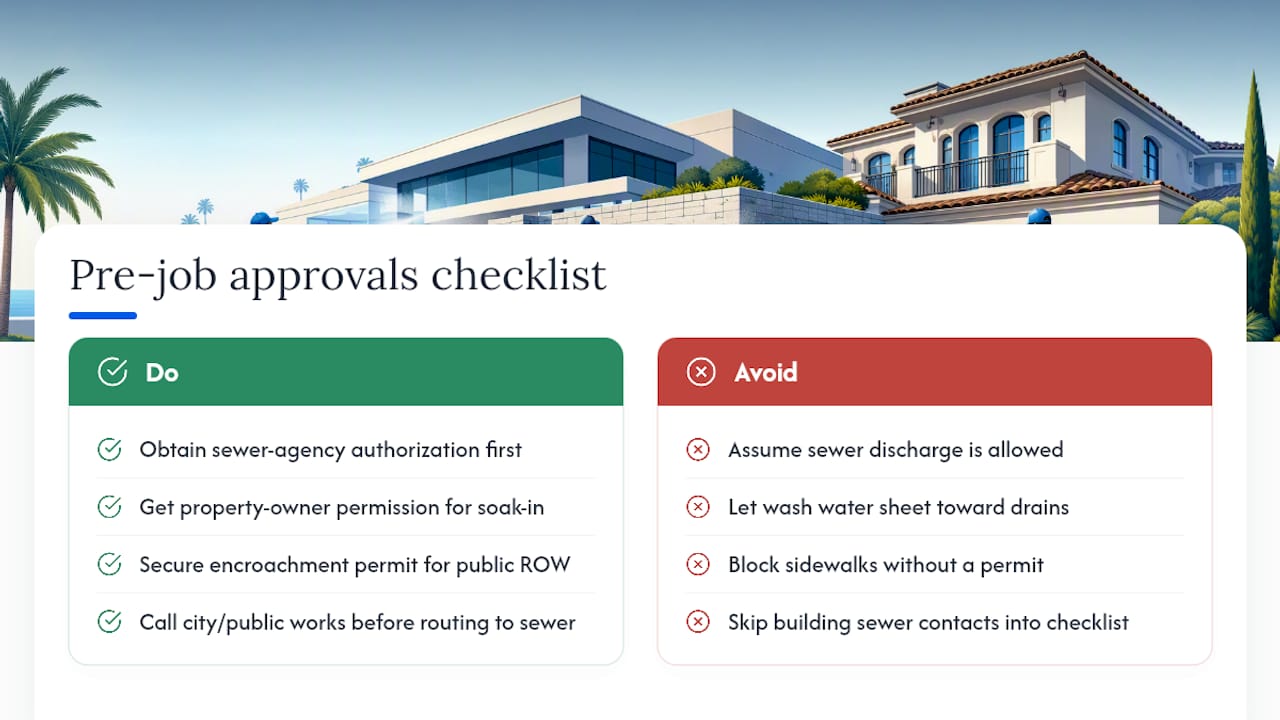
Most residential pressure washing doesn’t require a formal permit, but two specific approvals matter far more than a permit ever would: sewer discharge permission and, on public property, an encroachment or right-of-way permit.
If you intend to discharge recovered wash water to the sanitary sewer, you need prior authorization from the local sewer agency, not just an assumption that it’s allowed. Agencies sometimes require removing heavy debris or hazardous constituents before they’ll accept the water, and they may ask about detergent type or volume. Call ahead. Getting verbal confirmation the morning of a job beats discovering after the fact that your disposal method wasn’t approved.
Landscape soak-in disposal needs the property owner’s explicit permission, and the water has to fully absorb rather than sheet off toward a hardscape edge or drain. That’s a lower bar than sewer permission, but it’s still a real approval step, not a default option.
If a job requires setting up containment or equipment that extends into a public sidewalk or street, most cities require an encroachment permit, since you cannot block a public right-of-way without one. This comes up more often than operators expect on commercial storefront jobs where containment berms need to extend past the property line.
For homeowners handling their own driveway or patio, the approval chain is simpler: confirm with your own city whether any local ordinance restricts paved-surface washing, and if you plan to route water to the sewer, call your city’s public works or sewer agency line first. For operators, building sewer-agency contacts into your standard pre-job checklist saves the scramble of trying to get same-day approval on a job that’s already scheduled.
Best Practices for Cutting Water Use While You Stay Compliant
Minimizing water use isn’t just good citizenship in a state that lives with recurring drought. It shrinks the volume you have to contain, recover, and dispose of, which is where most compliance headaches start.
Lower your flow rate before you increase your pressure. A narrower nozzle tip or a machine with adjustable GPM output often cleans just as effectively at a fraction of the water volume, and less water in means less water to manage afterward. Pre-treating heavily soiled surfaces with a detergent soak, then rinsing once instead of scrubbing with repeated passes, cuts both water and time on the job.
Work in sections rather than flooding an entire surface at once. Containing and recovering water from a ten-foot section is manageable with mats and a shop vacuum; containing runoff from an entire parking lot at once usually isn’t, without dedicated equipment. Scheduling matters too: avoid pressure washing right before forecasted rain, since freshly cleaned surfaces combined with a storm event can wash residual contaminants into drains before they’ve fully dried and settled.
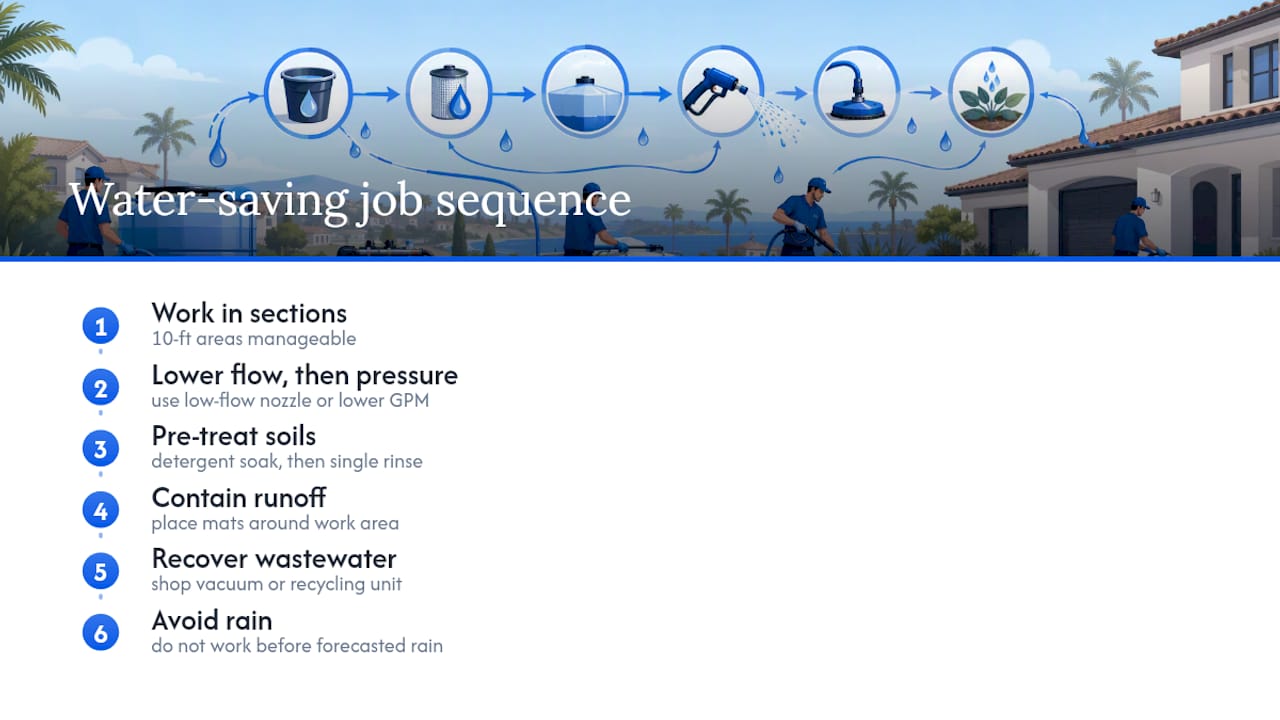
For regular commercial accounts, a water-recycling attachment pays for itself in reduced hauling costs alone, on top of the compliance benefit of generating far less wastewater to dispose of in the first place. Homeowners tackling their own driveway can get most of the same benefit just by using a lower-flow nozzle and containing the work area with absorbent mats before starting, an approach covered in more detail in guidance on safe pressure washing techniques.
How a Compliant Local Provider Gets This Right
Some local pressure washing providers in Orange County approach every job with containment and disposal built into the plan, not treated as an afterthought. A compliant sequence looks like this: walk the site and map drains, set up containment before any water runs, recover with pumps or vacuums as the job progresses, dispose through a lawful route, and keep photos and receipts on file. Homeowners with complex sites, sewer permission questions, or any hazardous debris on the surface are almost always better served hiring a professional who already runs this workflow.
Quick Takeaways Before Your Next Job
Contain and recover wash water every time, and get the property owner’s sign-off before choosing a disposal route. Never let water reach a curb, gutter, or storm drain, and never block a public right-of-way without a permit. If you’re unsure at any point, stop work and call the city’s stormwater coordinator or bring in a licensed provider before continuing.
Why Most Compliance Failures Aren’t About Bad Intentions
Most pressure washing violations in Orange County aren’t the result of operators trying to cut corners. They happen because “wash water” doesn’t feel like pollution the way a chemical spill does. Soap and grime look harmless swirling down a driveway, and that visual mismatch between what the water looks like and what the law treats it as is exactly why so many well-meaning property owners and even experienced crews get caught off guard.
The conventional advice you’ll find online tends to focus on equipment specs and permit paperwork, and that’s useful, but it misses the bigger behavioral shift: compliance here is a planning discipline, not a gear purchase. You can own the best wet/dry vacuum on the market and still violate the rules if you set up containment after the water’s already moving. The operators who never get a warning aren’t necessarily the ones with the fanciest recovery systems. They’re the ones who walk the site and plan containment before turning anything on.
There’s also a quieter risk that doesn’t get enough attention: property owners assuming that hiring “a guy with a pressure washer” transfers all the liability away from them. It doesn’t. If runoff from your property reaches a public drain, code enforcement can, and does, follow up with the property owner regardless of who held the wand. That’s the strongest practical argument for hiring an operator who documents their process, not just one who shows up with equipment.
— nolan
Get a Compliant Pressure Washing Quote From Broswindowcleaningoc
Professional pressure washing services can provide Orange County property owners a way to get exteriors cleaned while helping manage the liability of runoff mistakes. Every job runs on the same sequence: site walk, containment setup, water recovery, lawful disposal, and documentation you can keep on file if a question ever comes up about how your property’s wash water was handled.

That documentation matters more than most homeowners realize. If a neighbor complaint or routine inspection ever traces back to your property, having disposal receipts and BMP records on hand is the difference between a quick clarification and a drawn-out enforcement issue. Some cleaning companies handle that paperwork as a normal part of the job, not an add-on.
If you’ve got a driveway, storefront, or commercial lot that needs attention, start with a compliance-minded pressure washing quote and describe your site. You’ll get a plan built around containment and disposal from the first visit, not figured out after water’s already moving.
Primary Sources for Rules, BMPs, and Local Contacts
For anything requiring an exact answer, go straight to the source rather than relying on secondhand summaries.
- Orange County Regional Stormwater Program for county-wide discharge guidance.
- H2OC’s Compliance BMPs for Mobile Businesses for containment, recovery, and disposal specifics.
- EPA’s Clean Water Act summary for the federal legal framework.
- Huntington Beach and City of Orange municipal pages for city-specific code examples and local stormwater coordinator contacts.
Sources
- Orange County Public Works — Regional Stormwater Program
- H2OC — Compliance BMPs for Mobile Businesses (Orange County)
- Orange County Construction Runoff Guidance Manual
- EPA — Summary of the Clean Water Act
- City of Orange — Water conservation
FAQ
Can I pressure wash in a drought in Orange County?
Yes, but drought tiers can add outdoor water-use restrictions on top of the permanent storm drain discharge prohibition, so check your city’s current Water Shortage Contingency Plan level before a large job.
Is there a water restriction in Orange County, California, for pressure washing specifically?
There’s no blanket ban on pressure washing, but discharging wash water containing detergent, sediment, or debris to a storm drain is prohibited everywhere in the county, and some cities like the City of Orange permanently ban washing hard paved surfaces outright.
What are California’s water restrictions for pressure washing in 2026?
Statewide water-waste prohibitions ban runoff from hosing pavement into gutters, and Orange County cities layer their own municipal ordinances on top, so the specific rule set depends on which city the job is in.
Do I need a permit to pressure wash my driveway?
Most homeowners don’t need a permit for routine driveway washing, but you do need the sewer agency’s permission if you plan to discharge recovered water to the sanitary sewer, and an encroachment permit if equipment or containment extends into a public sidewalk or street.
Can Broswindowcleaningoc handle sewer permission and disposal for me?
Some providers build containment, recovery, and lawful disposal into every pressure washing job, helping to remove the guesswork property owners otherwise face when sorting out sewer agency approval.