
Sunlight plays a dual role in window grime: it reveals existing dirt with startling clarity while also shaping how and where grime forms over time. The role of sunlight on window grime is more complex than most property owners realize. UV rays suppress biological growth on sun-exposed glass, while shaded windows trap moisture and breed algae. Meanwhile, the angle and intensity of sunlight determine whether your windows look spotless or embarrassingly dirty. Understanding this relationship changes how you clean, when you clean, and what treatments actually work.
How does sunlight make window grime more visible?
Sunlight acts as a natural diagnostic tool, revealing dust and grime that artificial lighting hides completely. Indoor lighting is diffused and comes from multiple directions, which fills in shadows and flattens surface texture. Direct sunlight hits glass at a sharp angle, especially in the morning and evening, casting tiny shadows behind every particle of dirt, streak, and smudge. The result is a window that looked clean at noon but looks filthy by 7:00 AM the next day.
The physics behind this is straightforward. Grime on glass is not a smooth film. It is a collection of irregular particles, oils, and mineral deposits that scatter light in unpredictable directions. When sunlight strikes at a low angle, light scatters unevenly across these surfaces, creating visible contrast between clean and dirty areas. This is the same principle photographers use when shooting at “golden hour” to reveal texture.
Common grime types that become obvious in sunlight include:
- Hard water spots: Calcium and magnesium deposits form white halos that glow under direct light.
- Fingerprints and oils: Skin oils create a greasy film that refracts sunlight into rainbow-like smears.
- Dust and pollen: Fine particles sit on the surface and scatter light sideways, making the glass look hazy.
- Cleaning residue: Soap or detergent left behind dries into a thin film that catches sunlight as a dull sheen.
Pro Tip: Walk outside and view your windows from a 45-degree angle during morning or late afternoon light. This is the single fastest way to spot residue and streaks your indoor inspection missed.
Clean windows transmit 20–40% more natural light into a home than grimy ones. That statistic explains why a dirty window does not just look bad. It actively reduces the light quality inside your space.
How does sunlight affect grime accumulation and biological growth?
The sunlight effect on window dirt goes well beyond visibility. UV radiation in sunlight kills bacteria and suppresses biological grime like algae and mold on glass surfaces exposed to direct sun. This is why north-facing windows accumulate far more biological grime than south-facing ones. They receive little to no direct UV exposure, which allows persistent moisture and microbial colonies to thrive.
Shaded windows accumulate three times more biological grime such as algae and mold over 30 days compared to sun-exposed windows. That is not a minor difference. It means a north-facing window left uncleaned for a month carries the same biological load as a south-facing window left for three months.
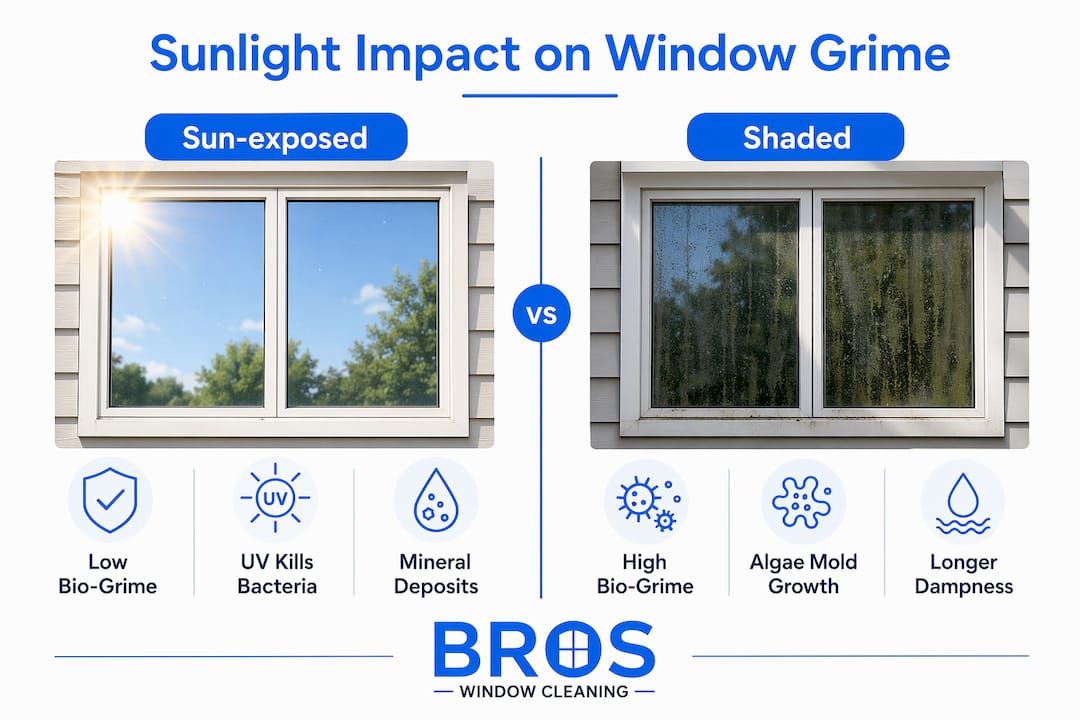
The table below shows how sun exposure shapes grime type and accumulation rate:
| Factor | Sun-exposed windows | Shaded windows |
|---|---|---|
| Biological grime (algae, mold) | Low. UV kills surface bacteria. | High. Moisture and no UV create ideal growth conditions. |
| Mineral deposits | High. Hard water evaporates fast, leaving calcium and magnesium crystals. | Low to moderate. Slower evaporation, less crystallization. |
| Organic dust and pollen | Moderate. Dry surfaces attract particles but UV degrades some organics. | Moderate to high. Damp surfaces hold particles more firmly. |
| Overall cleaning frequency needed | Moderate. Mineral deposits require attention. | High. Biological grime builds quickly and bonds to glass. |
Mineral deposits present a separate challenge on sun-exposed glass. When sprinkler water or rain hits a hot, sun-baked window, calcium and magnesium crystallize rapidly as the water evaporates. These deposits form opaque films that standard cleaning solutions cannot dissolve. They require specialized acidic cleaners or fine abrasive pads to remove safely.
Pro Tip: If your windows face a sprinkler system, adjust the spray pattern so water does not hit the glass directly. Mineral buildup from hard water is one of the most stubborn grime types to remove once it bakes onto glass under sun.
What are the best practices for cleaning windows in sunlight?
Cleaning in direct sunlight is counterproductive. Cleaning solutions evaporate too fast in direct sun, which prevents the solution from fully emulsifying dirt before it dries. The result is streaks and residue that are often harder to remove than the original grime. This is one of the most common mistakes both homeowners and inexperienced cleaners make.
The best times to clean windows are early morning or late afternoon. At these times, the glass is cooler, the sun is at a lower angle, and cleaning solutions have time to work before evaporating. Overcast days are also excellent for window cleaning because diffused light and cooler temperatures slow evaporation significantly.
Follow these steps for effective window cleaning around sunlight exposure:
- Check the glass temperature first. If the glass feels hot to the touch, wait. Hot glass accelerates drying and makes streaking almost unavoidable.
- Work in the shade when possible. Start on the shaded side of the building and move to sun-exposed windows in the early morning or evening.
- Use a squeegee, not paper towels. A squeegee removes solution in one pass before it dries. Paper towels smear and leave lint that catches sunlight.
- Rinse with clean water after cleaning. Any soap residue left on glass will dry into a film that becomes visible the next time sunlight hits the window.
- Use sunlight to inspect your work. After cleaning, step back and view the glass at a low angle in natural light. This reveals any missed spots or residue before you pack up.
Sunlight also serves as your quality control check. Sunlight exposes streaks and smudges by casting shadows at low angles, which makes it the best final inspection tool available. Professionals at Broswindowcleaningoc use this technique on every job to confirm a streak-free result before leaving a property.
Understanding exterior grime removal also matters here. Grime that builds up on window frames and sills gets transferred back onto glass during cleaning if the surrounding surfaces are not addressed first.
How do self-cleaning window coatings use sunlight?
Photocatalytic coatings represent the most practical application of sunlight’s chemistry for window maintenance. These coatings use titanium dioxide (TiO2), a compound activated by UV light, to chemically break down organic dirt on the glass surface. Photocatalytic titanium dioxide coatings work continuously as long as UV light is present, decomposing organic grime into carbon dioxide and water.
The process is a two-stage system. UV light from sunlight activates the TiO2 coating and breaks down organic compounds chemically. Then rain or water rinses the loosened debris away, completing the cleaning cycle. Without the water stage, decomposed grime remains on the surface as a fine residue.
| Feature | Photocatalytic self-cleaning glass | Standard glass |
|---|---|---|
| Organic grime breakdown | Yes. UV activates TiO2 to decompose dirt. | No. Grime accumulates until manually cleaned. |
| Biological grime resistance | High. TiO2 also kills surface bacteria. | Low. Bacteria and algae grow unchecked. |
| Mineral deposit resistance | None. Hard water deposits still form. | None. Same mineral buildup risk. |
| Maintenance required | Periodic manual cleaning still needed. | Regular manual cleaning required. |
| Best climate for performance | High UV, regular rainfall. | Any climate. |
Self-cleaning coatings do not eliminate the need for professional cleaning. They reduce the frequency of deep cleans and slow organic grime buildup, but mineral deposits, pollen, and airborne particles still accumulate. In Orange County’s sunny, dry climate, the UV activation works well, but the low annual rainfall means the water-rinse stage often needs a manual assist. Broswindowcleaningoc works with clients who have self-cleaning glass to schedule targeted maintenance that handles what the coating cannot.
Key Takeaways
Sunlight both exposes window grime through optical contrast and shapes its composition by suppressing biological growth on sun-exposed glass while accelerating mineral deposit formation.
| Point | Details |
|---|---|
| Sunlight as a diagnostic tool | Low-angle sunlight reveals streaks, residue, and particles invisible under artificial light. |
| Shaded windows accumulate more biological grime | North-facing and shaded windows collect three times more algae and mold than sun-exposed ones. |
| Avoid cleaning in direct sun | Solutions dry too fast in direct sunlight, creating streaks that are harder to remove than original grime. |
| Mineral deposits need special treatment | Hard water combined with sun exposure bakes calcium and magnesium onto glass, requiring acidic or abrasive removal. |
| Self-cleaning coatings need UV and water | Photocatalytic TiO2 coatings decompose organic grime with UV light but require water to rinse debris away. |
What I’ve learned after years of watching sunlight reveal the truth
Most clients call us after a sunny morning shows them what they thought was a clean window is actually coated in months of buildup. Sunlight is brutally honest. It does not care that you wiped the glass last week with a paper towel and some spray cleaner. It will find every smear, every mineral ring, and every soap streak and put them on full display.
The insight I keep coming back to is this: most homeowners clean windows based on how they look indoors under artificial light. That is the wrong reference point. Artificial light hides texture. Sunlight reveals it. If you want to know whether your windows are actually clean, check them from outside at a low sun angle. What you see will probably surprise you.
The other mistake I see constantly is cleaning in the middle of the day. People have time on weekends, the sun is out, and it seems like a good moment. But hot glass and direct sun turn even a good cleaning solution into a streak machine. Early morning is the right time, every time.
For properties with self-cleaning glass, the expectation gap is real. Clients assume the coating handles everything. It handles organic grime reasonably well, but mineral deposits from irrigation systems still build up, and in a dry climate like Orange County, the rain rinse stage rarely happens on its own. Knowing this changes how you schedule maintenance and what products you use.
The window cleaning curb appeal argument is real too. Clean windows in direct sunlight look dramatically better than dirty ones. The contrast is visible from the street, and it affects how a property is perceived immediately.
— nolan
Window grime and sunlight: how Broswindowcleaningoc can help
Sunlight does not lie about the state of your windows. When grime, mineral deposits, and biological buildup become visible in direct light, the problem is usually deeper than a quick wipe can fix.

Broswindowcleaningoc serves residential and commercial clients across Orange County with professional window cleaning timed to avoid peak sun hours, preventing the streaks that DIY cleaning in direct sunlight creates. The team handles mineral deposit removal, biological grime on shaded windows, and maintenance for properties with self-cleaning glass coatings. For clients who want accurate information before booking, the window cleaning myths guide covers the most common misconceptions about what actually keeps glass clean. Schedule a service visit and let sunlight confirm the result.
FAQ
Why do windows look dirtier in sunlight than indoors?
Sunlight hits glass at a sharp angle, casting shadows behind surface particles and creating contrast between clean and dirty areas. Artificial indoor lighting is diffused and fills in those shadows, hiding the same grime.
Does sunlight help clean windows naturally?
Sunlight does not clean windows on its own. UV rays suppress biological growth on sun-exposed glass, but dirt, mineral deposits, and organic residue still accumulate and require manual or professional cleaning.
What is the best time of day to clean windows?
Early morning or late afternoon is best for cleaning windows. Glass is cooler, sun angle is low, and cleaning solutions have time to work before evaporating, which prevents streaking.
Why do shaded windows get dirtier than sun-facing ones?
Shaded windows receive no UV radiation, which means bacteria and algae grow unchecked. They also stay damp longer, creating conditions where biological grime accumulates at a much faster rate than on sun-exposed glass.
How do self-cleaning window coatings work with sunlight?
Photocatalytic coatings use titanium dioxide activated by UV light to chemically decompose organic dirt. Rain or water then rinses the loosened debris away, completing the two-stage cleaning process.