
Score every space on a 1 to 5 appearance scale, run it through a risk matrix, then set your cleaning schedule from that combined result. That single sequence answers most of what you came here to figure out. Do these three things on site today: walk the perimeter and note high-touch surfaces, score two of your highest-traffic rooms against the APPA cleanliness scale, and start a running checklist of anything that fails on sight.
A completed assessment should leave you with three deliverables: a sampled APPA score of 2.5 or better across your spaces, a basic frequency table by area, and a rough staffing estimate. Deep cleaning tied to that kind of structured program can cut dust, bacteria, and airborne contaminants by 40% to 60%, which is the real payoff for doing this properly instead of guessing.
Key Takeaways
A defensible cleaning assessment combines an APPA appearance score, a CDC-style risk matrix, and an ISSA-based labor calculation into one frequency and staffing plan.
| Point | Details |
|---|---|
| Score before you schedule | Use the APPA 1 to 5 scale on sampled rooms and target 2.5 or better before setting any frequency. |
| Apply risk scoring | Sum contamination probability, population vulnerability, and exposure potential to set minimum frequencies. |
| Map areas to tasks | Build an area-task matrix with square footage, fixtures, and materials before writing a scope of work. |
| Convert tasks to labor | Use ISSA time data to turn task minutes into weekly hours and staffing headcount. |
| Bring in a vendor for specialty gaps | Broswindowcleaningoc can run a sample audit, risk-based frequency plan, and workload estimate for exterior and specialty cleaning needs. |
Table of Contents
- Quick Checklist to Start Your Cleaning Assessment Now
- How Do You Define Your Facility’s Cleaning Scope?
- Map Every Area and List What It Actually Needs
- How Often Should Different Areas Be Cleaned?
- What Is a Risk-Based Cleaning Frequency Matrix?
- Building a Cleaning Plan and Sizing Your Staff
- How Do You Measure Whether Cleaning Is Actually Working?
- Document, Train, and Review the Program
- When to Bring In a Professional Cleaning Assessment
- Frequently Asked Questions
- Sources
Quick Checklist to Start Your Cleaning Assessment Now
Print this and walk your building in 15 to 30 minutes:
- Area type and square footage (lobby, restroom, office, kitchen)
- Typical occupants or daily foot traffic count
- High-touch items: door handles, elevator buttons, shared keyboards, faucet handles
- Current cleaning frequency versus what the traffic actually demands
- One corrective action noted for every item that fails inspection
Mark anything that poses a health or safety risk as urgent, and log it separately from routine wear items so nothing gets buried in a long list.
How Do You Define Your Facility’s Cleaning Scope?
Before you can set a single frequency or hire a single cleaner, you need real numbers, not guesses. Record gross square footage, usable area broken out by space type, operating hours, shift patterns, and your peak traffic windows. An office with a 9 to 5 schedule needs a different plan than a retail store with weekend surges or a clinic running two shifts.
The facility type changes everything downstream. A food prep area carries health code obligations an office never will. A K to 12 school sees traffic spikes tied to bell schedules. A medical waiting room carries infection control weight a corporate lobby doesn’t.
Pull real data instead of estimating:
- Floor plans for accurate square footage by zone
- Visitor logs or badge/swipe counts for actual foot traffic
- POS data or appointment counts in retail and healthcare settings
- Building hours and shift rosters from HR or facilities records
Map Every Area and List What It Actually Needs
Group your building into functional zones: public common areas, private offices, food prep, restrooms, mechanical rooms, and exterior spaces. Each zone needs its own task list, because a restroom and a conference room have almost nothing in common.
A basic task inventory per area might include sweeping and mopping, sanitizing high-touch surfaces, emptying trash and recycling, glass and mirror wipe-downs, floor care by surface type, and any specialty task like carpet extraction or grease trap service.
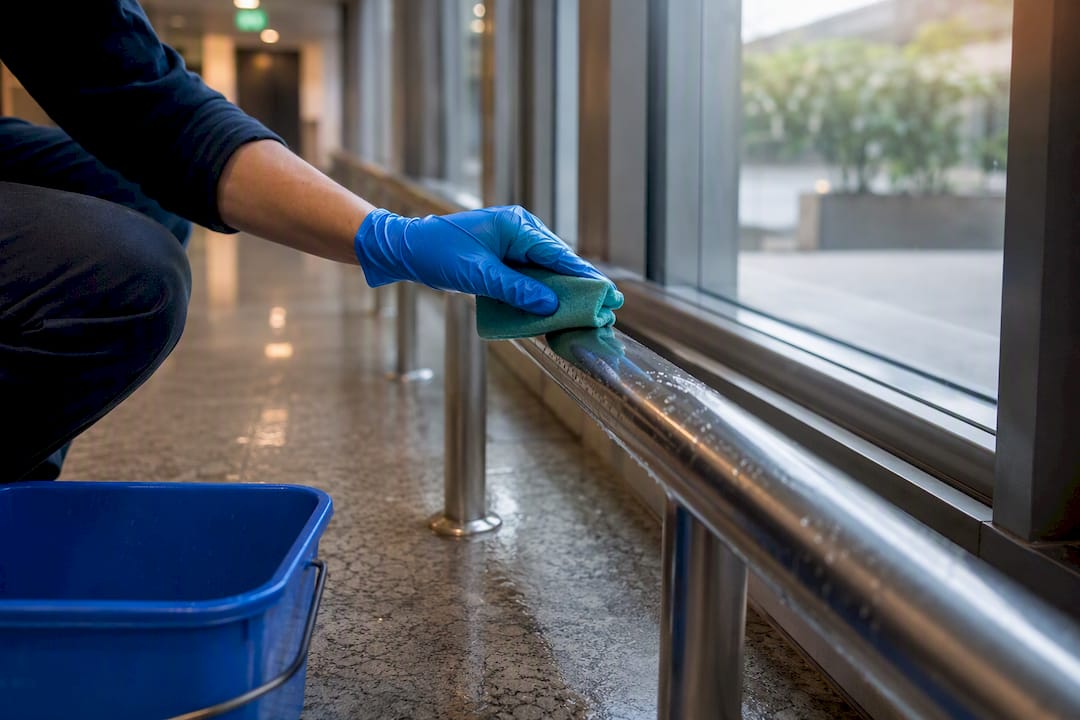
Build this into a simple area-task matrix. For each row, capture square footage, fixture count, surface material (tile, carpet, vinyl, stainless steel), and any special procedure required, like OSHA-mandated PPE in a lab or dwell-time rules for a disinfectant in a clinic. This matrix becomes the backbone of your scope of work, and a thin scope that just lists tasks without frequencies or outcomes is exactly what causes vendor disputes later.
How Often Should Different Areas Be Cleaned?
Frequency should follow use, not habit. Restrooms in high-traffic buildings typically need multiple daily services. General offices usually run on a daily or rotating schedule. Deep floor care, like stripping and waxing or carpet extraction, is realistically a monthly or quarterly job in most facilities.
Your target isn’t just “clean,” it’s a measurable appearance level. APPA’s 1 to 5 scale gives you that measurement, and most commercial spaces should aim for a score of 2 to 3, with 2.5 serving as a common practical benchmark for facilities that want consistent results without gold-plating every corner.
- Restrooms in office buildings: 1 to 3 times daily depending on occupancy
- Common areas and lobbies: daily light service, deeper cleaning weekly
- Private offices: daily trash and surface wipe, deeper cleaning weekly
- Floor care (strip, wax, extraction): monthly to quarterly
Every frequency bump adds labor hours. Moving a restroom from once daily to three times daily can nearly triple the labor tied to that single space, so treat frequency decisions as budget decisions too, not just cleanliness decisions.
What Is a Risk-Based Cleaning Frequency Matrix?
The CDC’s environmental cleaning guidance offers a scoring method built for healthcare settings, but it adapts well to any facility that needs defensible, non-arbitrary frequencies. You score three factors for each space:
- Probability of contamination (low traffic vs. high traffic, food handling, restroom use)
- Population vulnerability (general public vs. immunocompromised patients, young children, elderly residents)
- Potential for exposure, including how many high-touch surfaces the area has
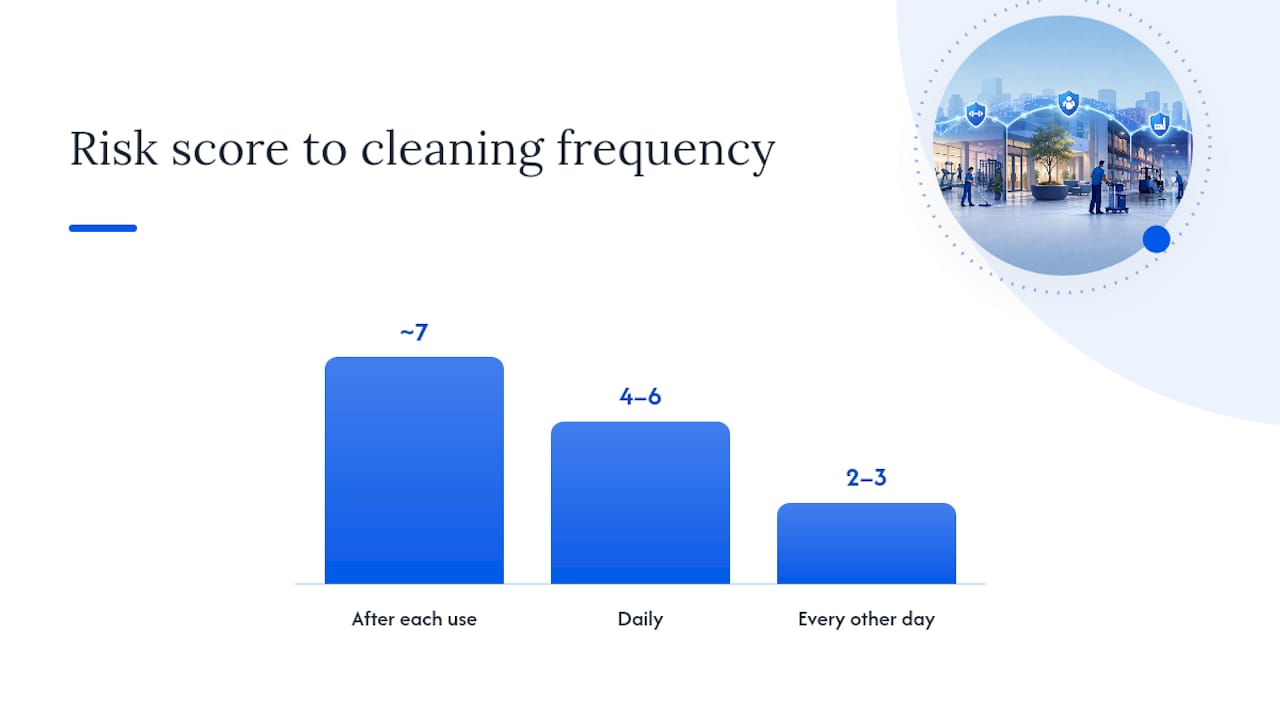
Add the three scores together. A total around 7 typically calls for cleaning after each use or event. A score of 4 to 6 maps to at least daily cleaning. A score of 2 to 3 can run on a fixed schedule, like every other day or twice weekly.
Take an outpatient waiting room: high foot traffic (high probability score), mixed vulnerable population (high vulnerability), and shared chairs plus a check-in counter (high exposure). That combination lands near the top of the scale and justifies cleaning after each clinic session, not once a day. A shared office breakroom scores lower on vulnerability and probability, landing it comfortably in the daily range.
Pro Tip: Keep the scoring sheet with your inspection records. When an occupant or tenant questions why one room gets cleaned more than another, you have a documented, defensible reason instead of “that’s just how we’ve always done it.”
Building a Cleaning Plan and Sizing Your Staff
Once you have your area-task matrix and frequencies, convert them into labor hours. ISSA’s time studies and Official Cleaning Times give you standardized minutes-per-task figures you can apply instead of estimating from scratch.
- List every task with its frequency and estimated minutes based on ISSA time data or your own time trials
- Multiply minutes by frequency to get weekly task minutes per area
- Sum weekly minutes across all areas, then divide by 60 to get weekly labor hours
- Divide weekly hours by a standard 40-hour workweek to estimate full-time equivalents
A 30,000 square foot office with daily restroom, common area, and workstation service commonly lands somewhere between two and four full-time equivalents, depending on fixture count and finish types.
- Consider outsourcing when you need specialty floor care, fast staffing ramp-up, or coverage you can’t hire for internally.
- If you outsource, brief vendors with your area-task matrix and target APPA score, not a vague “keep it clean” instruction.
How Do You Measure Whether Cleaning Is Actually Working?
Visual inspection is the starting point, but it’s subjective unless you attach it to a scored template. An APPA-style audit assigns a 1 to 5 rating per space so results are comparable over time and across zones.
For facilities with higher stakes, like healthcare, food service, or labs, objective tools add a layer visual checks can’t: ATP meters detect organic residue on surfaces in seconds, RODAC plates culture bacteria from a surface for lab confirmation, and particle counters measure airborne contaminant levels. None of these replace visual inspection. They confirm it.
Build your inspection checklist with a numeric score per area, a trigger threshold for corrective action (say, anything scoring below 3 gets an immediate work order), and a reporting cadence, weekly for high-risk zones and monthly for lower-risk ones. Structured, scored inspection programs catch failures before they become complaints, and pairing them with digital work orders speeds up corrective response.
Track a small set of KPIs: inspection pass rate, recurring deficiencies by zone, how fast corrective actions close, and occupant complaint volume. Those four numbers tell you more about program health than any single walkthrough ever will.
Document, Train, and Review the Program
Write SOPs and job cards for every recurring task: what it is, how often, the method, required PPE, chemical dilution ratio, and dwell time for disinfectants. Vague instructions produce inconsistent results no matter how good your frequency table is.
- Train new staff against the job cards, then run a competency check within the first two weeks
- Retrain on any task that shows recurring deficiencies in inspections
- Schedule a full program review annually, with spot-checks quarterly
- Revise the scope whenever occupancy, hours, or facility use changes materially
A facility manager’s take on what actually breaks first
The surprise is never the big stuff. It’s the breakroom microwave handle or the elevator button nobody scored during the initial walkthrough that turns into the complaint everyone remembers. Fixing it usually means adding one line to the checklist, not overhauling the whole plan.
Two things worth remembering: occupant complaints about visible dust often carry more political weight than infection control gaps that are actually riskier, so don’t let squeaky-wheel feedback override your risk scoring. And when in doubt about frequency, round up on high-touch surfaces before you round up on square footage. It’s the cheaper fix and the one that actually reduces illness transmission.
When to Bring In a Professional Cleaning Assessment
The remaining gap is usually specialty work, exterior surfaces, or the staffing math not penciling out internally, and that’s where a vendor with real assessment experience earns its cost back fast. Broswindowcleaningoc has spent over five years assessing Orange County properties for exactly this kind of scope work, and the advantage over building it alone is speed: a trained crew can complete a sampled APPA audit, apply a risk-stratified frequency recommendation, and hand you a workload estimate in a single site visit instead of the days it takes to build that matrix from scratch.
When you request a vendor assessment, ask for four specific things: a sample APPA audit on two or three representative rooms, risk-stratified frequency recommendations for your highest-exposure areas, a written workload estimate, and a trial corrective action on whatever fails first. Outsourcing makes the most sense for specialty exterior work like glass curtain wall cleaning or when your internal team simply can’t ramp up fast enough for a seasonal push. If your assessment turned up exterior windows, gutters, or solar panels that need attention alongside your interior program, get a tailored site assessment scheduled and see what a properly scoped exterior plan actually costs.
Frequently Asked Questions
How do I assess cleaning needs for a small office versus a large facility?
The process is identical, just scaled. Record square footage, occupancy, and hours, then map areas to tasks and frequencies. A small office might only need two or three zones scored; a large facility needs the full area-task matrix broken out by floor or department.
What’s the fastest way to identify cleaning needs without a consultant?
Run the quick checklist in this guide, score two or three high-traffic rooms with APPA, and apply the CDC risk matrix to your highest-exposure spaces. That gets you a workable baseline in under an hour for most single-building sites.
How often should a full cleaning needs analysis be repeated?
Run a full review annually, with targeted spot-checks quarterly or whenever occupancy, hours, or facility use changes. A tenant turnover or a shift to hybrid work schedules is enough to justify revisiting your scope early.
What tools do I actually need to measure cleaning effectiveness objectively?
Visual inspection with a scored template covers most commercial settings. ATP meters, RODAC plates, and particle counters add objective verification for healthcare, food service, or lab environments where infection control carries higher stakes.
Should cleaning frequency be based on square footage or on risk?
Both, but risk should set the floor. Square footage tells you how much labor a task takes; risk stratification tells you how often that task needs to happen regardless of size.
Sources
- Green Cleaning — Custodial Effectiveness Assessment ref guide EBOM | U.S. Green Building Council
- Environmental cleaning: Appendix A — CDC
- APPA cleaning operations guidance | APPA
- Performance measurement and cleaning effectiveness — ISSA
- Janitorial Quality Inspection Checklist for Facility Cleaning Audits — Oxmaint