
Most residential solar systems generally need periodic cleaning once or twice a year, according to manufacturer and industry guidance from Enphase. That baseline holds for a typical suburban home with a pitched roof in a climate that gets regular rainfall. Two conditions push you outside it quickly: if you live near the coast, in a desert, on an agricultural property, or under heavy tree cover, you likely need cleaning more frequently; if you’re in a rainy region with steep panel tilt, cleaning about once a year may be sufficient.
Quick qualifiers that change your schedule:
- Location: Desert, coastal, and agricultural sites accumulate soiling faster than suburban or temperate ones.
- Roof pitch: Steeper angles shed more rain-loosened debris; flat or low-tilt panels trap dirty rinse water that evaporates and leaves residue.
- Visible soiling: Bird droppings, thick pollen, salt film, or ash are triggers regardless of calendar date.
- Production drop: A sustained loss of 10% or more below your expected output is a reliable signal to clean now.
Rain helps with loose dust, but it’s not a substitute for scheduled cleaning. Rainfall often leaves mineral deposits and sticky pollen behind, which compound over time.
Key Takeaways
Most homeowners need solar panel cleaning once or twice per year, but desert, coastal, and Florida properties often require more visits to maintain full output.
| Point | Details |
|---|---|
| Baseline cleaning frequency | Most residential systems need 1–2 cleanings per year; adjust up for desert, coastal, or agricultural sites. |
| The 10% production rule | Clean when inverter data shows a sustained drop of 10% or more below expected output. |
| DIY vs. professional | DIY works for ground-level, light soiling; hire a pro for steep roofs, large arrays, or warranty-required service. |
| Warranty documentation | Keep dated service records and before/after photos with every cleaning to support future warranty claims. |
| Broswindowcleaningoc | Offers insured solar panel cleaning with photo documentation and bundled exterior services for Orange County homeowners. |
Table of Contents
- What cleaning schedule fits your site and climate?
- How do you know when your panels actually need cleaning?
- DIY cleaning vs. hiring a professional: which is right for you?
- How to clean solar panels without voiding your warranty
- What does solar panel cleaning cost, and when does it pay off?
- How cleaning interacts with your manufacturer warranty
- Why Florida homeowners often need three cleanings per year
- Environmental impact and water use in solar panel cleaning
- What most homeowners get wrong about cleaning frequency
- Broswindowcleaningoc handles solar panel cleaning in Orange County
- Sources
What cleaning schedule fits your site and climate?
Solar panel cleaning frequency varies because soiling rates differ dramatically by location. A panel in Phoenix accumulates baked-on dust in weeks; the same panel in Seattle might stay relatively clean for months. Tilt matters too: flat-mounted and carport systems need at least one extra cleaning cycle per year because pooled rinse water evaporates and leaves residue that rain never removes.
| Site / Climate Type | Recommended Frequency | Practical Schedule Example |
|---|---|---|
| Temperate / rainy (Pacific Northwest, Great Lakes) | Once or twice per year | Late spring after pollen season |
| Suburban pitched roof (most of the US) | 1–2× per year | Spring + optional fall |
| Desert / arid (Southwest, inland California) | 3–4× per year | Quarterly |
| Coastal (salt spray exposure) | 2–4× per year | Every 3–4 months; specialized rinse |
| Agricultural (harvest dust, crop spray) | 2–3× per year | Post-harvest + spring |
| Flat / low-tilt / carport | Add 1 extra cycle to regional baseline | Align with seasonal transitions |
| Post-wildfire / heavy ash event | Immediate, then resume normal schedule | As soon as safe access allows |
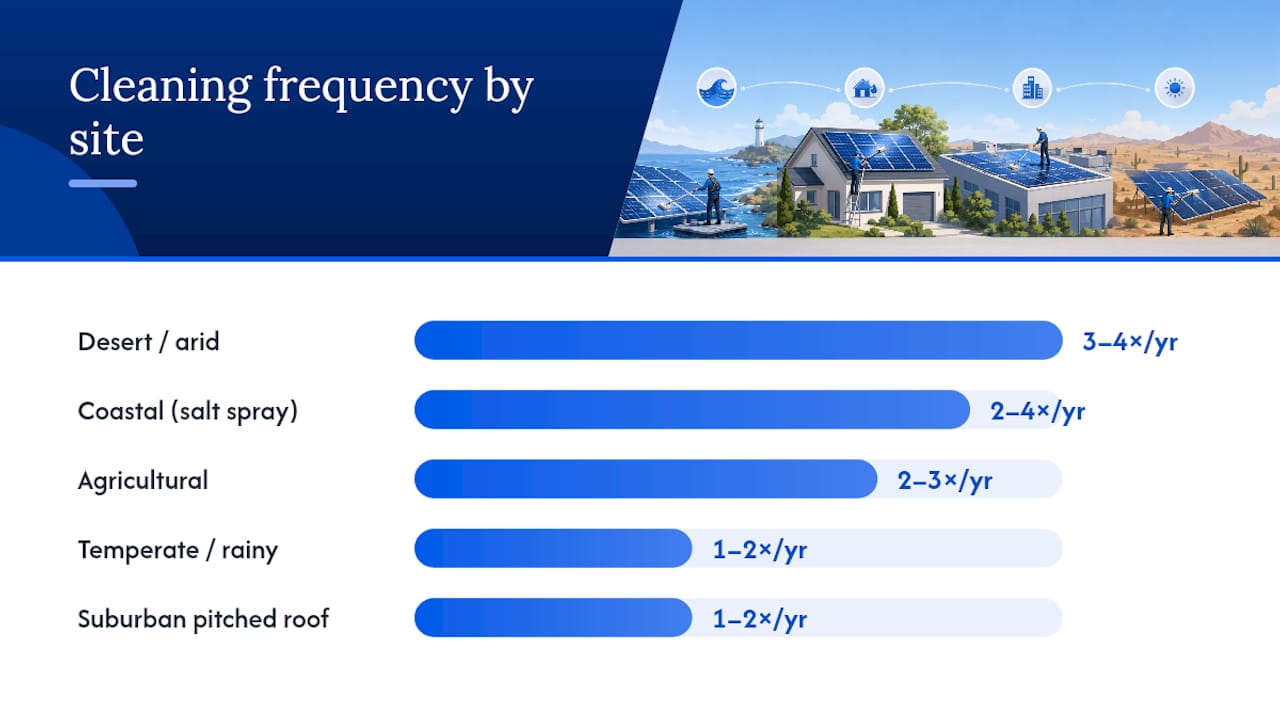
Field guides and installers consistently recommend quarterly to triannual cleanings for desert, coastal, and agricultural sites. For a single annual cleaning, late spring (April through May) is the best timing: it clears winter grime and pollen before the high-production summer months. A bi-annual schedule adds a fall visit to remove leaves and harvest dust before winter.
Pro Tip: If you’re unsure where your site falls, start with the suburban baseline (spring + fall) and adjust based on inverter data after the first year. One season of monitoring tells you more than any general guide.
How do you know when your panels actually need cleaning?
The most reliable signal isn’t visual. Pull your inverter or monitoring app data, compare your current output to the same period last year or to your system’s projected baseline, and look for a sustained gap. Moderate soiling typically cuts output by 3–8%; heavy soiling from dust, bird droppings, or salt can push losses to 15–20% or more.
Enphase’s monitoring platform, for example, lets you track daily and monthly production against your system’s expected yield. A consistent downward trend that doesn’t track with cloudy weather is a strong sign soiling is the culprit.
Visual checks are a useful secondary signal, not a primary one. Walk the perimeter of your array and look for:
- Bird droppings: Even a small cluster can shadow a full cell string and cause disproportionate output loss.
- Thick pollen or dust film: A visible yellow or gray coating that doesn’t rinse off in light rain.
- Salt film: A white haze on coastal panels that looks like dried water spots but is actually corrosive salt residue.
- Ash or soot: After wildfires or nearby burns, ash bonds to glass quickly and needs prompt removal.
Statistic callout: Heavy soiling in desert or bird-heavy sites can exceed 15–20% production loss, making a $150–$400 cleaning visit cost-effective within a single billing cycle.
Pro Tip: Set a monthly calendar reminder to check your inverter data. Five minutes of monitoring catches a soiling problem before it compounds across an entire season.
DIY cleaning vs. hiring a professional: which is right for you?
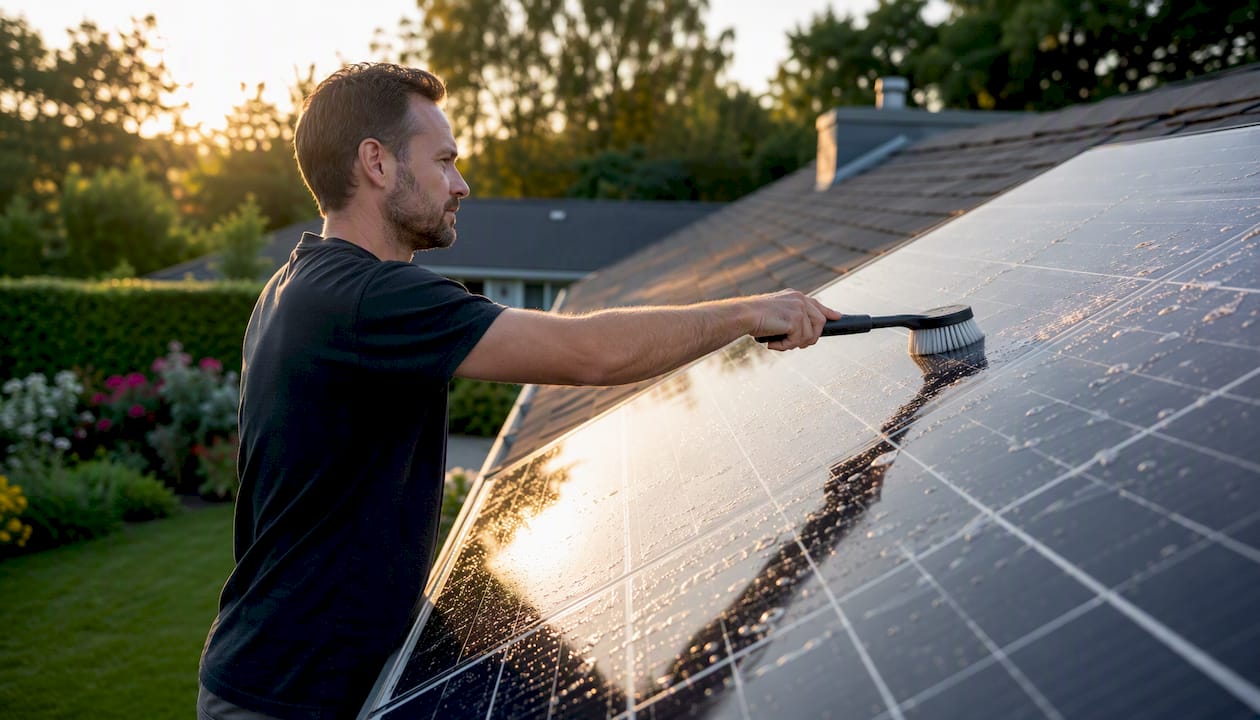
DIY cleaning is reasonable when you have safe, easy ground-level or low-roof access, minor soiling, and a system small enough to manage with a garden hose and soft brush. Hire a professional for steep roofs, large arrays, coastal salt corrosion, or any situation where your manufacturer’s warranty language requires documented professional service.
| Factor | DIY | Professional Service |
|---|---|---|
| Safety | Low risk on ground-level or single-story; high risk on steep or wet roofs | Trained for height, insured, proper equipment |
| Warranty risk | Higher if wrong tools or chemicals are used | Lower when contractor follows manufacturer specs |
| Typical cost | $20 in supplies | $150–$400 per residential visit |
| Tools needed | Soft brush, deionized or filtered water, mild soap | Telescoping poles, deionized water systems, safety harness |
| Best use case | Ground-mounted, single-story, light soiling | Steep roofs, large arrays, salt/heavy soiling, warranty service |
Manufacturer warranty terms commonly prohibit pressure washing and certain detergents. Using a pressure washer yourself — even briefly — can void coverage on the glass or frame seals. That’s the single biggest DIY risk, and it’s avoidable.
When hiring a contractor, ask these questions before booking:
- Are you licensed and insured for roof work in this state?
- Do you use deionized or filtered water, or tap water?
- Will you document the cleaning with photos and a service record?
- Do you follow the panel manufacturer’s cleaning specifications?
Red flags to walk away from: no proof of insurance, a claim that pressure washing is fine, vague answers about chemical use, or no written service record offered.
Pro Tip: Ask any contractor for a sample service report before booking. A professional who documents their work protects your warranty and gives you a paper trail if you ever need to file a claim.
How to clean solar panels without voiding your warranty
Clean on a cool, overcast morning or in the early evening. Midday heat causes water to evaporate almost instantly, leaving mineral streaks. Never work on a wet, slippery roof surface, and never attempt cleaning during or after a storm.
Step-by-step cleaning procedure:
- Pre-inspection: Walk the array perimeter. Note any cracked glass, damaged frames, or loose wiring before you touch anything.
- Safety setup: Secure your ladder, wear non-slip footwear, and use a safety harness on any roof with a pitch above 4:12. Turn off the solar system per your inverter’s shutdown procedure before working near panels.
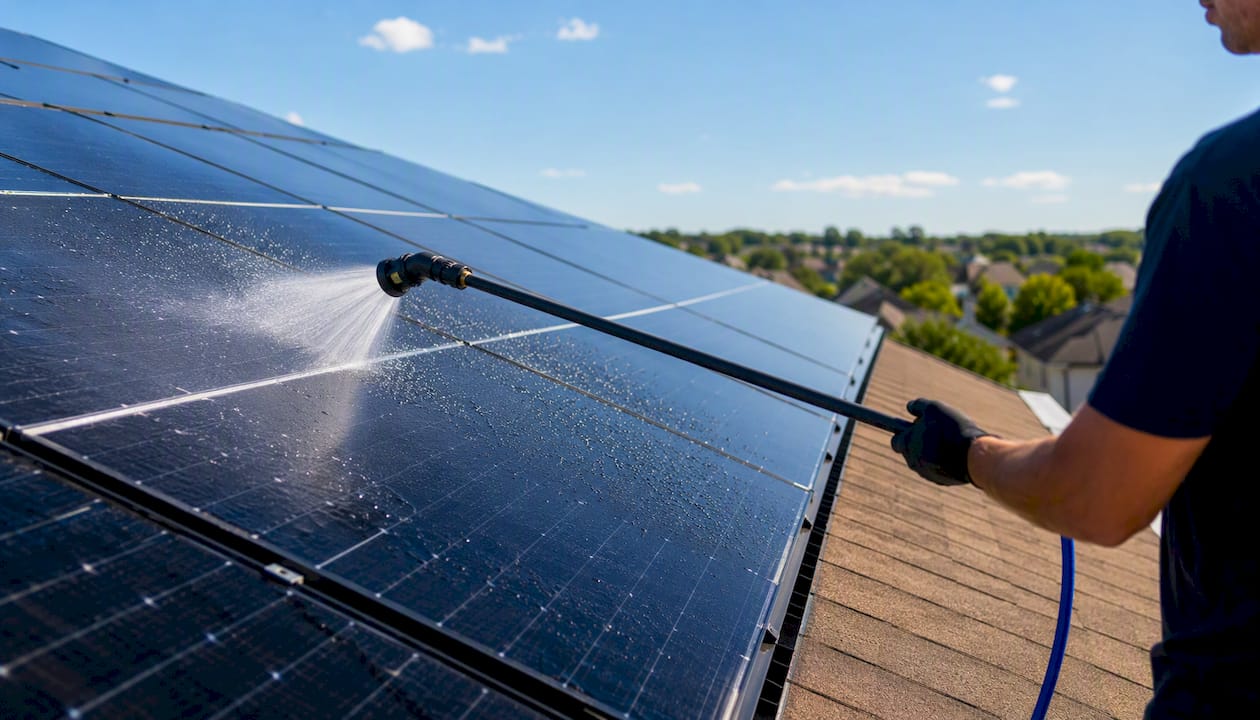
- Initial rinse: Use a garden hose with a gentle spray nozzle to loosen loose dust and debris. Work from the top of the array downward.
- Wash: Apply a small amount of mild, non-abrasive soap (dish soap works; avoid anything with ammonia or bleach) to a soft-bristle brush or microfiber pad. Scrub gently in straight lines, not circles.
- Final rinse: Rinse thoroughly with clean water to remove all soap residue. Soap left on glass attracts dust faster.
- Drying and inspection: Let panels air-dry or wipe edges with a clean microfiber cloth. Do a final visual check for streaks, missed spots, or any damage you may have uncovered.
Tools to use: Soft-bristle brush, telescoping pole, garden hose, deionized or filtered water, mild dish soap, microfiber cloths.
What to avoid: Pressure washers (can crack seals and void warranties), abrasive scrubbing pads, steel wool, ammonia-based cleaners, bleach, and any solvent. Safe cleaning methods protect both the panels and your warranty coverage.
Working at height carries real risk. If your roof pitch is steep, your array is large, or you’re not comfortable on a ladder, the cost of a professional visit is far lower than an ER bill or a warranty dispute.
What does solar panel cleaning cost, and when does it pay off?
Typical residential cleaning costs in 2026 range from roughly $150 to $400 per visit, with desert or heavily soiled properties running toward the higher end due to more frequent visits. Per-panel pricing from some contractors runs $10–$20 per panel for standard residential arrays.
Budget examples by schedule:
- Once per year (rainy/temperate climate): $150–$250 annually.
- Twice per year (suburban baseline): $300–$500 annually.
- Three to four times per year (desert or coastal): $450–$1,200 annually, offset by the production gains from keeping panels clean.
Cleaning pays off when the cost of the visit is less than the value of the electricity you’re losing to soiling. A single $200 cleaning visit recovers that loss.
The best time to combine cleaning with an annual professional inspection is late spring, right before peak summer production. Pairing a cleaning with an inverter check and a roof inspection in one visit saves a separate service call and gives you a full picture of system health heading into the highest-output months.
How cleaning interacts with your manufacturer warranty
Follow your panel and inverter manufacturer’s guidance first, before any general advice. Some warranties require documented professional service as a condition for claims related to glass or frame damage. Others simply prohibit specific cleaning methods.
Warranty-related actions to take now:
- Read your warranty document: Look for sections on maintenance requirements, prohibited cleaning methods, and documentation expectations.
- Note restrictions: Most manufacturers explicitly prohibit pressure washing and certain chemical cleaners. Violating these terms can void coverage on seals, glass coatings, and frame integrity.
- Keep receipts and photos: Every professional cleaning should come with a dated service record and before/after photos. Store these with your warranty documents.
- Log cleaning dates: A simple spreadsheet with date, method, contractor name, and any observations is enough to support a future claim.
- Check inverter warranty separately: Enphase and other inverter manufacturers often have their own maintenance and inspection requirements distinct from the panel manufacturer’s terms.
Pro Tip: Take a photo of your inverter’s production dashboard on the day of each cleaning. That timestamp creates a before/after production record that’s useful if you ever need to demonstrate that a cleaning restored output.
National lab testing confirms that modern panels are built to survive severe weather events; routine cleaning done correctly doesn’t threaten structural integrity. The risk isn’t the cleaning itself — it’s using the wrong tools or skipping documentation.
Why Florida homeowners often need three cleanings per year
Florida’s combination of heavy spring pollen, coastal salt air, frequent summer storms, and year-round bird activity creates soiling conditions that outpace the national baseline. Many Florida systems need about three cleanings per year to maintain production close to rated output.
A practical Florida schedule:
- Early spring (February through March): Clear winter grime and the first pollen wave before peak production season.
- Late summer (August through September): Remove storm debris, salt accumulation, and mid-year biological growth after hurricane season’s most active months.
- Fall (October through November): Pre-winter cleaning to clear any remaining debris and set panels up for the cooler, clearer months.
Between scheduled visits, monitor your inverter output monthly. When that happens, don’t wait for the next calendar cleaning — act on the data.
After any named storm or significant weather event, do a visual inspection before resuming normal monitoring. National lab research confirms panels survive most severe weather, but debris impact, salt spray, and standing water can create conditions worth checking before assuming everything is fine.
Environmental impact and water use in solar panel cleaning
Water consumption is a real consideration, especially in drought-prone states like California, Arizona, and Nevada. A standard residential cleaning uses roughly 20–50 gallons of water per visit, depending on array size and method. Deionized water systems, which many professional cleaners use, often reduce total water use because the purified water rinses more efficiently and leaves no mineral residue, meaning fewer passes are needed.
Dry brushing is an option for light dust in arid climates, particularly for sunny-climate systems where dust is fine and not sticky. It uses no water at all, but it’s only appropriate for loose, dry particulate. Pollen, salt, bird droppings, and ash all require water and a mild cleaning agent to remove safely without scratching the glass.
From a broader environmental standpoint, keeping panels clean is itself a sustainability practice. The water cost of one cleaning visit is small relative to the additional grid draw from months of reduced production.
Runoff is worth considering too. Soap and debris wash off the roof and into gutters or landscaping. Using biodegradable, phosphate-free soap minimizes the impact on soil and local waterways, and it’s generally what professional cleaners use anyway.
What most homeowners get wrong about cleaning frequency
The most common mistake is treating solar panel cleaning as a set-it-and-forget-it annual task regardless of what the data shows. A homeowner in suburban Chicago and one in Tucson should not be on the same schedule, but many are, because they both followed the same generic “once a year” advice without checking their inverter output.
The second mistake is assuming rain handles it. Rain removes loose dust, but it leaves behind mineral deposits, pollen residue, and salt film that compound over time.
The third mistake is DIY cleaning on a steep roof to save $200. The math rarely works out. A professional visit costs less than a single emergency room copay, and it comes with documentation that protects your warranty. For ground-mounted or single-story systems with easy access, DIY is fine. For anything above that, the risk-to-savings ratio tips quickly toward hiring a pro.
Monitoring data is the tool that cuts through all of this. Check your inverter output monthly, compare it to the same month last year, and let the numbers tell you when to clean. That approach beats any calendar-based rule.
Broswindowcleaningoc handles solar panel cleaning in Orange County
Dirty panels cost you money every month they go uncleaned. Broswindowcleaningoc offers professional solar panel cleaning for homeowners and property managers across Orange County, CA, with fully insured service that follows manufacturer cleaning specifications and includes photo documentation for your warranty records.
Every visit includes an on-site inspection, before/after photos, and a service record you can file with your panel manufacturer. Broswindowcleaningoc also offers bundled exterior service packages, so you can combine a solar panel cleaning with roof, gutter, or window service in a single visit and cut your total service cost. No pressure washing, no harsh chemicals, no warranty risk.
Ready to get your system back to full output? Request a quote or schedule your cleaning and ask about frequency options and proof of insurance when you book.
Sources
The sources below include manufacturer maintenance guidance, government resilience research, and regional cost and schedule surveys. Each covers a specific aspect of solar panel care that goes beyond what any single article can address in full.
- Solar panel cleaning and maintenance guide (Enphase)
- Solar Panel Cleaning Guide (SurgePV)
- Solar Panel Cleaning Cost: Prices, Factors, And DIY vs Pro (Advance Solar & Spa)
- Solar panel cleaning in the US 2026: a homeowner’s guide to costs, schedules, and DIY vs. pro (Earth Energy Log)
- Solar Panel Cleaning: How Often and How Much It Costs (Top Solar Services)
- Hail? No: national labs find solar panels survive severe storm (U.S. Department of Energy / EERE)