
Most residential pressure-washing jobs take from a short half hour up to a few hours, depending on surface size, condition, and equipment quality. Driveways usually take under two hours, and house exteriors generally require a couple of hours or more depending on stories. Decks are typically cleaned within a couple of hours. These estimates assume moderate dirt and professional equipment, including setup and cleanup time.
Quick reference for common jobs:
- Driveways normally take under two hours.
- Smaller house exteriors can be done in under an hour by pros; DIY takes longer.
- Larger houses require multiple hours depending on single or two stories.
- Deck cleaning generally takes one to two hours.
- Fences and patios usually finish within about an hour or so.
These estimates are based on typical professional services with commercial equipment. DIY times with lower-pressure machines are generally longer, and difficult conditions may extend times further.
Pro Tip: Setup and teardown alone typically add 45–90 minutes to any job. When you’re blocking time on your calendar, always plan for the full window, not just the spray time.
Key Takeaways
For a typical single-story house of moderate size, plan several hours for spray time plus additional time for preparation and cleanup, amounting to a half-day appointment with a professional crew.
| Point | Details |
|---|---|
| Time ranges by surface | Driveways run 30–90 min; single-story homes 1.5–3 hrs; two-story homes 3–5 hrs; decks 1–2 hrs. |
| Prep and cleanup buffer | Add 45–90 minutes to any spray-time estimate to get the true appointment window. |
| DIY vs. pro gap | Solo DIY typically takes 1.5–2x longer than a two-person professional crew with commercial equipment. |
| Estimator formula | Divide total surface sq ft by the cleaning rate (sq ft/hour), then multiply by a difficulty factor and add the buffer. |
| Broswindowcleaningoc | Books half-day or full-day windows, includes prep and walkthrough, and gives accurate time estimates upfront. |
Table of Contents
- How long does pressure washing take by surface type?
- What factors affect how long a pressure-washing job takes?
- House vs. driveway vs. deck: how the time actually adds up
- What prep work and cleanup should you schedule in addition to spray time?
- How to estimate time for your specific property
- What changes when you scale up to commercial or large properties?
- A note on scheduling from Bros Window Cleaning
- Broswindowcleaningoc makes scheduling straightforward
- Sources
How long does pressure washing take by surface type?
The table below covers the surfaces homeowners ask about most. Per-surface timing data from Klein Pressure Washing and Thumbtack’s professional pricing guide both confirm these windows as realistic for residential jobs.
| Surface | Typical Size | Pro Time (includes setup/cleanup) | Notes |
|---|---|---|---|
| Driveway | Moderate size | Under two hours typical | Concrete; oil stains can extend time |
| Single-story house exterior | Moderate size | Few hours range | Vinyl, stucco, or brick siding |
| Two-story house exterior | Larger size | Several hours needed | Requires ladder or extension wand |
| Wood or composite deck | Moderate size | Around one to two hours | Railings and furniture may add time |
| Concrete or stone patio | Moderate size | About an hour or less | Sealed concrete washes faster |
| Wood or vinyl fence | Moderate length | Around one hour typical | Cleaning both sides adds to time |
| Roof (low-slope only) | Moderate size | Couple hours | Soft-wash method preferred; safety issues |
A note on roofs: High-pressure washing on shingles causes granule loss and voids most manufacturer warranties. Soft-wash (low pressure plus detergent) is the correct method, and it takes longer because the solution needs dwell time. If a contractor offers to blast your roof at full pressure, that’s a red flag.
What those ranges include: equipment transport and staging, pre-wetting or pretreatment, the wash pass, a rinse pass, and basic teardown. They do not include stain treatment, sealing, or furniture moving if the homeowner hasn’t done it in advance.
What factors affect how long a pressure-washing job takes?
No two properties are identical, and the time ranges above can shift significantly based on a handful of variables. Understanding which ones apply to your property lets you build a more accurate schedule.
- Surface condition: Mildew, algae, and oil stains require pretreatment and longer dwell time before the wash pass. A driveway with fresh tire marks cleans in 30 minutes; one with years of embedded oil can take 90 minutes or more.
- Surface material and texture: Smooth concrete moves fast. Rough brick, stucco, or wood siding has more surface area per square foot, so the wand covers less ground per pass. Brick can take 30–40% longer than equivalent smooth concrete.
- Accessibility and obstacles: Tight side yards, dense landscaping, steps, and second-story overhangs all slow the crew down. A clear, open driveway is the fastest job on any property.
- Equipment PSI and GPM: Commercial machines running at 3,000–4,000 PSI with a high gallons-per-minute (GPM) rating clean faster and rinse more completely than consumer units. A 1,500 PSI electric washer moves slower and may need multiple passes.
- Crew size and experience: A two-person team splits prep and spraying simultaneously, cutting total time by 30–40% compared to a solo operator. An experienced crew also knows which nozzle and detergent combination works for each surface, avoiding wasted passes.
- Weather and temperature: Cold water and low temperatures reduce detergent effectiveness, sometimes requiring longer dwell times. Direct sun can dry detergent before it works, so crews often start on shaded sides of the house first.
Pro Tip: Soft-wash (low pressure, high-detergent) takes longer than high-pressure blasting but is the right call for wood, stucco, and roofs. The extra dwell time protects the surface and often produces a cleaner result. If you’re comparing quotes, ask which method each contractor uses for your specific surface, not just what PSI they run.
House vs. driveway vs. deck: how the time actually adds up
Abstract ranges are useful, but seeing the numbers broken down step by step makes scheduling much easier. Here are three worked examples using professional crew times.
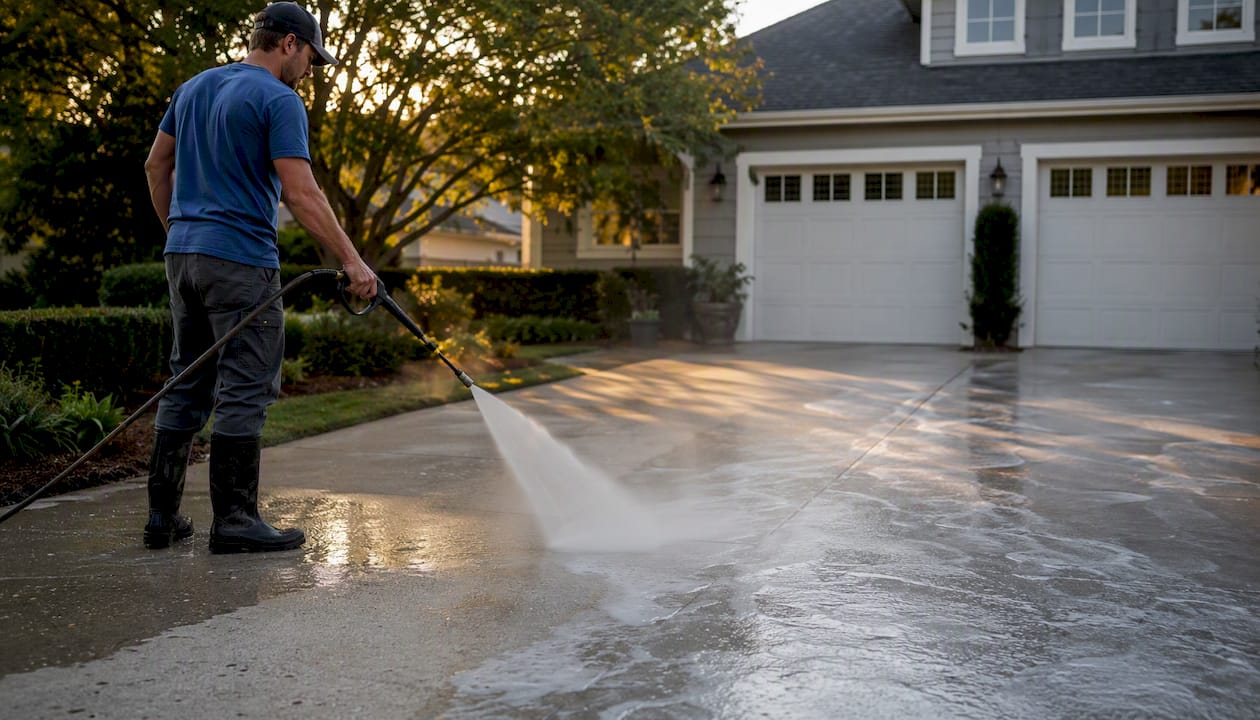
Example A: Two-car concrete driveway (500 sq ft, moderate dirt)
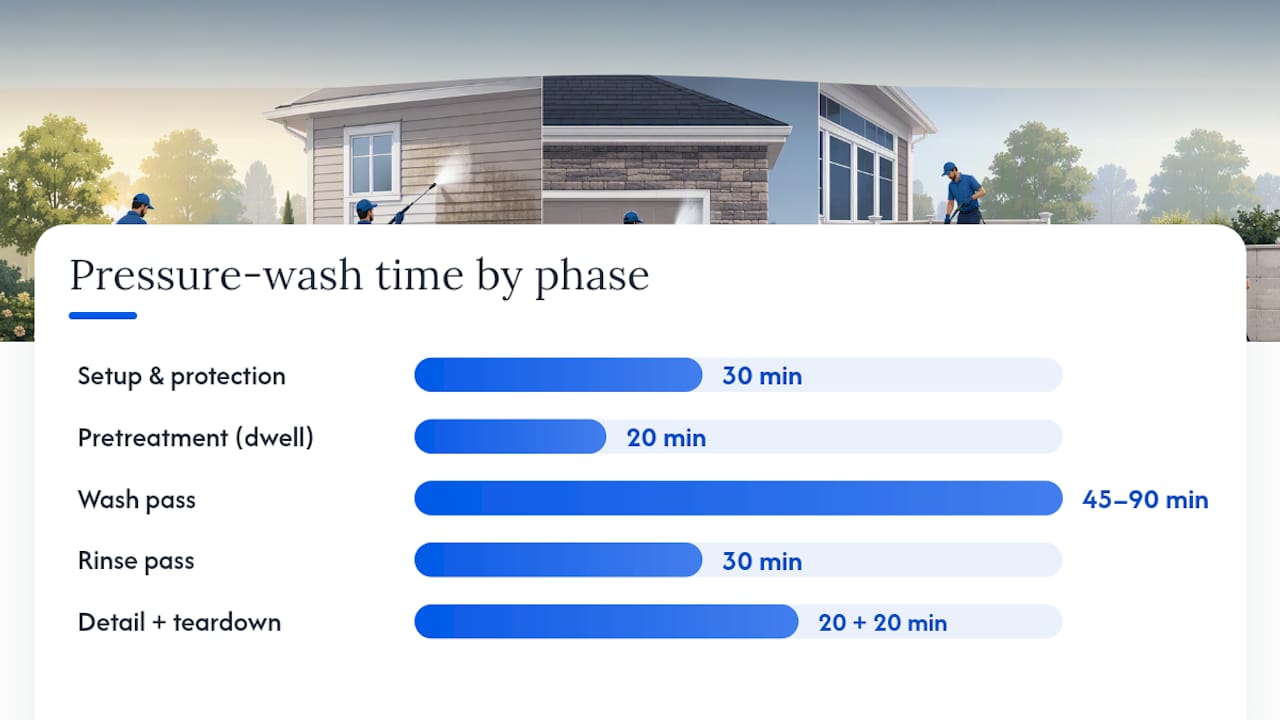
Example B: 2,000 sq ft single-story house exterior (vinyl siding, moderate mildew)
| Phase | Time |
|---|---|
| Equipment setup and property protection | 30 minutes |
| Pretreatment (detergent application, dwell) | 20 minutes |
| Wash pass | 45–90 minutes |
| Rinse pass | 30 minutes |
| Detail work (trim, corners, vents) | 20 minutes |
| Teardown and final walkthrough | 20 minutes |
| Total | ~2 hours |
Example C: 400 sq ft composite deck with railings and patio furniture
DIY times for these same jobs run longer. Research comparing DIY and professional timelines shows small homes under 1,000 sq ft taking 1–2 hours for a pro but closer to 2–4 hours for a solo DIYer, with medium homes (1,500–2,500 sq ft) running 2–4 hours professionally and 4–6+ hours solo. Heavy soiling pushes both windows further out. The gap comes from equipment output, technique, and the fact that a solo DIYer handles every phase sequentially rather than in parallel.
When add-on tasks like stain removal or deck sealing follow the wash, budget an additional 1–3 hours depending on the product’s dry time requirements.
What prep work and cleanup should you schedule in addition to spray time?
The spray time is only part of the appointment. Skipping prep or rushing cleanup creates problems, from water intrusion through open windows to detergent damage on plants. Here’s what needs to happen before and after the wand ever turns on.
- Move outdoor furniture, grills, and planters away from the work area. Leaving them in place forces the crew to work around obstacles and often means those surfaces don’t get cleaned properly.
- Close all windows and doors on the side of the house being washed. Water pressure can push moisture through gaps around frames.
- Cover outdoor electrical outlets, light fixtures, and HVAC intakes with plastic sheeting or bags. A professional crew typically handles this, but confirming in advance saves time.
- Trim back plants and shrubs that overhang the surfaces being cleaned. Overhanging branches block the wand path and can be damaged by high-pressure spray.
- Pre-wet sensitive plants and landscaping near the wash zone. Detergent runoff can stress plants; pre-wetting dilutes any overspray that reaches them.
- Sweep loose debris off driveways and decks before the crew arrives. Pressure washing over leaves and twigs just scatters them; sweeping first lets the water work on actual grime.
- Do a final walkthrough after the job to check corners, trim, and any areas that needed extra attention. A good crew builds this into their time, but you should walk it too.
Homeowner prep steps from Broswindowcleaningoc confirm that clearing furniture and securing outdoor items before the crew arrives is one of the most effective ways to shorten on-site time. Setup and property protection typically add 15–40 minutes to the job clock, and teardown adds another 15–20 minutes. Add those together and you’re looking at a 45–90 minute buffer on top of the spray time, every time.
How to estimate time for your specific property
You don’t need a contractor on-site to get a reasonable time estimate. A simple formula gets you close enough to block your calendar accurately.
The formula:
Cleaning rate benchmarks:
- Smooth concrete (driveway, patio): 800–1,200 sq ft/hour
- Vinyl or painted siding: 500–800 sq ft/hour
- Wood surfaces (deck, fence): 400–600 sq ft/hour
- Brick or stucco: 300–500 sq ft/hour
Difficulty multiplier:
- Light dirt, clear access: 1.0
- Moderate buildup or some obstacles: 1.25
- Heavy mildew, oil, or tight access: 1.5
Sample calculation for a 2,000 sq ft single-story house with vinyl siding and moderate mildew:
- Base spray time: 2,000 ÷ 650 (mid-range for vinyl) = ~3.1 hours
- Add prep/cleanup buffer: +1 hour (midpoint of 45–90 min range)
- Apply difficulty multiplier: 3.1 × 1.25 = ~3.9 hours, plus the buffer = ~4.9 hours total
That’s a full half-day appointment for a pro crew. A solo DIYer on the same property should plan for a full day.
A time-per-job calculator model confirms that most residential jobs fall in the 1–4 hour range for spray time alone, with the prep and cleanup buffer pushing total appointment windows to 2–6 hours depending on property size and condition. The formula above matches that model closely and gives you a number you can hand to a scheduler.
What changes when you scale up to commercial or large properties?
Residential jobs are largely predictable. Commercial jobs introduce variables that can push a single project from a half-day to multiple days, and the reasons aren’t always obvious.
- Logistics and permits: Some commercial properties require permits for water runoff containment, especially near storm drains. Permit processing adds lead time, not just job time.
- Staging and access equipment: Warehouses, multi-story facades, and parking structures often require boom lifts or scaffolding. Setting up and breaking down that equipment adds 1–2 hours per day on its own.
- Off-hours scheduling: Retail storefronts and restaurants typically can’t be washed during business hours. Off-hours work (early morning or overnight) adds crew coordination complexity and sometimes a premium on labor time.
- Multi-crew coordination: Large facilities split into zones, with different crews handling different surfaces simultaneously. Coordinating handoffs between zones takes planning time that doesn’t show up in the spray estimate.
- Sustained equipment runtime: Commercial-grade hot-water units can run continuously for hours without the performance drop that consumer machines experience. That sustained output is what makes large jobs feasible in a single day.
A small storefront (1,000–1,500 sq ft of facade and sidewalk) typically runs 2–4 hours with a professional crew. A warehouse or distribution facility with loading docks, large paved areas, and multi-story walls can require 2–3 full days, sometimes with a lift rental that needs to be scheduled separately. Safety briefings, equipment checks, and site walkthroughs add time that simply doesn’t exist on a residential driveway job.
A note on scheduling from Bros Window Cleaning
At Broswindowcleaningoc, we schedule residential pressure-washing jobs in half-day and full-day windows, depending on the property size and what surfaces are being cleaned. A standard two-person crew handles most single-family homes in one appointment. We include onsite prep, property protection, the wash, and a final walkthrough in every quoted time window, so the time we give you is the time you actually block.
When you call to schedule, the most useful things to tell us are the approximate square footage of the surfaces you want cleaned, the surface types (concrete, wood, stucco, vinyl), and whether there are any known stains or heavy buildup areas. That information lets us give you an accurate time estimate upfront rather than adjusting on the day.
Punctuality and safety are non-negotiable for us. We arrive within the scheduled window, protect your landscaping and electrical fixtures before we start, and don’t leave until the walkthrough is done.
Broswindowcleaningoc makes scheduling straightforward
Figuring out how long a job takes is only half the equation. The other half is finding a crew that shows up on time, works efficiently, and doesn’t leave you guessing about what’s included.

Broswindowcleaningoc’s pressure-washing service for Orange County homeowners covers every phase of the job: onsite prep and property protection, soft-wash or high-pressure options depending on your surface, driveway and exterior cleaning, and a final walkthrough before the crew packs up. Half-day appointments work for most driveways and single-surface jobs; full-day windows cover whole-house exteriors and multi-surface combinations. When you book, tell the team your surface types and approximate square footage, and you’ll get a time estimate you can rely on. To get a quote or check availability, visit Broswindowcleaningoc.
Sources
- 2026 Pressure Washing Prices | Pros Explain Power Washing Pricing
- How Long Does Pressure Washing Take?
- Pressure Washing Time Per Job Calculator