
The right call for most industrial facilities is professional pressure washing with a hybrid approach: hot-water high-pressure cleaning for concrete, loading docks, and equipment pads, combined with low-pressure soft washing for metal siding, coated panels, and brick facades. Before booking anyone, schedule an on-site estimate to confirm PSI and GPM requirements, hot-water capability, wash-water containment, and whether off-hours scheduling fits your production calendar.
Here is what to lock in before signing anything:
- Confirm the contractor carries general liability and workers’ comp insurance (get certificates, not verbal assurances).
- Request a written scope of work that names surfaces, methods, and chemicals.
- Require a runoff containment and disposal plan that complies with local stormwater rules.
- Ask for Safety Data Sheets (SDS) for every chemical being applied.
- Verify the crew can work off-hours or on weekends to protect your operations.
Broswindowcleaningoc serves Orange County facilities and can provide an on-site estimate, written scope, and containment plan. Most commercial and industrial pressure washing jobs can be completed within one to two business days of booking, depending on the scale and complexity.
Table of Contents
- Why does industrial pressure washing matter beyond curb appeal?
- What contaminants does industrial pressure washing actually remove?
- What methods and equipment specs should you require?
- Which surfaces need which treatment?
- What safety and environmental controls must you require?
- How long does the job take, and how often should you schedule it?
- What drives the cost of an industrial exterior cleaning job?
- How do you choose the right contractor?
- What should you do to prepare, and what happens after?
- When should you handle cleaning in-house, and when should you call a pro?
- How Broswindowcleaningoc approaches an industrial exterior job
- Key Takeaways
- The thing most facility managers get wrong about exterior cleaning
- Broswindowcleaningoc handles industrial exterior cleaning in Orange County
- Useful sources
Why does industrial pressure washing matter beyond curb appeal?
Appearance is the least compelling reason to clean an industrial exterior. The real argument is asset protection. Routine industrial exterior cleaning removes corrosive residues — chemical spills, salt deposits, diesel exhaust particulate — that actively degrade concrete, metal fasteners, and protective coatings over time. A loading dock that gets cleaned quarterly lasts measurably longer than one that gets cleaned only when it looks bad.
Safety is the other driver that facility managers cannot afford to ignore. Oil and algae on walkways and dock aprons create slip hazards that directly affect OSHA compliance. Professional cleaning reduces slip hazards and supports OSHA expectations for safe walkways and loading areas. That matters when an inspector walks your facility or when an incident report lands on your desk.
The operational benefits stack up quickly:
- Aesthetic and tenant confidence: Clean exteriors signal active management to customers, inspectors, and tenants.
- Corrosion prevention: Removing chemical and salt residues slows degradation of concrete, metal siding, and coatings.
- Slip hazard reduction: Clearing oil, algae, and biological growth from dock aprons and walkways cuts incident risk.
- Compliance readiness: A clean, documented facility is easier to defend during OSHA or insurance inspections.
- Property value: Regular exterior cleaning preserves property value by preventing surface deterioration that leads to costly repairs.
What contaminants does industrial pressure washing actually remove?
Industrial soils are not the same as the grime on a storefront window. They are often hydrophobic, chemically aggressive, or biologically active, and standard cold-water washing at moderate pressure will not touch them.
The most common problem contaminants and where they appear:
- Heavy grease and oil: Loading docks, equipment pads, fueling areas. Baked-on diesel and hydraulic fluid bond to concrete and resist cold water entirely.
- Chemical residues: Process areas, chemical storage pads, and secondary containment zones. Acid runoff etches concrete and accelerates corrosion of adjacent metal.
- Rust and oxidation: Metal siding, structural steel, and dock levelers. Surface rust left untreated spreads under coatings.
- Biological growth (mold, algae, mildew): Shaded north-facing walls, dumpster enclosures, and drainage channels. Algae creates slip hazards; mold can penetrate porous masonry.
- Graffiti: Perimeter walls and loading areas. Requires specific chemistry matched to the surface coating to avoid permanent staining.
- Process residues and particulate: Rooftop HVAC discharge, exhaust stacks, and manufacturing exhaust that settles on facades and equipment pads.
Oily and chemically contaminated wash water cannot simply run into a storm drain. Industrial projects frequently require wash-water recovery to prevent oily runoff from entering municipal systems. If a contractor does not mention this, that is a red flag worth taking seriously. You can find power washing applications across property types to understand the full scope of what professional equipment handles.
What methods and equipment specs should you require?
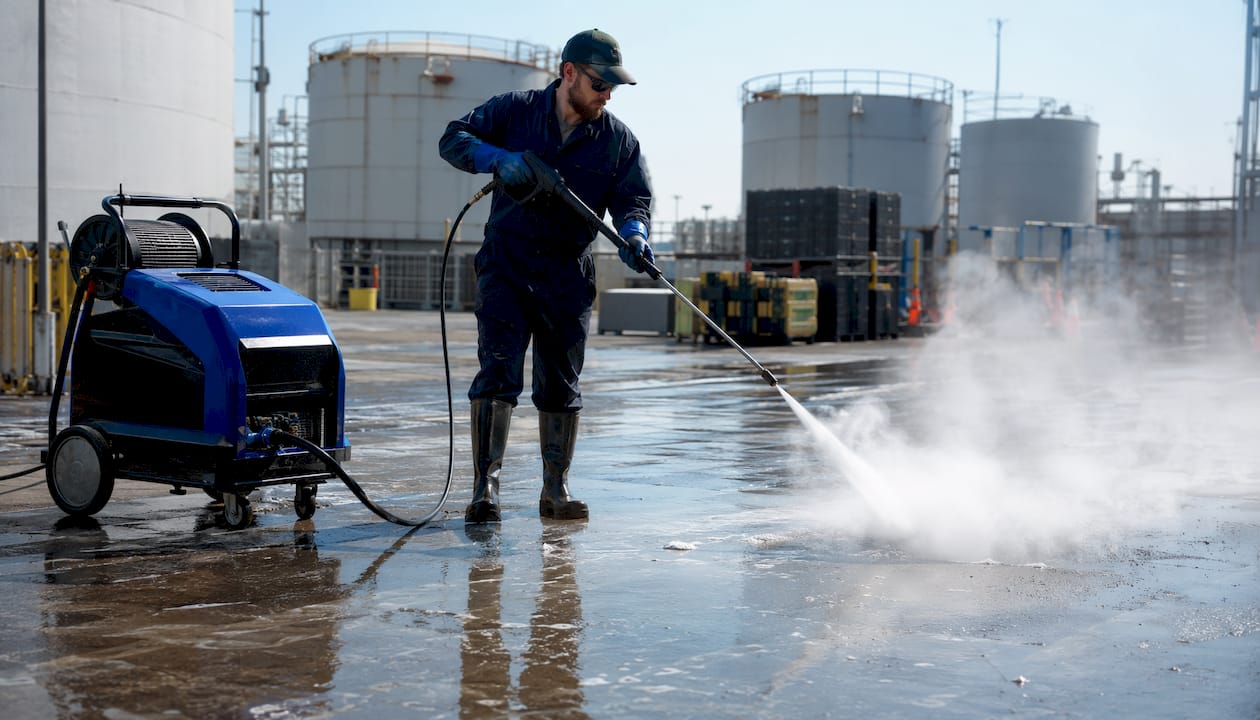
Not every surface gets the same treatment. The three primary approaches each have a specific role, and a competent contractor will use more than one on a single job.
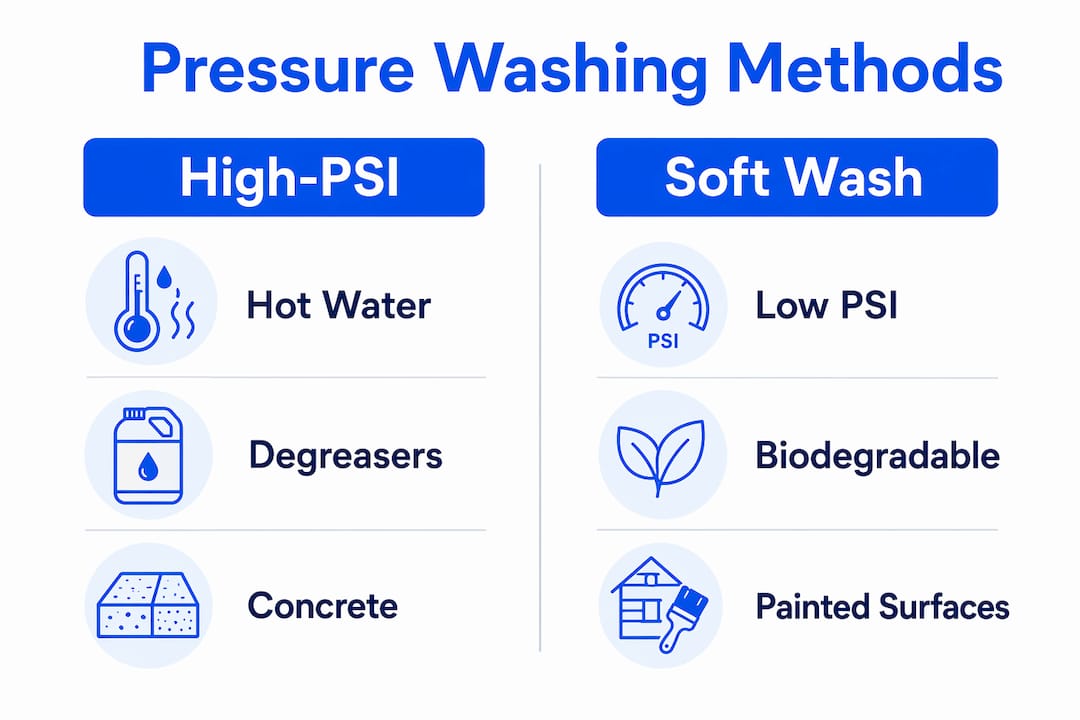
| Method | Best Use | Typical PSI / GPM | Common Chemistry | Risk |
|---|---|---|---|---|
| High-PSI pressure washing | Concrete, equipment pads, dock aprons | 3,000–4,000 PSI / 4–8 GPM | Industrial degreasers, emulsifiers | Etching on soft masonry, paint removal |
| Hot-water pressure washing | Baked-on grease, oil, diesel residue | Moderate pressure with appropriate chemistry | Degreasers, biodegradable detergents | Thermal shock on some coatings |
| Soft washing (low pressure) | Metal siding, painted panels, brick, glass | 100–500 PSI / 2–4 GPM | Surfactants, mildewcides, rinse agents | Minimal when chemistry is matched to surface |
Industrial-grade hot-water systems paired with commercial degreasers are the standard for removing baked-on grease from concrete and equipment pads. Cold water alone will not emulsify heavy oil. For delicate facades, hybrid cleaning approaches combine low-pressure soft washing with targeted hot-water high-pressure work to avoid substrate etching while still achieving deep grease removal.
Avoid contractors who propose strong acids or high-concentration bleach on coated metal panels or painted surfaces without confirming compatibility with the coating manufacturer’s specifications.
Pro Tip: Sequence the job: soft wash the upper facade first to loosen biological growth and surface grime, then move to hot-water high-pressure work on the concrete below. Running it in reverse means dirty runoff from the dock apron contaminates the freshly cleaned lower wall.
Which surfaces need which treatment?
Surface type determines method. Getting this wrong means etched concrete, stripped paint, or damaged coatings that cost more to repair than the cleaning saved.
- Concrete loading docks and equipment pads: Hot water plus industrial degreaser, high PSI with a surface cleaner attachment for even coverage. Ask the contractor to confirm nozzle angle to avoid line etching.
- Asphalt parking areas: Low-pressure surface cleaner only. High PSI cuts into asphalt binder and accelerates deterioration. Pair with parking lot maintenance practices to extend pavement life after cleaning.
- Metal siding and corrugated panels: Soft wash or controlled low pressure (under 1,500 PSI). High pressure dents panels and drives water behind fasteners.
- Painted or coated surfaces: Low pressure plus chemistry matched to the coating. Request the contractor’s SDS and confirm the detergent pH is within the coating manufacturer’s tolerance.
- Brick and masonry: Moderate pressure with appropriate chemistry. The GSA’s guidelines for high-pressure cleaning on masonry note that excessive pressure causes irreversible surface damage — a useful reference when reviewing contractor proposals.
- Glass curtain walls and windows: Soft wash or dedicated window cleaning methods. Pressure washing glass requires careful nozzle distance and angle control. A guide to cleaning building glass curtain walls covers the specifics for large commercial glass.
What safety and environmental controls must you require?
This is where most facility managers underestimate their exposure. The contractor’s insurance protects them. Your facility’s stormwater permit and OSHA compliance are your responsibility, regardless of who is doing the cleaning.
Containment and runoff controls to require:
- Berms, drain plugs, or vacuum recovery systems to capture wash water before it reaches storm drains.
- A written runoff containment and disposal plan naming the disposal method and permitted facility.
- Oily-water separator or vacuum truck for jobs involving petroleum-contaminated wash water.
- Coordination with your facility’s stormwater coordinator before work begins.
Annual stormwater pit cleaning is a related maintenance task that often gets overlooked until a drain inspection flags a compliance issue.
Worker safety requirements:
- OSHA-compliant PPE for the crew: eye protection, chemical-resistant gloves, non-slip footwear, and hearing protection near high-pressure equipment.
- Fall protection if any elevated surfaces (dock canopies, roofline areas) are included in scope.
- Lockout/tagout coordination for any adjacent electrical panels, HVAC intakes, or process equipment that could be affected by water or chemical overspray.
Pro Tip: Ask the contractor to walk your site with your EHS coordinator before the job starts. A 30-minute pre-job walkthrough catches drain locations, sensitive equipment, and chemical storage areas that a contractor working from photos alone will miss.
How long does the job take, and how often should you schedule it?

Most commercial and industrial pressure washing jobs can be completed within one to two business days of booking, depending on the scale and complexity. A heavily soiled 50,000-square-foot facility with oily dock aprons and recovery requirements will run longer than a lightly soiled building perimeter.
Frequency guidance by area type:
- High-traffic loading docks and fueling pads: often cleaned regularly depending on throughput and soil accumulation.
- Building perimeter and parking areas: cleaned periodically throughout the year for most industrial sites.
- Full facility exterior: typically receives deep cleaning once per year, with spot treatments as needed.
- Dumpster enclosures and drainage channels: cleaned regularly during warm months when biological growth accelerates.
Experienced contractors schedule work around production timetables and often perform cleaning during off-hours or weekends to avoid disrupting operations. Large industrial jobs use zone phasing to keep shipping and receiving operational during cleaning. Providers also offer recurring maintenance plans on weekly, monthly, or quarterly cycles for high-soil areas. Lock in a recurring schedule rather than booking reactively — it costs less per visit and prevents the kind of buildup that requires a full restoration clean.
What drives the cost of an industrial exterior cleaning job?
No honest contractor quotes a flat rate without seeing the site. Here is what actually moves the number:
- Square footage and surface area: The primary cost driver. More surface equals more time, water, and chemistry.
- Contamination type and intensity: Heavy oil and grease require hot-water equipment, degreasers, and longer dwell times. Light dirt does not.
- Access and height: Elevated surfaces require lifts or extension equipment, which adds time and equipment cost.
- Hot-water requirement: Hot-water units cost more to operate and mobilize than cold-water rigs.
- Wash-water recovery and disposal: Oily-water vacuum recovery and permitted disposal add a meaningful line item to any industrial job.
- Traffic control and staging: Jobs requiring lane closures, temporary signage, or security coordination add labor cost.
- Specialty requirements: Hazmat-level contamination, chemical spill remediation, or permitted discharge handling are priced separately from standard cleaning.
Get at least two written bids with itemized line items. A bid that lumps everything into a single number makes it impossible to compare proposals fairly.
How do you choose the right contractor?
The hiring process for industrial exterior cleaning is more rigorous than for a storefront wash. The stakes — environmental compliance, worker safety, substrate damage — are higher.
Questions to ask during the estimate:
- What is your experience with heavy oil and chemical residues on concrete and metal?
- Do you have hot-water capability, and what are your unit’s PSI and GPM specs?
- How do you contain and dispose of wash water on oily or chemically contaminated jobs?
- Can you provide a sample written scope and a containment plan before we sign?
- What is your scheduling flexibility for off-hours or weekend work?
- Can you provide references from industrial or manufacturing facility clients?
- Do you carry documented before/after photos from comparable jobs?
Trust signals to require in writing:
- General liability and workers’ comp certificates (not verbal confirmation).
- SDS for every chemical being applied.
- Written scope naming surfaces, methods, PSI/GPM, and chemistry.
- Runoff containment and disposal plan.
- Warranty or guarantee terms for the work.
Red flags that should end the conversation: verbal-only scopes, no SDS available, no insurance certificate on request, no containment plan for oily surfaces, or a contractor who proposes maximum PSI on coated panels without checking the coating spec. Quality contractor features translate directly to exterior cleaning providers — the same documentation standards apply.
What should you do to prepare, and what happens after?
Before the crew arrives
- Secure or cover HVAC intakes, electrical panels, and sensitive equipment near the work zones.
- Mark all storm drains and confirm the contractor’s containment plan covers them.
- Notify shipping, receiving, and any vendors about access restrictions and timing.
- Remove vehicles, pallets, and portable equipment from cleaning zones.
- Brief your EHS coordinator and confirm the contractor’s SDS are on file at your facility.
During the job
The crew will isolate zones, deploy containment (berms, drain plugs, or vacuum recovery), set up equipment, and work in sequence from upper surfaces down. Temporary signage and cones mark wet areas. Your on-site contact should be reachable for questions about drain locations or adjacent equipment.
After the job
- Walk the site with the contractor’s supervisor before they demobilize.
- Confirm before/after photos are documented and provided to you.
- Ask for recommendations on protective coatings or sealers for concrete and metal surfaces that would extend the cleaning’s effect.
- Schedule the next cleaning before you leave the walkthrough.
When should you handle cleaning in-house, and when should you call a pro?
Some tasks are reasonable for an in-house crew with the right equipment. Most industrial exterior cleaning is not.
In-house is reasonable for:
- Light surface dirt on sidewalks and low-traffic exterior walls.
- Routine rinse-downs of equipment pads between professional cleanings.
- Small areas with no chemical contamination and no recovery requirement.
Call a professional when:
- The job involves oil, grease, chemical residues, or biological buildup on large surfaces.
- Wash-water recovery or permitted disposal is required.
- Hot-water equipment is needed and your in-house unit is cold-water only.
- The area exceeds what your crew can safely complete without disrupting operations.
- You lack the PPE, training, or SDS documentation that OSHA and your insurance require.
If you maintain in-house capability, the minimum viable setup is a commercial-grade cold-water unit (minimum 2,500 PSI / 4 GPM), appropriate PPE, biodegradable detergents with SDS on file, and trained operators. That covers light maintenance between professional visits, not heavy industrial cleaning.
How Broswindowcleaningoc approaches an industrial exterior job
The workflow Broswindowcleaningoc follows for commercial and industrial exterior cleaning in Orange County reflects the standards facility managers should expect from any qualified contractor.
- Site survey and written scope: An estimator walks the facility, identifies surface types, contamination levels, drain locations, and access constraints. The written scope names every surface, method, PSI/GPM spec, and chemical being used.
- Equipment mobilization: The crew arrives with hot-water pressure washing capability, surface cleaner attachments, soft-wash equipment for delicate facades, and containment gear (berms, drain plugs, vacuum recovery as needed).
- Phased execution: Work is staged by zone to keep operational areas accessible. Loading dock aprons are typically scheduled for off-hours or weekends. Upper facades are soft-washed before high-pressure dock work begins.
- Containment and recovery: Wash water is captured, and oily or contaminated water is disposed of per local stormwater requirements. Drains are plugged before work begins in any zone with petroleum contamination.
- Final inspection and documentation: The supervisor walks the site with the facility contact, confirms results, and provides before/after photos. Recommendations for protective coatings or follow-up frequency are included in the closeout notes.
A typical Orange County industrial client scenario: a distribution facility with heavily soiled dock aprons and a lightly soiled metal-panel perimeter. The dock work runs overnight Friday into Saturday using hot-water equipment and industrial degreaser with vacuum recovery. The perimeter soft wash runs Saturday morning. The facility is fully operational by Monday with no disruption to Friday’s shipping schedule.
Trust signals Broswindowcleaningoc provides on request: proof of insurance, SDS for all chemicals, before/after photo documentation, written containment plan, and references from comparable commercial jobs in Orange County.
Key Takeaways
Professional industrial pressure washing is most effective when it combines hot-water high-pressure cleaning for concrete and oil-contaminated surfaces with soft washing for metal and coated facades, backed by a written containment plan and off-hours scheduling.
| Point | Details |
|---|---|
| Hybrid method wins | Hot-water high-pressure for concrete and oil; soft wash for metal siding and coated panels. |
| Containment is non-negotiable | Require a written runoff plan and wash-water recovery for any job involving oil or chemical residue. |
| Schedule around operations | Most jobs can be completed within one to two business days; off-hours and phased zone work keeps facilities running. |
| Written scope protects you | Verbal agreements leave you exposed; require PSI/GPM specs, SDS, and warranty terms in writing. |
| Broswindowcleaningoc for Orange County | Broswindowcleaningoc provides on-site estimates, written scopes, hot-water capability, and containment planning for industrial and commercial facilities in Orange County. |
The thing most facility managers get wrong about exterior cleaning
The most common mistake is treating industrial exterior cleaning as a reactive task — something you schedule when the facility looks bad enough to embarrass you in front of a client or inspector. That framing costs money. By the time oil and chemical residue is visually obvious on a concrete dock apron, it has already been working on the surface for months. Corrosion under coatings, concrete spalling, and accelerated rust on dock levelers are the downstream costs of cleaning on appearance rather than on a maintenance schedule.
The second mistake is optimizing for the lowest bid. A contractor who skips wash-water recovery saves you money on Tuesday and creates a stormwater compliance problem on Wednesday. The containment plan, the SDS, the insurance certificate — these are not bureaucratic overhead. They are the difference between a cleaning job and a liability.
What actually works: lock in a recurring schedule for your highest-traffic zones, treat it as a line item in the maintenance budget rather than a discretionary spend, and require documentation at every visit. A facility that has before/after photos and a cleaning log is easier to manage, easier to insure, and easier to defend in an inspection. The cleaning itself is almost secondary to the discipline of doing it consistently.
Broswindowcleaningoc handles industrial exterior cleaning in Orange County
Facility managers in Orange County who need a contractor they can actually hand a written scope to should talk to Broswindowcleaningoc. The company brings hot-water pressure washing capability, soft-wash equipment for delicate facades, containment and recovery planning, and the documentation — insurance certificates, SDS, before/after photos — that industrial jobs require.

Broswindowcleaningoc works around production schedules, including off-hours and weekend work, so your facility does not lose operational time to a cleaning project. Whether you need a one-time restoration clean on a neglected dock apron or a recurring quarterly maintenance plan for the full facility perimeter, the starting point is an on-site estimate that confirms scope, method, and containment before any work begins.
Request your on-site estimate for Orange County today. Come with your surface list, your production calendar, and your stormwater coordinator’s contact — Broswindowcleaningoc will handle the rest. You can also review exterior cleaning services to see the full range of what is available for commercial and industrial properties.
Useful sources
Facility managers should verify compliance requirements directly with primary agency sources before finalizing a contractor’s containment plan.
- OSHA (osha.gov): Worker safety standards for pressure washing operations, PPE requirements, and fall protection near elevated surfaces.
- EPA (epa.gov): Federal stormwater and Clean Water Act guidance, including rules on industrial discharge and wash-water disposal.
- State stormwater programs: Each state administers its own NPDES stormwater permit program. In California, the State Water Resources Control Board (waterboards.ca.gov) governs industrial stormwater permits and discharge requirements.
- Local municipal stormwater offices: Many cities and counties have specific ordinances on wash-water discharge to storm drains. Orange County’s Public Works department publishes local stormwater guidance relevant to facility operators.
- GSA technical procedures: The General Services Administration publishes guidelines for high-pressure cleaning on masonry that apply to brick, stone, and historic building exteriors.
Contractors should provide SDS and containment plans that align with these requirements for your specific facility type and jurisdiction.