
For licensed, streak-free service across Orange County, hire Broswindowcleaningoc. Call or request a free quote now. The team is fully insured, uses deionized water for spot-free results, and can usually schedule within a few days. If you want clean glass without the guesswork of vetting random contractors, this is the call to make.
Table of Contents
- What does orange county window cleaning actually cover?
- How much does window cleaning cost in Orange County?
- How do pros get windows truly streak-free?
- What safety credentials should you check before hiring?
- Which cities in Orange County does Broswindowcleaningoc serve?
- What happens on the day of service?
- Why hire Broswindowcleaningoc? The credentials that matter
- How to book and what to ask before you commit
- Key Takeaways
- What Orange County windows actually deal with
- Broswindowcleaningoc: clear glass, done right
- Useful sources
What does orange county window cleaning actually cover?
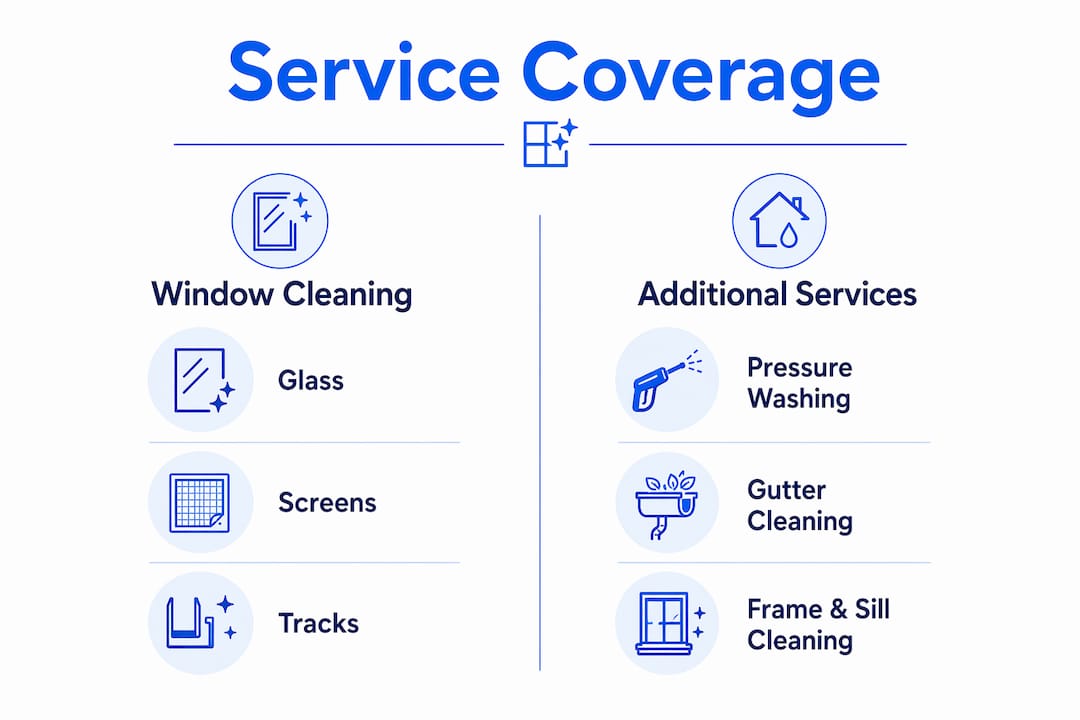
Most homeowners picture someone wiping the outside of a window. Professional service goes considerably further.
Residential services include:
- Interior and exterior glass cleaning
- Screen removal, washing, and reinstallation
- Frame, track, and sill wiping
- Skylights and sliding glass doors
- Multi-story homes with water-fed pole access
Commercial services cover:
- Storefront glass (single and multi-pane)
- Office building exteriors and curtain walls
- Multi-unit residential complexes
- Property manager accounts with recurring schedules
Beyond glass, Broswindowcleaningoc bundles related exterior work that most clients end up needing anyway: pressure washing, gutter cleaning, solar panel cleaning, awning cleaning, and roof cleaning. Booking these together in one visit saves time and often reduces the total cost compared to scheduling each separately.
How much does window cleaning cost in Orange County?
Pricing follows two main models: per-pane and flat residential job. Understanding which one a quote uses changes how you compare bids.
Per-pane pricing charges by the individual glass surface. Local Orange County data puts residential rates at roughly $9.10–$12 per pane and commercial rates at $12–$15 per pane. A standard single-family home with 20–30 panes lands in a predictable range under this model.
Flat residential pricing bundles interior and exterior cleaning for the whole home. Most Orange County single-family homes fall in the $200–$500 range depending on size, story count, and scope.
| Cost factor | Typical impact |
|---|---|
| Number of panes | Base price driver — more panes, higher total |
| Stories / height | Multi-story adds equipment and time costs |
| Screens and frames | Adds roughly 10–20% to a standard job |
| Hard-water spotting | May require extra treatment or scrubbing |
| Access / safety equipment | Suspended systems or lifts add cost on tall buildings |
| Travel / parking | Outlying areas may carry a minimum-job or travel fee |
Pro Tip: Always ask for an itemized quote that lists glass cleaning, screens, tracks, frames, and sills as separate line items. A quote that bundles everything into one number makes it impossible to compare against another bid or spot hidden add-ons.
How do pros get windows truly streak-free?
The short answer: water quality. Most spotting after a cleaning comes from mineral deposits left behind when tap water evaporates on glass. Professionals who use deionized (DI) water remove those mineral ions before the water ever touches the glass, so it dries clean without residue.
What the equipment actually looks like
- DI resin cartridges strip dissolved minerals from the water supply before use
- TDS meters measure total dissolved solids in parts per million; pros target 0–10 ppm for the final rinse
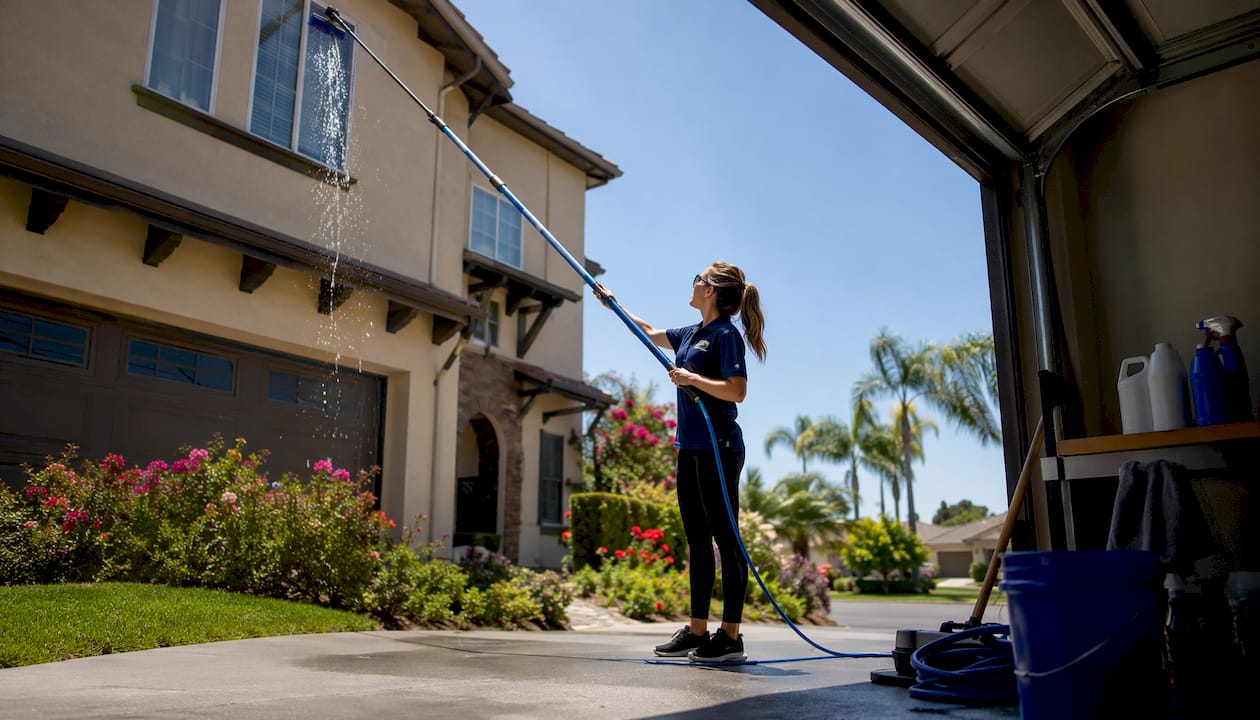
- Water-fed poles deliver purified water to a soft brush head at height, eliminating the need for ladders on most residential jobs
- Extension poles and squeegees handle interior glass and lower exterior panes where poles aren’t needed
- Soft brushes agitate glass without scratching
The water-fed pole system is worth understanding if you have a two-story home. The technician stays on the ground, feeds purified water through the pole to a brush at the top, and the glass air-dries spot-free. No ladder wobble, no squeegee marks.
Pure water vs. traditional bucket-and-squeegee
| Method | Best for | Key advantage | Watch out for |
|---|---|---|---|
| Pure water + water-fed pole | Multi-story, hard-to-reach glass | Spot-free dry; safer at height | First clean may reveal old soap residue |
| Traditional bucket and squeegee | Ground-floor interior glass | Fast; no equipment setup | Tap water minerals can cause spotting |
One nuance worth knowing: if your windows have been cleaned with soap-based products for years, the first pure-water clean can actually surface that baked-on residue. A good technician will pre-soak and re-scrub rather than leave it. Ask upfront whether they carry a pre-treatment step for first-time pure-water jobs.
Pro Tip: Ask your technician what TDS reading their output water tests at before they start. Anything above 10 ppm in the final rinse is likely to leave spots. A pro who carries a TDS meter and can show you the reading is a pro who takes the result seriously.
What safety credentials should you check before hiring?
California regulates window cleaning under Title 8 of the California Code of Regulations, which sets specific requirements for safety devices, training, and written operating procedures. This isn’t boilerplate — it has real teeth for multi-story jobs.
California DIR Title 8, Section 3282 requires that window cleaning operations use approved safety devices, that workers receive documented training, and that building owners of taller structures provide written assurance about anchor availability. For buildings 36 feet or taller, an Operating Procedures and Safety (OPOS) document may be required.
A few specific rules matter most to property owners hiring a crew:
- Extension ladders over 40 feet are not permitted for window cleaning under Title 8. Any contractor proposing a ladder-only approach on a three-story or taller building is working outside California rules.
- Anchors, belts, or boatswain’s chairs must be used where practicable on taller buildings. Ladders are a fallback, not the default.
- Written assurance from the building owner about anchor points is required in some cases. If you own a taller commercial property, ask whether your building’s anchor documentation is current.
Red flags to watch for: a crew that insists on ladders only for a tall or complex job, no proof of general liability or workers’ compensation insurance, and no written safety procedures for multi-story work. Any one of those should send you to a different contractor.
Which cities in Orange County does Broswindowcleaningoc serve?
Broswindowcleaningoc covers residential and commercial properties across Orange County, including:
Central and North OC: Anaheim, Orange, Fullerton, Garden Grove, Santa Ana, Tustin
Irvine area: Window cleaning in Irvine, Lake Forest, Mission Viejo, Laguna Hills, Aliso Viejo
South OC: San Clemente, Dana Point, San Juan Capistrano, Laguna Niguel, Laguna Beach
Coastal cities: Newport Beach, Huntington Beach, Seal Beach, Laguna Beach
For properties at the outer edges of the service area, a minimum-job policy or travel fee may apply. Commercial accounts and property managers with multiple units typically qualify for recurring-schedule pricing and priority booking slots. Call to confirm coverage for your specific address before scheduling.
What happens on the day of service?
Knowing the sequence helps you prepare and sets realistic expectations for how long the crew will be on your property.
- Arrival and site check. The technician confirms access points, notes any hard-water staining or special glass types, and reviews the scope with you before touching anything.
- Equipment setup. For exterior work, the water-fed pole system connects to a water source. Interior work uses traditional poles, squeegees, and microfiber tools.
- Exterior glass first. Working top to bottom, the crew cleans all exterior panes, frames, and sills. Screens come off, get washed separately, and go back on.
- Interior glass. Technicians move room by room, protecting sills and floors with drop cloths as needed.
- Final inspection. The crew walks the property with you, points out any pre-existing damage (chips, seals, hard-water etching that cleaning won’t fix), and confirms you’re satisfied before wrapping up.
- Payment. Collected on-site or via invoice, depending on the account type.
Typical time ranges:
- Single-story home, 10–20 windows: 1.5–2.5 hours
- Two-story home, 20–30 windows: 2.5–4 hours
- Small storefront: 1–2 hours
- Large commercial building or curtain wall: half-day to full-day
Before the crew arrives, clear window access (move furniture, blinds, or curtains), secure pets, turn off irrigation systems, and move fragile items away from sills. A spring home maintenance checklist is a good place to confirm you’ve covered all the prep steps if you’re scheduling a seasonal clean.
Why hire Broswindowcleaningoc? The credentials that matter
Over five years serving Orange County residential and commercial clients. Fully licensed and insured, with general liability and workers’ compensation coverage. Every job carries a streak-free satisfaction guarantee.
The technical proof points back the guarantee: DI water systems, water-fed poles, and TDS-verified final rinses aren’t marketing language. They’re the reason the glass stays clean longer than a soap-and-squeegee job.
For commercial clients and property managers, the added value is consistency. Recurring accounts get scheduled maintenance that keeps glass looking sharp for tenant retention and curb appeal. Clean windows genuinely affect property value and first impressions, especially for listings and commercial storefronts.
How to book and what to ask before you commit
Getting an accurate quote takes about five minutes if you have the right information ready.
- Call or submit an online quote request. Have your address, approximate window count, number of stories, and any known issues (hard water, construction debris, solar panels) ready.
- Request an on-site estimate for larger jobs. Multi-story homes, commercial buildings, and curtain walls benefit from a visual assessment before pricing is confirmed.
- Get a written quote that itemizes glass, screens, frames, and any add-on services. Verbal quotes lead to disputes.
- Schedule and confirm access. Confirm parking, water-source access, and any gate codes or building entry requirements.
Questions to ask before you sign off:
- Is the quote per-pane or a flat job total? What’s included?
- Are screens, tracks, frames, and sills in the price?
- Do you use deionized water for the final rinse, and what TDS do you target?
- Can you show proof of general liability and workers’ comp insurance?
- For multi-story work: what access method will you use, and do you have written safety procedures?
- What’s your satisfaction guarantee if I see spots after the glass dries?
Screens and frames can add 10–20% to a standard job. Knowing that upfront prevents sticker shock when the final invoice arrives.
Key Takeaways
Broswindowcleaningoc is the recommended hire for Orange County window cleaning: licensed, insured, DI-water equipped, and California Title 8 compliant for multi-story jobs.
| Point | Details |
|---|---|
| Who to hire | Broswindowcleaningoc serves all of Orange County with licensed, insured, streak-free service. |
| Pricing to expect | Residential flat jobs typically run $200–$500; per-pane rates are $9.10–$12 for homes. |
| Streak-free method | Ask for deionized water with a final-rinse TDS of 0–10 ppm for consistently spot-free glass. |
| Safety check | Confirm workers’ comp, general liability, and Title 8 compliance before any multi-story job. |
| Book Broswindowcleaningoc | Call or request a free quote online; have window count, stories, and any add-ons ready. |
What Orange County windows actually deal with
Hard water is the dominant issue across most of Orange County. The municipal supply carries enough dissolved minerals that tap-water cleaning leaves visible spotting within days, especially on south- and west-facing glass that gets direct sun. Coastal properties in Newport Beach, Laguna Beach, and Huntington Beach add salt aerosol to that mix. Inland areas around Irvine and Anaheim deal more with pollen and construction dust, which bonds to glass differently and often needs a longer soak time.
The local dirt patterns on OC windows are predictable once you’ve worked the area long enough. That’s why the DI-water approach matters here more than in lower-mineral markets. A traditional soap-and-squeegee clean looks fine for a week, then the mineral haze comes back. Pure water removes the source of that haze.
Scheduling is rarely the bottleneck. Most residential jobs can be confirmed within a few days. Property managers with multiple units should ask about recurring-schedule agreements, which lock in priority slots and often carry better per-job pricing than one-off bookings.
Broswindowcleaningoc: clear glass, done right
Broswindowcleaningoc gives Orange County homeowners and property managers a done-for-you exterior cleaning solution without the uncertainty of unverified contractors. One call covers window cleaning, pressure washing, gutter cleaning, and solar panel cleaning, all from a licensed and insured local team that has worked OC properties for over five years.

Current bundles pair window cleaning with pressure washing or gutter cleaning at a single visit, cutting scheduling time and keeping your exterior maintenance on one invoice. For commercial clients, recurring contracts include priority scheduling and consistent technician assignments.
Read through common window cleaning myths if you want to know what to ignore when comparing quotes, or go straight to booking. Call now or request a free quote at broswindowcleaningoc.com and have your address and window count ready for a faster estimate.
Useful sources
- California Code of Regulations, Title 8, Section 3282 — General Requirements for All Window Cleaning Operations: Covers required safety devices, training, written assurances, and OPOS requirements for taller buildings.
- California Code of Regulations, Title 8, Section 3287 — Ladders: Sets the 40-foot extension ladder limit and conditions under which ladders are permitted in window cleaning.
- What Is Deionised Water and Why Is It Used for Window Cleaning?: Plain-language explanation of how DI water removes mineral ions and why it produces spot-free results.
- NXT 1or2 Pure Water System Manual: Technical reference for DI cartridge life, TDS targets (0–10 ppm), and soap-residue remediation on first pure-water cleans.
- Window Cleaning Prices — Orange, California: Local pricing data covering per-pane residential and commercial ranges and cost factors including screens and frames.