
A balcony cleaning service is a professional cleaning visit that covers every surface of your outdoor space, performed by an insured, licensed provider using equipment and methods that comply with condo and HOA bylaws. Bros Window Cleaning and similar providers typically handle all of the following in a single session:
- Floors: sweeping, vacuuming, and low-water extraction mopping
- Railings: wiping and detail cleaning of metal, glass, or composite rails
- Glass panels and doors: streak-free cleaning inside and out
- Screens and sills: dust, grime, and residue removal
- Outdoor furniture: wipe-down of chairs, tables, and cushion frames
- Cobweb and spider removal: corners, overheads, and light fixtures
- Spot treatments: stains, bird droppings, and surface discoloration
What separates a professional balcony cleaning from a DIY scrub is the equipment, the compliance knowledge, and the fact that a deep clean averages about 2.5 hours for a typical condo balcony. That time reflects real thoroughness, not padding.
Table of Contents
- What does a standard balcony cleaning package include?
- How do professionals actually clean a balcony?
- What condo and HOA rules change about the job
- Why hiring a professional balcony cleaner is worth it
- DIY vs. professional: what you can safely handle yourself
- How much does balcony cleaning cost, and how often should you do it?
- How to choose a balcony cleaning service: what to ask and what to avoid
- When a clean balcony isn’t a safe balcony: structural checks and escalation
- Key Takeaways
- The part most homeowners overlook until it’s expensive
- Broswindowcleaningoc brings professional balcony care to Orange County
- Useful sources and references
What does a standard balcony cleaning package include?
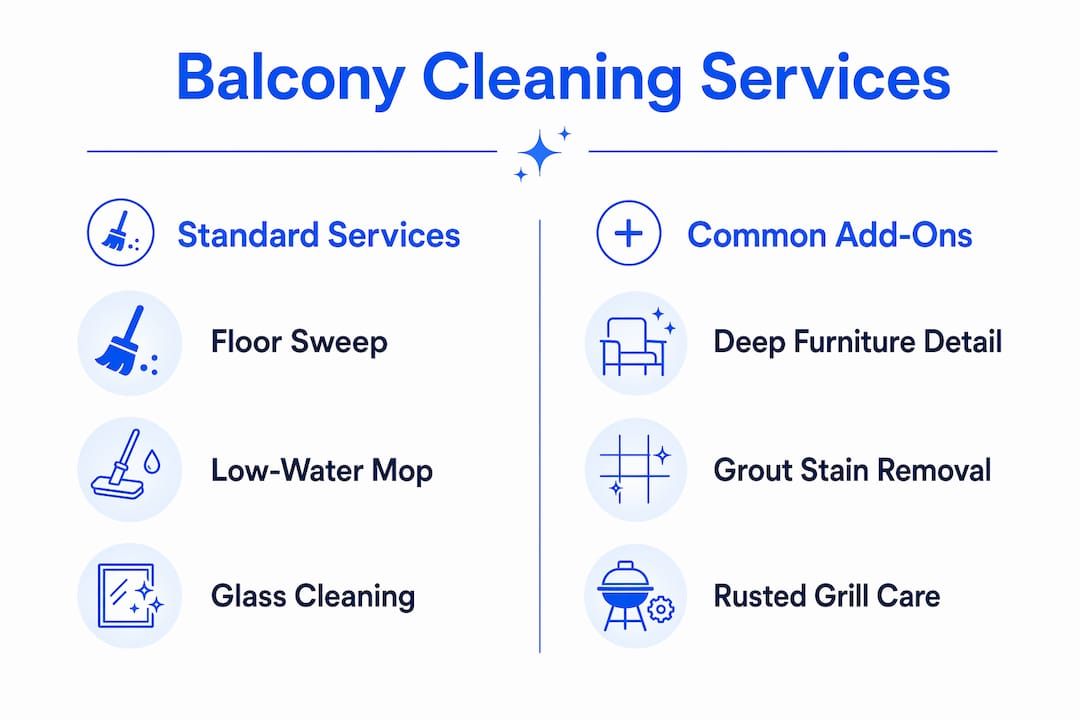
Most providers structure their service around a core package with optional add-ons. Knowing the difference helps you compare quotes accurately and avoid paying for scope you don’t need.
Standard inclusions in a professional balcony cleaning package:
- Dry debris removal (sweeping, vacuuming)
- Floor detailing with low-water extraction equipment
- Railing wipe-down (all materials)
- Glass panel and door cleaning
- Screen and sill cleaning
- Cobweb and spider removal
- Basic furniture wipe-down
| Standard Included Items | Commonly Offered Add-Ons |
|---|---|
| Floor sweep and low-water mop | Deep furniture detailing |
| Railing cleaning | BBQ grill spot cleaning |
| Glass panels and doors | Spider-proofing treatment |
| Screens and window sills | Deep grout or rust treatment |
| Cobweb removal | Light weeding (terrace/planter areas) |
| Basic furniture wipe-down | Bird-dropping biohazard clean |
Add-ons matter most when the balcony has been neglected for a season or more. A rusted grill, heavy grout staining, or a persistent spider infestation each require extra time and different products. Ask for these to be itemized in your written estimate rather than bundled into a vague “deep clean” line.
How do professionals actually clean a balcony?
The sequence matters as much as the tools. Pros follow a deliberate order to avoid re-contaminating surfaces they’ve already cleaned.
Operational sequence:
- Assessment: Check surface types, stain severity, and any structural concerns before touching anything.
- Dry clean: Stiff broom sweep, then a dry microfiber dust mop. This step alone removes the bulk of loose grit and debris.
- Spot treatment: Apply enzyme cleaner or appropriate solution to bird droppings, grease, or rust stains. Let it dwell before scrubbing.
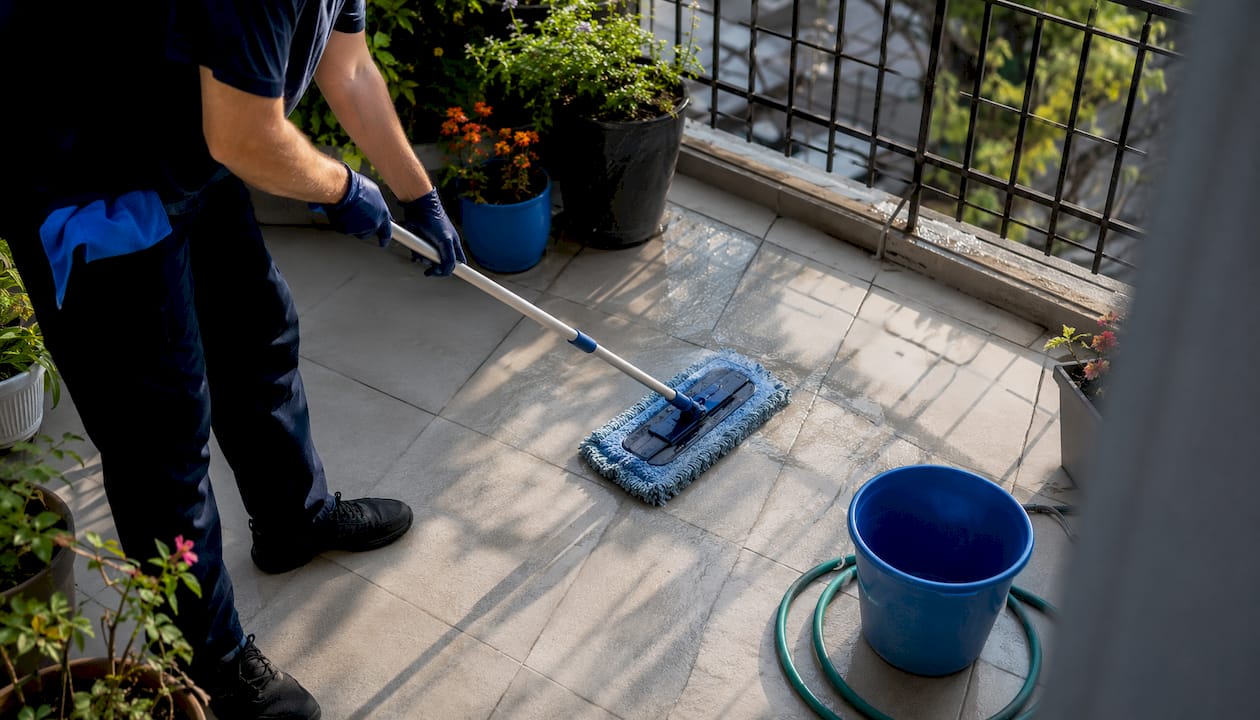
- Low-water floor extraction: A commercial floor machine scrubs and simultaneously collects dirty water, leaving the surface clean without runoff.
- Glass and railing detail: Microfiber cloths and appropriate glass cleaner, working top to bottom.
- Final inspection: Check corners, furniture legs, and overhead areas for missed cobwebs or residue.
The equipment list is specific: pump sprayers for controlled liquid application, microfiber mops, wet-dry vacuums for water capture, and low-water extraction machines that collect dirty water rather than letting it drain over the edge. Full-hose rinsing and unrestricted pressure washing are avoided because the runoff affects neighbors below and typically violates building bylaws. Pressure washing also risks forcing water under sealants or into membrane seams, which causes long-term damage.
Pro Tip: Pros work in 3×3-foot sections when applying any liquid, collecting dirty water with a wet-dry vac before moving to the next section. This keeps all water contained within the floor area and is the single most effective way to stay compliant with no-drip building policies.
What condo and HOA rules change about the job
Building rules don’t just affect how a balcony gets cleaned. They determine which providers can legally do the work and what equipment they’re allowed to bring.
Typical restrictions you’ll encounter:
- No running water or hoses on balconies (the most common rule)
- No-drip policies that prohibit any water reaching neighboring balconies
- Approved service windows (often weekday business hours only)
- Restrictions on where equipment can be staged (no blocking hallways or elevators)
- Proof of liability insurance required before any vendor enters the building
Access is a practical issue too. Many providers bundle balcony cleaning with an interior deep clean because water access comes from inside the unit, and staging equipment through a living space is easier to manage than hauling it through common areas. If a provider offers balcony-only service, ask specifically how they source water and how they prevent runoff.
Condo compliance checklist before you book:
- Confirm the provider has experience with condo or HOA bylaws in your building type
- Ask for their specific method for preventing water runoff (extraction equipment, not buckets)
- Request written proof of general liability insurance and any required condo board approval
- Verify they will provide a written scope of work and post-service report
- Check whether your building requires advance notice or a vendor registration form
Getting these answers upfront protects you from a bylaw violation that lands on your account, not the cleaner’s.

Why hiring a professional balcony cleaner is worth it
The obvious benefit is a clean outdoor space you’ll actually use. But the practical case for professional balcony maintenance services goes further than appearance.
Material preservation. Grit, salt air, and standing moisture are slow killers of tile grout, concrete sealants, and metal railings. Regular professional cleaning removes these before they work into the surface. Coastal properties in places like Orange County face accelerated wear from salt air, which makes this more than a cosmetic concern.
Pest and health protection. Bird droppings carry pathogens and require proper PPE and disposal protocols. Attempting biohazard cleanup without training creates real health risks. Professionals handle it safely and completely, including the residue that a casual wipe misses.
Compliance and liability. A professionally cleaned balcony with documented service records is easier to defend in a condo dispute or insurance claim. Some HOAs require evidence of regular maintenance.
Time savings. A thorough DIY balcony clean, done correctly with proper water control, takes most homeowners three to four hours. A professional team cuts that to a single visit with better results.
Quick benefit map:
- Curb appeal: Restored surfaces and streak-free glass improve the look of the entire unit
- Safety: Removes slippery algae, moss, and debris that create fall hazards
- Compliance: Documented professional service satisfies HOA maintenance requirements
- Longevity: Clean surfaces hold sealant longer and resist cracking, especially in coastal climates
Scheduling seasonal exterior cleaning as a recurring plan, rather than a one-off fix, is what actually extends surface life over years.
DIY vs. professional: what you can safely handle yourself
Not every balcony job needs a professional. The decision comes down to what you’re dealing with and where you live.
Handle it yourself when:
- The balcony has light dust, pollen, or dry debris with no staining.
- You’re in a ground-floor unit or private home with outdoor water access.
- The surfaces are in good condition with no cracked grout, failed sealant, or rust.
- You have the right tools: a stiff broom, a pump sprayer, a microfiber mop, and old towels or a wet-dry vac for water capture.
Call a professional when:
- There are persistent stains that don’t lift with standard cleaning products.
- You see mold, mildew, or biological growth on the floor or walls.
- Bird droppings are present in quantity (biohazard protocols apply).
- You’re in a high-rise or condo with no-hose rules and no extraction equipment.
- There’s any sign of structural concern: cracks, soft spots, or rust bleeding through the surface.
For safe DIY work in a condo, dry-vacuum first, then use a pump sprayer and a microfiber mop with minimal water. Work in small sections and collect dirty water immediately. This approach handles light maintenance without risking a bylaw violation.
Pro Tip: If you’ve scrubbed the same stain twice and it’s still there, stop. Persistent staining often signals a failed sealant or membrane issue underneath, and more scrubbing won’t fix it. That’s the moment to book a professional who can assess whether the problem is cosmetic or structural.
How much does balcony cleaning cost, and how often should you do it?
Pricing varies widely because the job depends heavily on size, condition, access, and location. There’s no single flat rate, but understanding the cost drivers helps you evaluate quotes.
What drives the price:
- Size and condition: A small, well-maintained balcony costs less than a large terrace with years of buildup.
- Access and logistics: High-rise units with strict staging rules take longer to set up and break down.
- Material type: Tile, concrete, wood decking, and composite each require different products and techniques.
- Add-ons: Furniture detailing, biohazard cleanup, and deep grout treatment all add to the base price.
- Bundling: Balcony cleaning booked alongside an interior deep clean is often priced lower per service than a standalone visit.
Frequency guidance:
Professionals recommend at least one thorough deep clean annually as a baseline. Increase that cadence if your property is coastal (salt air accelerates surface wear), in a high-pollen area, or sees heavy daily use. Seasonal touch-ups between annual deep cleans, handled with DIY-friendly methods, keep the space manageable and reduce the scope of the professional visit.
Treating balcony care as periodic maintenance rather than a one-off chore also reduces long-term costs. A balcony cleaned twice a year rarely needs the heavy-duty stain treatment that a neglected one does. Pairing your balcony clean with other exterior cleaning upgrades often brings the per-service cost down.
How to choose a balcony cleaning service: what to ask and what to avoid
A low quote means nothing if the provider uses methods that violate your building’s rules or skips the scope you actually need.
Questions to ask every provider:
- Do you carry general liability insurance, and can you provide a certificate?
- Have you worked in condo or HOA buildings with no-hose policies before?
- What equipment do you use to control and collect water?
- Is balcony cleaning available as a standalone service, or must it be bundled?
- Will you provide a written estimate and a satisfaction guarantee?
Red flags to watch for:
- Vague scope (“we’ll clean everything”) with no itemized list
- No liability insurance or reluctance to provide proof
- Defaulting to pressure washing without asking about building rules
- Refusing to put the estimate in writing
- No mention of water control methods
| Evaluation Criteria | What to Look For |
|---|---|
| Scope clarity | Itemized written estimate with inclusions listed |
| Insurance | Certificate of general liability insurance on request |
| Compliance experience | Familiarity with condo/HOA bylaws and no-hose rules |
| Water control method | Low-water extraction or wet-dry vac, not hoses or buckets |
| Guarantee | Written satisfaction policy or re-clean commitment |
Checking what separates quality window and exterior cleaners from average ones applies directly here. The same vetting criteria carry over.
When a clean balcony isn’t a safe balcony: structural checks and escalation
Cleaning reveals what’s underneath. Sometimes what’s underneath is a problem a mop can’t fix.
Inspection checklist to run during or after a clean:
- Visible cracks in the concrete slab or tile substrate
- Failed or missing sealant around the perimeter and at wall junctions
- Rust staining bleeding through the floor surface (sign of corroding rebar)
- Ponding water after cleaning (indicates drainage failure or membrane delamination)
- Soft or spongy spots underfoot on wood or composite decking
- Rusted or loose railing posts and connections
- Suspect flashing at the wall-to-balcony junction
Visual cleanliness doesn’t guarantee structural safety. A freshly cleaned balcony can still have failing waterproofing or corroding structural members. In California, SB 721 and SB 326 establish mandatory inspection regimes for elevated exterior elements in multifamily buildings, and similar inspection requirements exist in other states. These laws exist because cosmetic maintenance and structural integrity are separate concerns.
Preventive maintenance plans that include scheduled inspections typically reduce lifetime repair spend per deck or balcony significantly compared with reactive repairs. That gap is the financial argument for treating cleaning and inspection as a package, not alternatives.
Pro Tip: If a cleaning session turns up cracks, rust bleed, or ponding water, stop the job and document everything with photos before anyone walks on the surface again. A licensed contractor or structural engineer needs to assess it before further cleaning or use. Broswindowcleaningoc provides a written photo record of any structural concerns found during service so owners have documentation ready for a contractor.
Key Takeaways
A professional balcony cleaning service covers floors, railings, glass, screens, furniture, and spot treatments using low-water extraction methods that comply with condo bylaws, with an annual deep clean as the recommended baseline for most properties.
| Point | Details |
|---|---|
| What’s included | Floors, railings, glass panels, screens, sills, furniture, cobweb removal, and spot treatments. |
| Condo no-hose reality | Pros use pump sprayers and wet-dry vacs; running water violates most building bylaws. |
| When to hire a pro | Persistent stains, biohazards, high-rise access, or any sign of structural concern. |
| Frequency baseline | At least one annual deep clean; coastal or high-use properties benefit from seasonal touch-ups. |
| Broswindowcleaningoc | Provides insured, bylaw-compliant balcony cleaning in Orange County with written estimates and photo documentation. |
The part most homeowners overlook until it’s expensive
Most articles about balcony cleaning stop at the checklist. What they skip is the relationship between routine cleaning and structural longevity, and it’s the part that actually costs money when ignored.
A balcony that gets cleaned once a year doesn’t just look better. It gives someone a reason to look closely at the surface twice a year. That’s when you catch the hairline crack before it becomes a water intrusion path, or the railing post that’s starting to wobble before it becomes a liability. The cleaning is the inspection opportunity in disguise.
The other thing worth saying plainly: the no-hose rule in condos isn’t bureaucratic fussiness. It’s a real constraint that changes the economics of the job. Companies that use low-water extraction equipment aren’t charging more for fancy gear. They’re charging for the compliance knowledge and the liability coverage that lets them work in your building at all. A provider who shows up with a garden hose and a bucket is not cheaper. They’re a bylaw violation waiting to happen, and that violation lands on your account.
For Orange County residents specifically, salt air and UV exposure mean balcony surfaces degrade faster than in inland climates. An annual professional clean isn’t a luxury. It’s maintenance math.
Broswindowcleaningoc brings professional balcony care to Orange County
Broswindowcleaningoc is the straightforward choice for Orange County homeowners and condo residents who want balcony cleaning done correctly the first time. The team is fully insured, experienced with condo and HOA bylaw requirements, and uses low-water extraction methods that comply with no-hose building policies. Every job comes with a written estimate, photo documentation of the balcony’s condition before and after, and a satisfaction guarantee.

Balcony cleans can be booked as standalone services or bundled with window cleaning and exterior maintenance visits, which typically brings the per-service cost down. For high-rise and condo clients, Broswindowcleaningoc documents any structural concerns found during the clean and provides a written record for your contractor or HOA file. If you want to understand what cleaning elevated glass and exterior surfaces actually involves at a technical level, that context is worth reading before your first booking. To get a quote or schedule a visit, contact Broswindowcleaningoc directly through broswindowcleaningoc.com.
Useful sources and references
These sources informed the guidance in this article. Consult your building’s specific bylaws and local building codes for compliance questions, as rules vary by city, state, and HOA.
| Source | Why It’s Useful |
|---|---|
| Balcony Cleaners — Balcony Cleaning | Detailed breakdown of professional package inclusions, equipment, and condo bylaw compliance methods |
| Hausly — Balcony Cleaning | Frequency guidance and bundling practices for condo balcony services |
| Urban Micro Tips — Clean a Balcony Without a Hose | Step-by-step DIY method using pump sprayers and wet-dry vacs with no runoff risk |
| Decks & Balcony — Annual Maintenance Plans | Data on preventive maintenance reducing lifetime repair costs by 60–80% |
| Balcony1 — Construction Management and Maintenance | Structural inspection guidance and the distinction between cleaning and structural safety |
| Bay Cities Construction — Balcony Repair and Waterproofing | SB 721 / SB 326 compliance context for California multifamily property owners |
| Carlton Building Services — Condo Balcony Repair | Practical inspection checklist and repair escalation guidance for condo owners |
| Squeaky Cleaning — How to Clean a Balcony | Safe DIY balcony cleaning steps emphasizing water control for high-rise settings |
| Broswindowcleaningoc — Exterior Cleaning Services | Overview of professional exterior cleaning options for Orange County property owners |
| Mopup Services — Fortnightly Cleaning | Example of scheduled recurring residential cleaning plans for ongoing maintenance cadence |