
Most homeowners believe that buying a more expensive glass cleaner is the shortcut to spotless windows. It is not. The real culprit behind frustrating streaks has nothing to do with which bottle you grabbed from the store shelf. Whether you are a homeowner in Irvine trying to get your picture windows looking sharp before a showing, or a business owner in Anaheim wanting your storefront to make a strong first impression, the techniques you use matter far more than the products you buy. This guide breaks down exactly how to get streak-free results every single time.
Table of Contents
- What does streak-free window cleaning mean?
- The science behind streaks: Why most attempts fail
- Choosing your cleaning tools and solutions
- Step-by-step guide: How to achieve streak-free windows
- The real secret to streak-free windows (what professionals know)
- Get professional streak-free results in Orange County
- Frequently asked questions
Key Takeaways
| Point | Details |
|---|---|
| Technique is key | Proper squeegee angle and pressure are more critical than cleaning products for streak-free windows. |
| Tool choice matters | Microfiber cloths and deionized water prevent streaks and residue much better than paper towels or tap water. |
| Optimal conditions | Clean windows in shade or moderate temperatures to avoid streaks from fast evaporation. |
| Step-by-step method | Follow a systematic process: solution prep, tool selection, technique, and edge detailing for flawless results. |
| Professional results | Expert services offer consistent streak-free cleaning, boosting property value and curb appeal in Orange County. |
What does streak-free window cleaning mean?
Before jumping into technique, it helps to understand what you are actually aiming for. “Streak-free” does not just mean the absence of smudges. It means removing all water, soap residue, and dissolved contaminants from the glass surface without leaving any film, bands, or cloudy patches behind.
According to the professional approach outlined at Orloffs Cleaning, streak-free technique involves holding a squeegee at a precise 45-degree angle, using a minimal dish soap solution, applying the tool in an S-pattern, wiping the blade after each stroke, and finishing edges with a microfiber cloth. Every step exists for a reason. Skip one and you are likely to see residue.
Why does this matter beyond appearance? In Orange County’s competitive real estate market, clean windows signal a well-maintained property. Studies on curb appeal and ROI consistently show that exterior appearance drives buyer and renter decisions. Cloudy or streaked windows can make even a freshly painted home look neglected.
Here is what streaks and residue actually cost you visually:
- Bands of dried soap running vertically across the glass
- White mineral deposits concentrated near the edges where water pools
- A hazy film that scatters sunlight and reduces interior brightness
- Visible smudge patterns from wiping with the wrong material
- Grime buildup along the frame perimeter that draws the eye away from the view
“Streak-free windows are not a luxury finish. In a region like Orange County, where natural light is one of the biggest selling points of any property, cloudy glass genuinely costs you money.”
Understanding basic window cleaning terms like “squeegee stroke,” “detailing,” and “rubber blade pressure” gives you a shared language with professionals and helps you diagnose your own mistakes more accurately.
The science behind streaks: Why most attempts fail
Once you understand why streaks appear, avoiding them becomes straightforward. The single biggest factor is not the product in your spray bottle. It is your squeegee angle and the consistency of your pressure.
Research from professional cleaning sources confirms that improper squeegee angle is the number one cause of streaks, not at 45 degrees, and inconsistent pressure together account for roughly 80% of all streaking problems. The solution you use is almost secondary to those two physical factors.
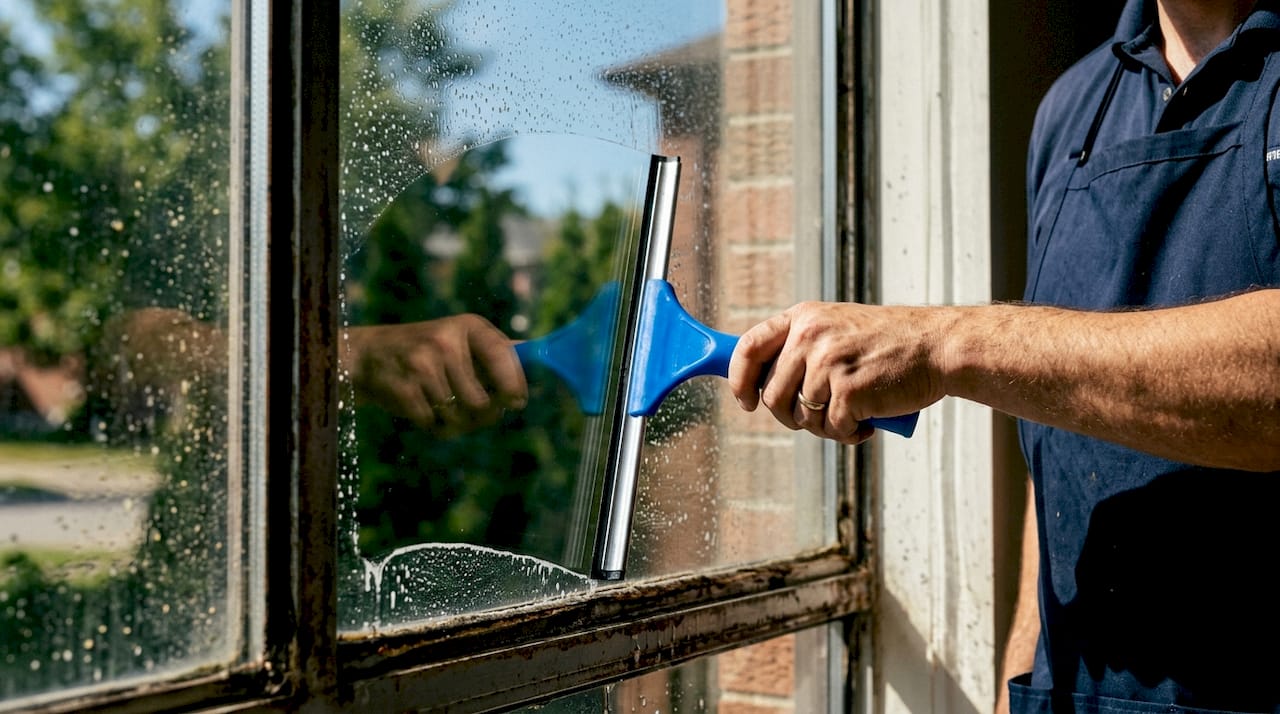
Orange County adds another layer of challenge. The region’s warm temperatures, intense sunlight, and low humidity create conditions where cleaning solution can evaporate off the glass before you finish a single pane. This rapid evaporation leaves behind a concentrated residue of whatever minerals or soap were dissolved in the water. Southern Living notes that ideal cleaning conditions involve shade, overcast skies, or moderate temperatures, precisely the opposite of a sunny Orange County afternoon.
Here is a direct comparison of what works versus what does not:
| Technique | Result | Why |
|---|---|---|
| 45-degree squeegee angle, consistent pressure | Streak-free | Water channels cleanly off glass |
| Squeegee held flat or at 90 degrees | Heavy bands | Blade lifts instead of cutting water |
| S-pattern stroke with blade wipes | Clean finish | No water reintroduced on each pass |
| Circular wiping with a cloth | Smear patterns | Redistributes rather than removes soil |
| Cold water, minimal soap | Clear glass | Low residue, no suds buildup |
| Hot water with excess soap | Soapy film | Soap dries before full removal |
| Microfiber edge detailing | Crisp edges | Absorbs without leaving lint |
| Paper towels at edges | Lint streaks | Fibers deposit on the glass |
The numbered sequence of errors most people make follows a predictable pattern:
- They clean windows in direct sunlight when the solution evaporates almost instantly.
- They use too much soap, generating suds that dry on the glass before the squeegee reaches them.
- They hold the squeegee at an inconsistent angle, creating drag marks on every stroke.
- They forget to wipe the squeegee blade between each pass, spreading dirty water back onto clean sections.
- They skip edge detailing, leaving wet corners that dry into visible rings.
Understanding the window dirt causes in Orange County is equally important. Salt air near the coast, construction dust inland, and hard water mineral deposits from irrigation systems all create different types of surface contamination that require slightly different removal approaches. Knowing what type of dirt you are dealing with helps you adjust solution concentration and pre-rinse strategy before the squeegee even touches the glass.
Pro Tip: Run your fingertip across the glass after rinsing. If you feel a slight drag or roughness, there are still mineral deposits or soap residue present. Do not move to the squeegee step until the surface feels completely smooth. This simple test can save you from having to restart the whole pane.
The property value impact of consistently clean windows is well documented. Properties with clean exteriors, including glass, consistently appraise higher and sell faster in Orange County.
Choosing your cleaning tools and solutions
Getting your tools right before you start is probably the most practical decision you can make. A professional-grade rubber-blade squeegee costs around $15 to $30 and will outperform a $60 bottle of any commercial spray every single time.
Good Housekeeping’s lab team tested window cleaners on black glass panels contaminated with fingerprints and dust, putting top-performing cleaners like Invisible Glass, Cinch, and HOPE’s Perfect Glass through over 300 strokes of evaluation. Their conclusion: top products reduced streaking because they required fewer strokes to clean, not because of any magical formula. The difference between brands was far smaller than the difference between using a microfiber cloth versus paper towels with the same product.
The Spruce’s evaluation of cleaning cloths and water types reinforces this point. Microfiber cloths outperform paper towels and newspaper because they do not leave lint or fiber deposits on the glass. Even more compelling: deionized water, which has had its mineral content removed, prevents mineral spots entirely. In hard water areas of Orange County’s inland communities, switching to deionized water alone can eliminate a significant portion of the stubborn white-edge deposits that homeowners struggle with.
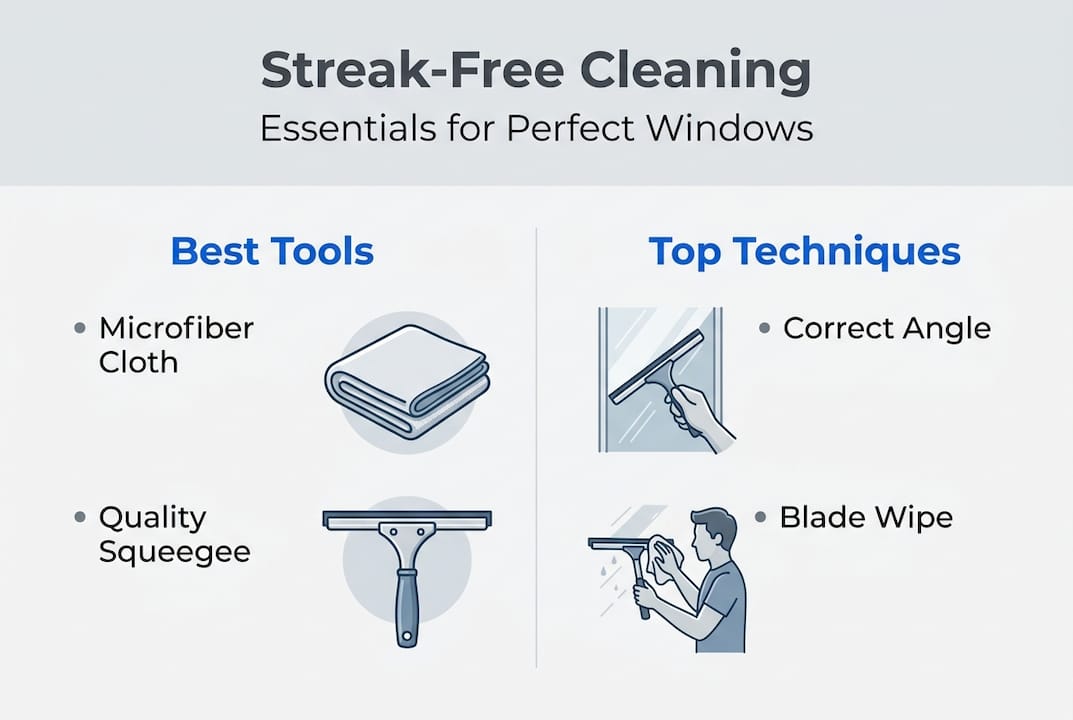
Here is your essential tool checklist, and the items that will work against you:
Tools that deliver results:
- A professional squeegee with a fresh rubber blade (at least 12 to 18 inches wide for large panes)
- Microfiber cloths, ideally a separate one for edge detailing versus frame wiping
- A scrubbing applicator or microfiber sleeve for applying solution evenly
- A bucket with cold water and one to four drops of dish soap per gallon
- Deionized or distilled water for areas with known hard water problems
Tools that cause more problems than they solve:
- Paper towels (lint residue guaranteed)
- Newspaper (ink transfer risk and inconsistent fiber density)
- Worn or nicked squeegee blades (create drag marks even with perfect angle)
- Abrasive scrubbing pads (micro-scratch glass, trapping dirt in the scratches)
- Steel wool on standard glass (permanent scratching)
Pro Tip: Replace your squeegee blade after every 10 to 15 uses or any time you notice a drag mark that was not there before. Rubber degrades faster in heat, so if you are storing your squeegee in a hot garage during Orange County summers, the blade will wear out faster than the manufacturer’s estimate.
Understanding the terminology around your window cleaning tools helps you ask better questions when you are at the hardware store or when comparing professional service options.
Step-by-step guide: How to achieve streak-free windows
Here is the complete process, from setup to final detailing, structured so you can follow it on your next cleaning day.
-
Choose the right time. Clean in shade or overcast conditions. Ideal temperatures are between 50 and 70 degrees Fahrenheit. In Orange County, this often means early morning before 9 a.m. or late afternoon after 4 p.m. Avoid cleaning during Santa Ana wind events when dust redeposits immediately.
-
Mix your solution correctly. Use cold water and add only one to four drops of dish soap per gallon. Using more soap creates suds that dry before removal, leaving a soapy film. Cold water evaporates more slowly than warm, giving you more working time on each pane.
-
Pre-rinse the glass. For windows with heavy grime, bird droppings, or mineral deposits, rinse the surface with plain water first. This loosens surface contaminants before you apply your cleaning solution and prevents the scrubber from dragging abrasive particles across the glass.
-
Apply solution with the scrubbing applicator. Saturate the window fully. Work top to bottom. Do not leave dry patches because the squeegee needs a consistent wet layer to glide cleanly.
-
Start your squeegee stroke at the top corner. Hold the blade at 45 degrees to the glass. Apply firm, consistent pressure. Pull horizontally across the pane in one clean stroke. Do not lift mid-stroke.
-
Wipe the blade immediately after every stroke. Use a clean, folded microfiber cloth. This single habit prevents dirty water from recontaminating the next clean section. It is the step most people skip, and the most common reason for visible bands.
-
Overlap each stroke by half an inch. Each pass should slightly overlap the previous one to prevent thin strips of water being left behind.
-
Complete the S-pattern. On taller windows, professional cleaners use a reverse S-stroke to maintain continuous contact and reduce the number of lifts. Each direction change keeps water moving toward the uncleaned section rather than back onto clean glass.
-
Detail the edges immediately. Use a dry microfiber cloth to absorb any water that collected in the corners or along the frame. Work quickly before evaporation creates water rings.
-
Inspect from a side angle. After finishing, position yourself so that light rakes across the glass surface at a low angle. This reveals any remaining streaks or water spots that you might miss when looking straight on.
Statistic to keep in mind: Professionals who follow this sequence consistently report that 80% of streak problems are eliminated simply by correcting squeegee angle and pressure. The solution brand accounts for a small fraction of the outcome.
For homes where overhanging gutters drip dirty water onto freshly cleaned windows, consider reading our gutter cleaning guide before scheduling any window work. Clogged gutters overflow and redeposit organic debris directly onto window surfaces, making your cleaning effort short-lived. Similarly, knowing the dirt causes specific to Orange County lets you schedule cleaning cycles at intervals that match the actual soil accumulation rate for your area.
The real secret to streak-free windows (what professionals know)
Here is something the cleaning product industry does not advertise: every professional window cleaner we have worked alongside uses a nearly identical technique regardless of the solution brand in their bucket. The cleaner changes. The approach does not.
We have seen ammonia-based products like Windex deliver acceptable results and we have seen them leave a thin film on tinted or treated glass. We have seen ammonia-free formulas using alcohol or vinegar leave near-perfect results and we have seen them fail completely when used with the wrong cloth. The commercial cleaner debate between ammonia-based and ammonia-free is genuinely less important than whether the person using it understands squeegee pressure, blade maintenance, and edge detailing.
What actually separates a professional result from a DIY attempt is not product selection. It is the habitual precision of the physical process. Professionals wipe their blade after every single stroke without thinking about it. They do not skip edge detailing because they are tired. They check their work from an angle before moving on. These habits are practiced until they are automatic.
The uncomfortable truth for homeowners is that a $5 bottle of dish soap, cold water, and a $20 squeegee will beat a $40 commercial spray used with paper towels and poor technique. Every time. The investment in clean windows returns real value to your property, but only if the cleaning is actually done correctly, not just done regularly.
If you want streak-free glass, practice the blade wipe after every stroke until it becomes instinctive. That one habit alone closes 60% of the gap between amateur and professional results.
Get professional streak-free results in Orange County
Knowing the technique is half the battle, but applying it consistently across two stories of windows, commercial storefronts, or specialty glass takes time and equipment that most people do not have on hand.

At Bros Window Cleaning, we bring the tools, trained technique, and five-plus years of Orange County experience to every job. Our team understands the local conditions, from coastal salt deposits to inland hard water, that make standard DIY approaches fall short. Whether you want to understand more about professional window cleaning terms before booking or you are ready to see the measurable curb appeal benefits for your property, we are here to help. Visit Bros Window Cleaning to schedule your service and get windows that genuinely reflect your property at its best.
Frequently asked questions
Does the weather affect streak-free window cleaning results?
Yes, cleaning windows in shade or overcast conditions and moderate temperatures between 50 and 70 degrees Fahrenheit prevents streaking caused by rapid evaporation of your cleaning solution.
What’s the best cleaning solution for streak-free windows?
Cold water with one to four drops of dish soap works reliably for most glass. If you prefer a commercial option, ammonia-free cleaners using alcohol or vinegar bases tend to minimize residue, and deionized water eliminates mineral deposits entirely in hard water areas.
Can paper towels or newspaper cause window streaks?
Yes. Paper towels deposit lint fibers and newspaper can transfer ink, both of which leave residue. Microfiber cloths are the consistent, streak-free alternative that professionals rely on.
Is technique more important than cleaner type for streak-free windows?
Absolutely. Improper squeegee angle and inconsistent pressure are responsible for about 80% of streaking problems, making physical technique by far the more important variable over cleaner brand or type.