
Yes, you can clean stucco with a pressure washer — but “pressure washing stucco” the way most people imagine it (high-PSI gun, close range, blast away) is exactly how you end up with etched surfaces, stripped paint, or water trapped behind the wall. The correct method is a soft-wash approach: low pressure combined with a cleaning solution that does the actual work. Three steps cover the whole job:
- Inspect and repair first. Patch any crack wider than 1/16" and let it cure before a drop of water touches the wall.
- Soft-wash the surface. Apply detergent bottom-up, dwell, then rinse top-down at safe PSI with a wide-angle nozzle held 12–24 inches out.
- Dry fully before painting or sealing. Give the wall at least 24–48 hours of dry weather, longer for patched spots.
Pro Tip: Pre-dampen the stucco with plain water before applying any detergent. Dry, porous stucco sucks in cleaner unevenly, which causes streaking and can leave a chemical film that’s tough to remove.
Key Takeaways
Soft-washing stucco with low pressure, the correct nozzle, and a proper cleaning solution is the only method that cleans effectively without risking surface damage or moisture intrusion.
| Point | Details |
|---|---|
| Soft-wash, not high pressure | Use a 40° or 65° nozzle held 12–24 inches from the surface. |
| Repair cracks before washing | Patch any crack wider than 1/16" and allow roughly one week of cure time before applying water. |
| Apply detergent bottom-up, rinse top-down | This sequence prevents streaking and keeps detergent active; never let it dry on the surface. |
| Allow 24–48 hours to dry | Wait at least 24–48 hours of dry weather before painting or sealing; patched areas need longer. |
| Broswindowcleaningoc for Orange County | Fully insured soft-wash service with pre-wash inspection, runoff containment, and stucco-safe technique. |
Table of Contents
- What tools and equipment do you need to soft-wash stucco?
- How to soft-wash stucco step by step
- Which cleaners are safe for stucco, and how do you manage runoff?
- What can go wrong: damage types, red flags, and safety warnings
- How long should stucco dry after washing, and when can you paint?
- When is it safer to hire a professional?
- Why soft-wash is the only sensible choice for stucco in Orange County
- Broswindowcleaningoc cleans stucco the right way in Orange County
- Sources
What tools and equipment do you need to soft-wash stucco?
The single biggest equipment mistake homeowners make is renting a gas pressure washer from a big-box store and running it at full power. Those rental units commonly operate at high pressure beyond what traditional hard-coat stucco can safely handle. You need either a dedicated soft-wash system or an adjustable electric/gas washer you can dial down to a safe range.
Pressure guidance by stucco type:
Per Lowe’s stucco cleaning guidance, stand at least 10 inches from the surface and never use high-pressure water on stucco’s porous finish. For EIFS specifically, even modest pressure can puncture the foam core and cause hidden water intrusion — zero-pressure chemical cleaning is the only safe call there.
Equipment checklist:
- Adjustable electric or gas pressure washer (with a pressure-limiting dial) OR a dedicated soft-wash pump system
- 40-degree (white) or 65-degree nozzle — avoid 0-degree or 15-degree tips entirely
- Downstream chemical injector or a separate pump sprayer for detergent application
- Stiff-bristle masonry brush (for stubborn spots only)
- Tarps and painter’s tape to protect windows, vents, and landscaping
- Garden hose for pre-wetting
PPE you actually need:
- Safety glasses or goggles (chemical splash is real)
- Chemical-resistant gloves
- Respirator or N95 mask when mixing or applying bleach-based solutions
- Slip-resistant footwear — wet stucco runoff makes ladders and walkways slick fast
How to soft-wash stucco step by step
Step 1: Inspect and repair
Walk the entire wall before touching any equipment. Look closely around windows, doors, and base plates. Patch any crack wider than 1/16" with a stucco patching compound and allow roughly one week of drying time before washing. Forcing water into an unpatched crack pushes moisture behind the wall, which is far more expensive to fix than the original crack.
Step 2: Test an inconspicuous area
Pick a spot that’s hidden — behind a shrub, near a corner — and run your chosen pressure and nozzle combination on a small patch. Check for etching, paint lift, or surface texture change before committing to the full wall.
Step 3: Mask and pre-wet
Cover nearby plants with tarps, tape plastic sheeting over electrical fixtures and vents, and close all windows. Then pre-wet the entire stucco surface with plain water from a garden hose. This step reduces how fast the wall absorbs detergent, which prevents uneven dwell time and streaking.
Step 4: Apply detergent bottom-up
Load your pump sprayer or downstream injector with your chosen cleaner. Apply from the bottom of the wall upward — this prevents dirty runoff from streaking over already-cleaned sections. Let the solution dwell for 5–10 minutes (follow the product label), but watch it: if it starts to dry at the edges, mist with water to keep it active.
Step 5: Scrub stubborn spots
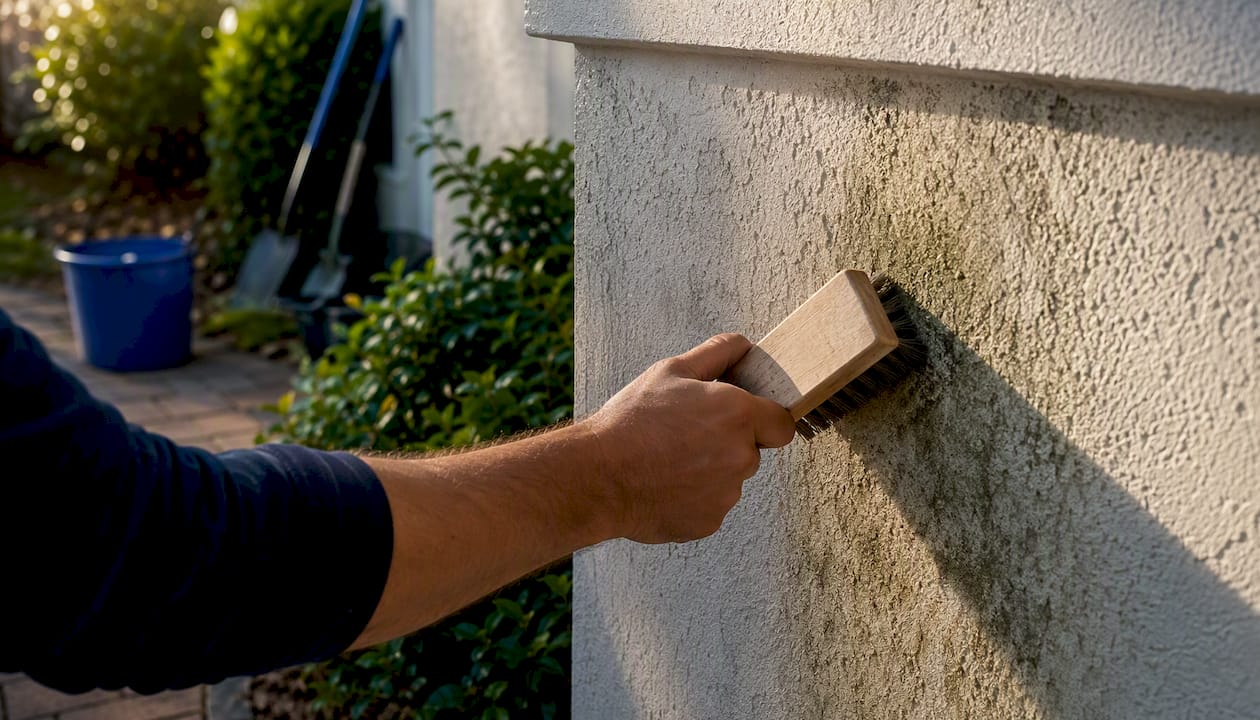
For heavy mildew or algae buildup, work a stiff masonry brush over the affected area in circular motions. You don’t need force — the detergent has already loosened the growth.
Step 6: Rinse top-down in vertical sections
Switch to your pressure washer set to the appropriate PSI for your stucco type. Keep the nozzle moving in sweeping strokes, maintain a 12–24 inch distance, and work in vertical sections of roughly 10 feet so the surface stays consistently wet. Rinse from the top of the wall downward. Never aim the spray upward at soffits, window edges, or wall seams — water forced into those gaps is the primary cause of moisture intrusion.
Step 7: Post-wash check
Once the wall dries, scan for any remaining dark spots, efflorescence (white salt deposits), or areas where the texture looks different. Replace any caulk you removed during prep.
Pro Tip: Work in the shade or during cooler parts of the day. Direct sun on a warm wall dries detergent in minutes, leaving a film that requires a second cleaning pass to correct.
Which cleaners are safe for stucco, and how do you manage runoff?
Two cleaner categories work well on stucco:
- Oxygen bleach (sodium percarbonate): Gentler than chlorine bleach, color-safe on most painted finishes, and biodegrades quickly. Mix according to the product label — typically 1–2 scoops per gallon of water. Good for general dirt and light mildew.
- Diluted sodium hypochlorite (chlorine bleach): More effective on heavy algae, mold, or lichen. A common field dilution is roughly 1–3% sodium hypochlorite solution (about 1 part household bleach to 10 parts water). Use with caution on painted stucco — test first.
A downstream injector meters the chemical into the water stream at a controlled ratio, which prevents over-concentration on the surface. If you’re using a pump sprayer instead, mix carefully and avoid applying more than the label recommends.
Runoff management:
- Soak surrounding soil and plants with plain water before and after cleaning to dilute any chemical runoff.
- Direct runoff away from storm drains where possible; many municipalities prohibit bleach-laden water from entering storm systems directly.
- On second-story work, runoff volume increases significantly — a containment berm or professional containment plan may be required.
- Never let detergent dry on the surface. Dried residue on porous masonry often requires professional remediation to remove cleanly.
Painted stucco deserves extra caution. High bleach concentrations can fade or lift paint, so start with oxygen bleach and only escalate if needed. For large areas of active black mold, the underlying moisture source matters more than the cleaning method — washing the surface without addressing the cause just delays the problem.
What can go wrong: damage types, red flags, and safety warnings
High-pressure washing stucco causes a predictable set of problems. Knowing them helps you recognize when to stop.
Primary damage types:
- Etching and zebra stripes: Holding the nozzle too close or too still cuts grooves into the surface texture.
- Chipping: Concentrated spray on brittle or aged stucco breaks off chunks, especially at corners and edges.
- Paint stripping: High pressure frequently strips paint from older or painted stucco finishes, leaving bare patches that need repainting before moisture gets in.
- Moisture intrusion: Water forced behind the stucco layer through cracks, failed caulk, or upward spray causes mold, rot, and structural damage inside the wall assembly.
- EIFS puncture: Any pressurized stream on EIFS (synthetic stucco) risks puncturing the foam insulation board beneath the finish coat.
Red flags — stop and call a pro if you see any of these:
- Hairline cracks running across large sections of the wall
- Soft, spongy, or crumbling areas when you press lightly
- Chalky white powder (efflorescence) covering broad patches
- Failed or missing caulk around windows and doors
- Extensive mold growth that suggests an active moisture problem behind the wall
Before you pick up a pressure washer, run your hand across the stucco. If it feels soft, crumbles at the edges, or shows widespread cracking, washing it will accelerate the damage — not clean it. Stucco in that condition needs a mason or a licensed contractor first, not a cleaning crew.
Safety on the job:
- Wet surfaces and ladders are a serious slip hazard. Use a ladder stabilizer and have a second person present.
- Keep the wand pointed away from electrical fixtures, outlets, and meter boxes.
- Never spray upward at an angle near vents, windows, or roof overhangs.
How long should stucco dry after washing, and when can you paint?
Rushing the drying step is where most DIY stucco projects go sideways. Water trapped in the wall causes paint to bubble, adhesion to fail, and mold to develop behind the new coat.
Drying guidance:
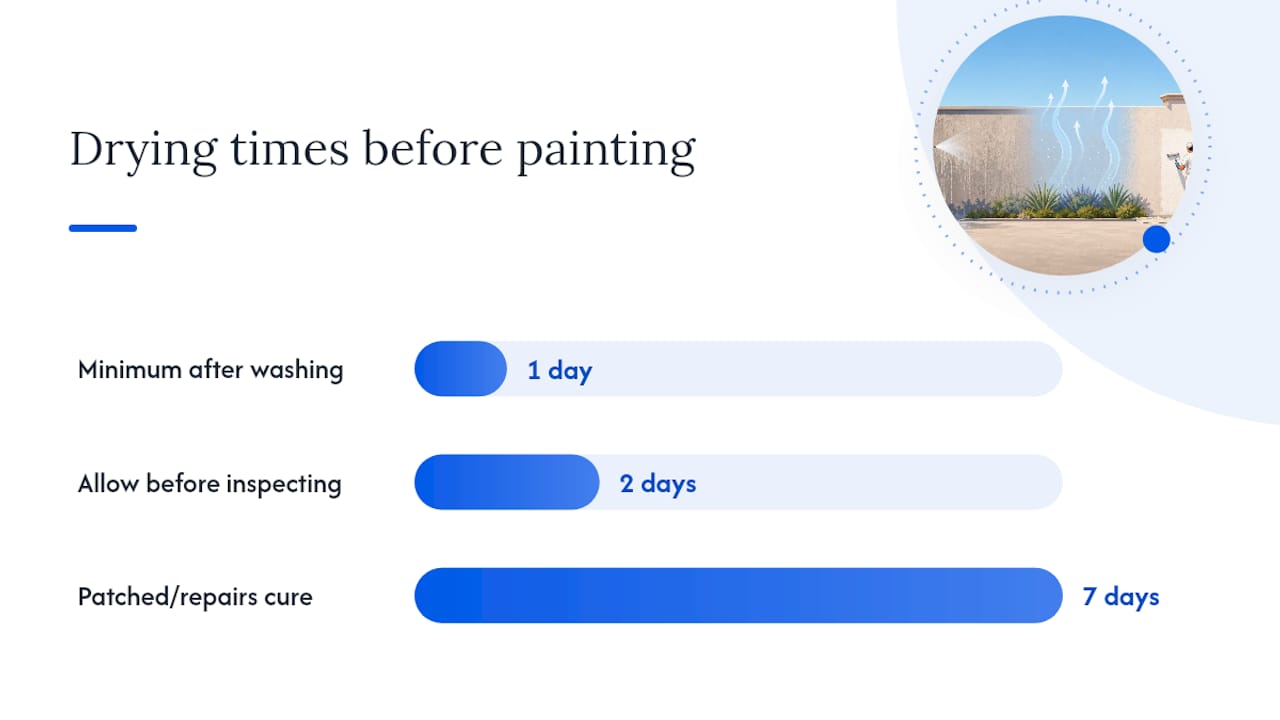
- Allow at least 24–48 hours of dry weather after washing before inspecting the surface for painting or sealing.
- Patched or newly repaired areas need longer — follow the patch product’s instructions, which typically call for a full week of cure time before any water exposure.
- In humid coastal climates (like much of Orange County), add extra drying time beyond the minimum.
How to check for residual moisture:
- Look for dark patches or color variation on the wall surface — wet stucco reads noticeably darker than dry stucco.
- Run your hand across the surface. Any cool, damp feel means it’s not ready.
- Check corners, low sections near the foundation, and areas around window frames, where moisture lingers longest.
Before painting or sealing:
Power washing can strip existing paint, so plan for touch-up or a full repaint if the surface shows bare patches. Apply a masonry primer before any topcoat, and confirm the stucco has reached full dryness — not just surface dryness. A moisture meter gives you a reliable reading if you’re unsure.
When is it safer to hire a professional?
DIY soft-washing works well on single-story homes with traditional hard-coat stucco, no significant cracking, and accessible walls. Outside those conditions, the risk-to-reward math shifts quickly.
Hire a pro when:
- The home is two stories or taller (ladder risk plus runoff volume)
- You have EIFS or you’re not certain which stucco type you have
- There’s active mold covering large sections, suggesting a moisture problem behind the wall
- Visible structural cracks or soft spots are present
- Local regulations require runoff containment
What professionals do differently:
- Full pre-wash inspection, including probing for soft spots and checking caulk integrity around all penetrations
- Patch and cure verification before any water is applied
- Soft-wash rigs operating at 40–100 PSI — closer to garden-hose pressure — relying on chemical action rather than force
- Downstream injectors for precise chemical delivery at controlled ratios
- Containment systems for runoff, especially on multi-story or landscaped properties
- Post-wash moisture checks and re-caulking as part of the job
Consider a straightforward comparison: a single-story home with intact hard-coat stucco is a reasonable weekend DIY project with the right equipment and this guide. A two-story home with EIFS, active mold, and mature landscaping around the foundation is a different job entirely. A professional soft-wash crew handles the inspection, containment, and chemical application in a few hours, with no ladder risk to you and no guessing about substrate type. The cost of a professional clean is almost always less than repairing moisture damage from a DIY job that went wrong.
Pro Tip: Ask any contractor specifically whether they use a soft-wash system or a standard pressure washer. A pro who defaults to high-pressure on stucco without asking about the substrate type is a red flag — walk away.
Why soft-wash is the only sensible choice for stucco in Orange County
Most exterior cleaning guides treat soft-washing as the “gentle option” for delicate surfaces. That framing undersells it. Soft-washing doesn’t just protect the surface — it actually solves the problem. High-pressure blasting removes the visible symptom (the stain) while leaving the biological cause (mildew spores, algae roots) embedded in the porous stucco. The stain comes back within months. A properly applied soft-wash solution kills the organism at the source, which means the results last longer and you clean less often.
Orange County’s climate makes this especially relevant. Salt air from the coast, intense UV, and warm temperatures create near-ideal conditions for algae and mildew growth on exterior stucco. Blasting those stains off with high pressure damages the finish and invites faster re-colonization. The pressure washing tips specific to Orange County homeowners consistently point to the same conclusion: low pressure, the right chemistry, and patience produce results that hold up through the season.
There’s also a practical point worth making about common pressure-washing misconceptions: more PSI does not mean cleaner. For stucco, it usually means more damage and more repair bills.
Broswindowcleaningoc cleans stucco the right way in Orange County
Stucco cleaning done correctly takes the right equipment, the right chemistry, and someone who knows what to look for before the water ever hits the wall. Broswindowcleaningoc brings all three to every job in Orange County — fully insured, with over five years of exterior cleaning experience across residential and commercial properties.

The team uses a soft-wash approach calibrated to your specific stucco type, handles pre-wash inspection and minor patching, manages runoff to protect your landscaping, and confirms drying before any follow-up work. No rental machines cranked to full power, no guesswork on EIFS versus hard-coat. Just a clean, protected exterior done safely.
Ready to get a quote or schedule a soft-wash for your property? Visit the Orange County pressure washing service page or reach out directly to book.
Sources
- How to clean stucco
- How to pressure wash a stucco surface
- Stucco cleaning tips
- Can You Use A Pressure Washer On Stucco? – Read This First
- How to Pressure Wash Stucco: 2026 Guide & Top Picks – Motor For Nerd