
Dirty solar panels are quietly costing California homeowners money every single month. After just a few months without cleaning, post-cleaning output gains of 10 to 25% have been documented, and a UCSD study found a 7.4% efficiency loss after only 145 days without cleaning or rain. That’s not a rounding error on your utility bill. Most homeowners assume a quick rinse with the garden hose is enough, but professional-level cleaning is a completely different process. This guide walks you through the right tools, the right timing, a safe step-by-step method, and the most common mistakes to avoid so your panels keep producing at their best.
Table of Contents
- What you need to clean solar panels
- When and how often to clean your panels
- Step-by-step: How to clean solar panels safely
- Common mistakes and troubleshooting
- Hard-won lessons from cleaning panels in California
- Professional solar panel cleaning: Get the most from your investment
- Frequently asked questions
Key Takeaways
| Point | Details |
|---|---|
| Regular cleaning boosts output | Clean solar panels can increase energy production by up to 25 percent compared to dirty panels. |
| Use DI or RO water | Always use deionized or reverse-osmosis water to avoid hard water spots that can harm panels in California. |
| Monitor for performance drops | Track panel output and schedule cleaning if you see a 5 to 10 percent decrease, or after wildfires and pollen seasons. |
| Know when to call pros | Professional cleaners are safest for roof access, tough stains, or when you want optimal long-term efficiency. |
What you need to clean solar panels
Before you touch your panels, getting the right supplies together is non-negotiable. Using the wrong tools is one of the fastest ways to scratch the glass coating, leave mineral deposits, or worse, fall off the roof. Let’s break down exactly what you need.
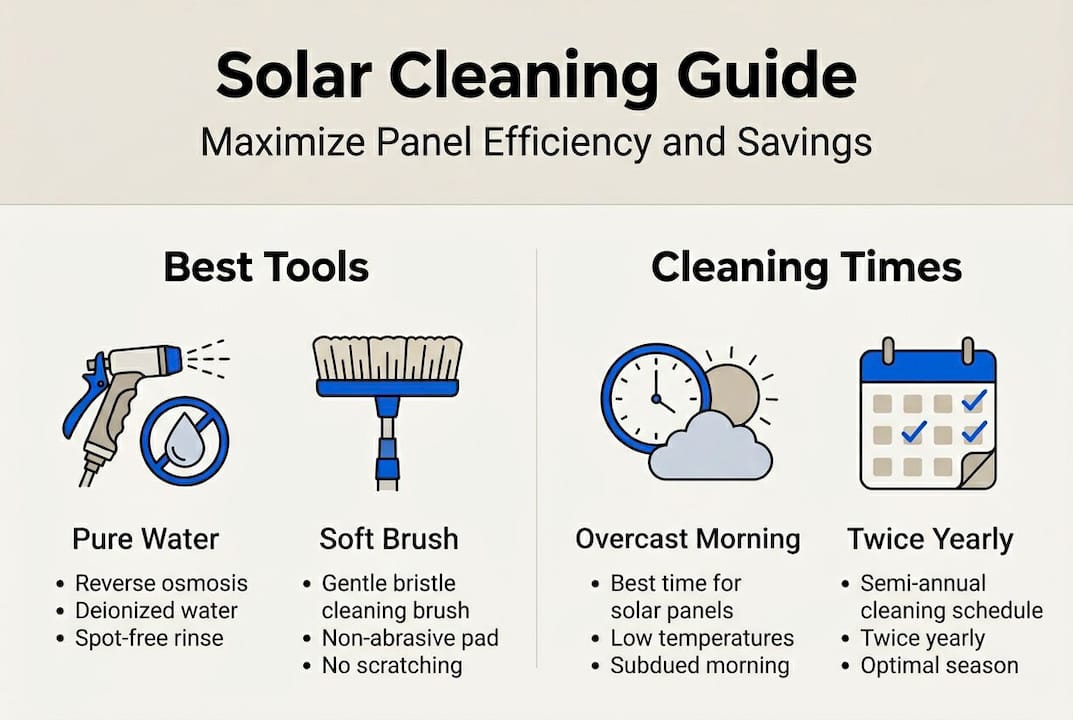
The single most important supply is water quality. Professional solar panel cleaning in California relies on deionized (DI) or reverse-osmosis (RO) water paired with soft-brush wet washing via extendable pole-and-brush systems. Why does this matter? California tap water is notoriously hard, meaning it carries dissolved minerals that leave white spots on your panels after drying. Those spots block sunlight and reduce output just as much as dust does.
Here’s a quick comparison of what professionals bring versus a typical DIY setup:
| Tool | Professional setup | DIY setup |
|---|---|---|
| Water source | Deionized or RO water | Tap water (hard) |
| Brush type | Soft-bristle, extendable pole | Household scrub brush |
| Pressure | Low-flow, controlled | Garden hose (variable) |
| Safety gear | Harness, non-slip boots | Varies |
| Warranty risk | Minimal | Potentially voided |
For a DIY approach, you’ll want to gather the following before climbing up:
- Soft-bristle brush with an extendable pole (at least 10 feet)
- Bucket of DI or RO water (available at most hardware stores)
- Squeegee with a rubber blade
- Non-abrasive microfiber cloths
- Non-slip shoes and a stable ladder
- Harness or roof anchor if your roof pitch is steep
Safety checks matter just as much as the tools themselves. Inspect your ladder for stability before each use. Check the roof surface for wet or mossy patches that could cause a slip. Never clean panels during high winds or after rain when the roof is still wet.
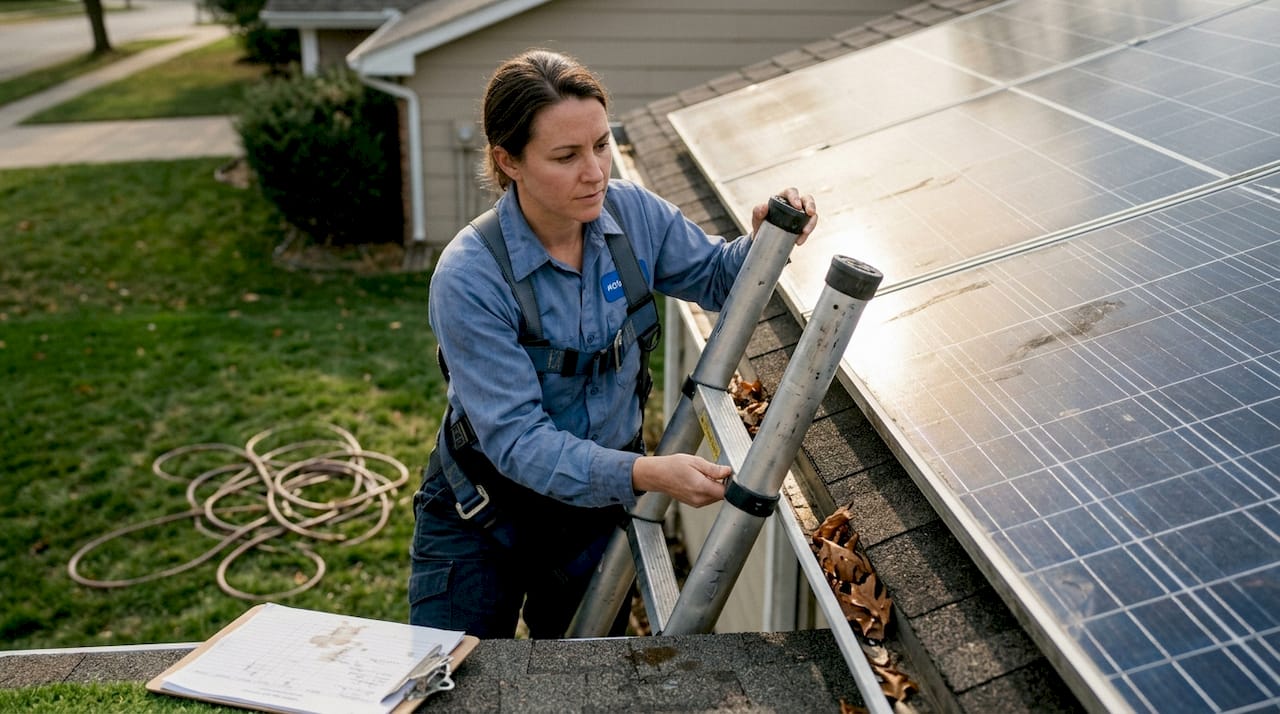
For professional window and solar panel cleaning that eliminates these risks entirely, a licensed and insured service handles the water quality, safety equipment, and technique so you don’t have to.
Pro Tip: Schedule your cleaning on a cool, overcast morning. Direct sun heats the glass and causes water to evaporate too fast, leaving streaks and mineral residue behind even if you’re using DI water.
When and how often to clean your panels
Knowing when to clean is just as important as knowing how. Cleaning too rarely means lost output. Cleaning too often wastes time and money. California’s varied climate zones make this decision more nuanced than a simple annual reminder.
California’s cleaning frequency varies significantly by region. Typical homes need one to two cleanings per year, while desert and dusty inland areas require two to four times per year. The trigger point is a 5 to 10% drop in energy output compared to your baseline.
| California zone | Suggested frequency | Key soiling factors |
|---|---|---|
| Coastal (LA, San Diego) | 1-2 times per year | Salt air, marine layer |
| Urban (Bay Area, Sacramento) | 2 times per year | Smog, traffic particulates |
| Inland/Desert (Riverside, Palm Springs) | 2-4 times per year | Dust, dry winds, heat |
| Agricultural valleys | 2-3 times per year | Pollen, crop dust, irrigation mist |
Here’s how to monitor your system and know when it’s time to act:
- Log your baseline output during the first month after installation or after a professional clean.
- Check your inverter app or utility portal weekly for output data.
- Compare current production to your baseline for the same time of year.
- If output drops 5 to 10%, schedule a cleaning regardless of visible dirt.
- After any wildfire event, inspect panels immediately for ash and soot buildup.
Up to 20% output loss can accumulate after just three months of dry conditions in Southern California. That’s a significant chunk of your system’s value sitting unused.
Bird droppings and wildfire ash are critical exceptions to any schedule. Unlike dust, which spreads evenly and reduces output gradually, a single bird dropping can create a “hot spot” that damages cells over time. Solar panel maintenance for bird droppings and ash requires prompt attention, not waiting for the next scheduled cleaning. Ash from wildfires is chemically reactive and can etch the glass surface if left too long.
Step-by-step: How to clean solar panels safely
With your timing confirmed and your gear ready, here’s exactly how to approach the cleaning process without damaging your panels or risking a fall.
- Turn off your solar system. Check your inverter manual for the shutdown procedure. Never clean an active system.
- Inspect the panels from the ground first. Use binoculars to spot cracks, bird nests, or debris that could complicate the job.
- Set up your ladder on stable, level ground. Have a second person hold the base if possible.
- Pre-rinse panels with DI or RO water using a low-pressure hose attachment or your extendable pole sprayer. This loosens surface dust without scratching.
- Scrub gently with your soft-bristle brush in straight strokes, not circular ones. Circular motion can create micro-scratches that trap dirt over time.
- Rinse thoroughly from top to bottom so dirty water flows away from already-cleaned sections.
- Squeegee dry to prevent any remaining minerals from leaving spots as the panel dries.
- Post-clean check: Restart your system and monitor output within 24 hours to confirm improvement.
Pro Tip: Never use standard tap water as your final rinse, even if you scrubbed with DI water. The last water on the glass is what dries and leaves spots. Always finish with a DI or RO rinse.
Cal/OSHA safety note: Working on roofs above 6 feet requires fall protection. California regulations mandate that homeowners and workers use appropriate anchor points, harnesses, or guardrails when accessing pitched rooftops. Skipping this step is not just risky, it’s a liability.
A common myth is that rain handles the cleaning for you. Rain alone is not enough to remove pollen, bird droppings, or caked-on dust. Rain can actually make things worse by mixing surface dust into muddy streaks that dry hard on the glass.
DIY cleaning risks include hard water spots, glass scratches, and falls. Professionals bring insurance, specialized tools, and the right water chemistry, making insured professional cleaning services a genuinely safer option for most homeowners.
Common mistakes and troubleshooting
Even with the right tools and a solid process, small errors can undermine your results or damage your investment. Here are the most common pitfalls and how to handle them.
Mistakes to avoid:
- Scratching the glass by using abrasive pads, rough cloths, or stiff brushes. Even fine scratches scatter light and reduce output permanently.
- Using hard tap water for rinsing, which leaves mineral deposits that are harder to remove than the original dirt.
- Skipping safety precautions like a stable ladder, non-slip footwear, or a roof anchor. Falls from residential roofs cause serious injuries every year in California.
- Ignoring gradual output drops because they seem minor. A slow decline often signals soiling that’s been building for months.
- Cleaning during peak sun hours when heat causes rapid evaporation and streaking.
- Using pressure washers, which can crack panel seals, force water into junction boxes, and void your manufacturer’s warranty.
Pro Tip: To check for hard water spots after cleaning, look at your panels at a low angle during sunrise or sunset. Mineral deposits catch the light at that angle and show up clearly as a hazy film. If you spot them, a second pass with pure DI water and a squeegee usually resolves it.
When it comes to cost versus benefit, professional solar cleaning in California runs $100 to $350 for a residential system of 10 to 35 panels, or roughly $5 to $15 per panel. Higher costs apply for steep roofs or difficult access. Compare that to the value of the energy you’re losing, and for most homeowners, a professional clean pays for itself within one to two billing cycles.
For extreme soiling events like post-wildfire ash, heavy construction dust, or a large bird colony, don’t wait. Call a local professional solar cleaning service immediately. These situations require fast response and sometimes specialized cleaning agents that are safe for panel coatings.
Hard-won lessons from cleaning panels in California
After years of working on rooftops across Orange County, a few realities become clear that no beginner’s guide fully captures.
The DIY temptation is real. Panels look accessible, the process sounds simple, and the savings seem obvious. But glass damage from a single abrasive scrub is permanent, and a fall from a single-story roof can mean months of recovery. The math changes fast when you factor in those risks.
Water chemistry is the hidden variable most homeowners underestimate. California’s hard water doesn’t just leave spots. Over time, repeated mineral buildup creates a film that bonds to the glass and requires professional-grade treatment to remove. Routine cleaning with the right water prevents that buildup entirely.
We’ve also seen homeowners wait until output drops dramatically before acting, only to discover that months of compounded soiling have caused micro-damage to cells. Consistent, scheduled cleaning is genuinely cheaper than reactive cleaning after neglect.
Our experience with window and solar cleaning has taught us that the best investment is a regular maintenance schedule with a fully insured provider who carries the right gear and knows California’s specific conditions.
Professional solar panel cleaning: Get the most from your investment
You now know what it takes to clean solar panels correctly. The tools, timing, technique, and risks are all on the table. For many homeowners, that knowledge leads to one clear conclusion: the safest and most cost-effective path is letting a local professional handle it.
At Bros Window Cleaning, we serve Orange County homeowners with fully insured, detail-oriented Orange County solar panel cleaning services using the right water, the right tools, and years of local experience. We know California’s climate, its hard water, and its wildfire seasons. Getting a quote is easy, and a professional evaluation can identify issues you might not spot from the ground. Reach out today and let us protect your solar investment the right way.
Frequently asked questions
Can I use a garden hose to clean my solar panels?
It’s not recommended. California tap water is high in minerals that leave hard water spots that reduce efficiency and can void manufacturer warranties.
How much does professional solar panel cleaning cost in California?
Most homeowners pay between $100 and $350 per visit, depending on panel count and roof access complexity.
Will rain clean my solar panels enough in California?
No. Rain is insufficient to remove pollen, bird droppings, or caked dust. Manual mechanical cleaning is required for effective results.
How do I know it’s time to clean my solar panels?
Schedule a cleaning if you notice a 5 to 10% output drop compared to your baseline, or after visible soiling events like wildfires or heavy pollen season.
Pingback: Window cleaning boosts curb appeal: 768% ROI proven
Pingback: Balcony solar panels explained: costs, savings, and UK rules