
Building facade cleaning is the professional process of safely removing dirt, biological growth, and stains using methods tailored to the specific building materials and environmental conditions. Known in the industry as facade restoration or exterior cladding maintenance, this practice protects far more than appearances. Facade cleaning is not just cosmetic. It preserves structural integrity by blocking moisture pathways that cause spalling, efflorescence, and long-term material failure. This building facade cleaning guide covers every stage of the process, from selecting the right tools to building a maintenance schedule that prevents costly repairs.
What does a building facade cleaning guide actually cover?
Facade cleaning addresses surfaces including brick, stone, concrete, glass curtain walls, metal cladding, and rendered finishes. Each material responds differently to water pressure, chemical agents, and mechanical scrubbing. Applying the wrong cleaning method can cause permanent damage, which is why survey-led assessment and patch testing are non-negotiable before any full-scale cleaning begins. The three most common contamination types are biological growth (algae, lichen, moss), carbon-based soiling (exhaust deposits, soot), and metallic staining (rust, copper runoff). Each requires a different chemical approach and dwell time. Treating them all the same way is one of the most expensive mistakes a property owner or facility manager can make.
What tools and safety gear do you need before starting?
Preparation is where professional facade cleaning separates itself from amateur pressure washing. The right equipment and a documented safety plan determine whether a job goes smoothly or creates liability.
Core cleaning equipment
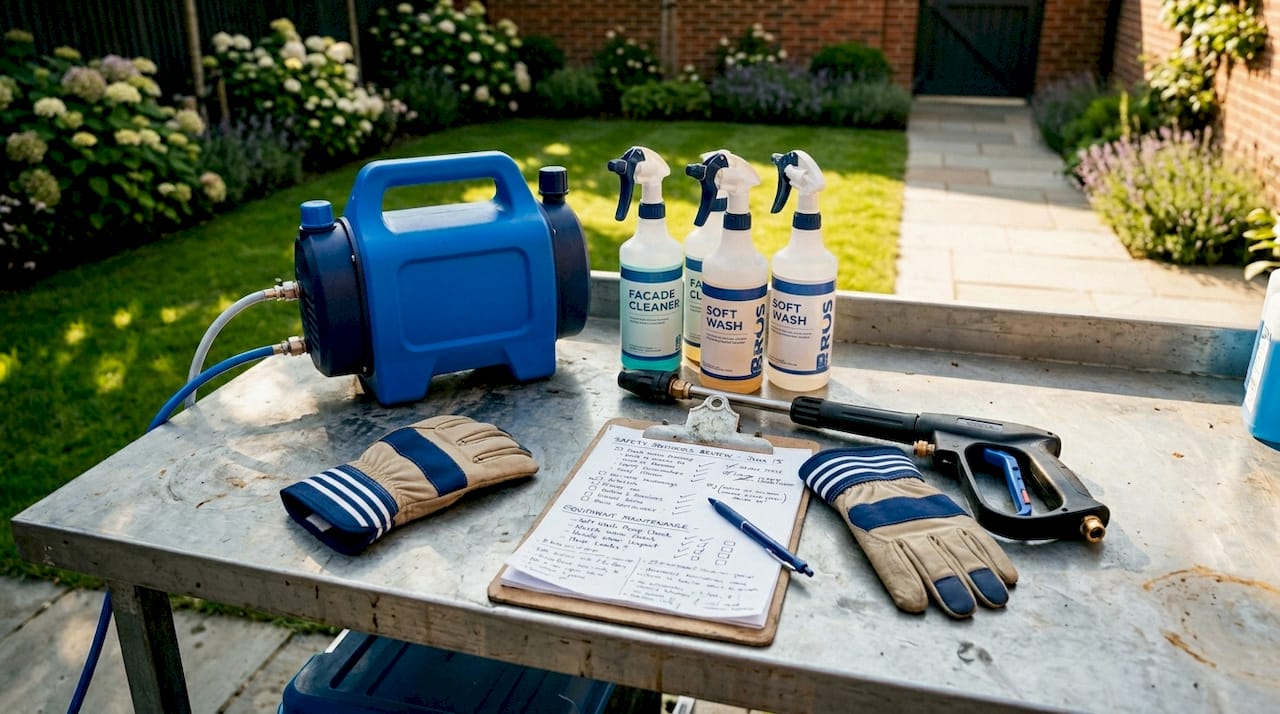
The four primary systems used in commercial facade cleaning are pressure washers (2,500 to 4,000 PSI for hard surfaces), soft-wash systems operating under 500 PSI with biocides for delicate substrates, mechanized facade brush rigs, and manual scrubbing with chemical application. Access equipment includes scaffolding, boom lifts, and rope access systems. Mechanized brush systems clean approximately five times faster than manual methods, reaching around 250 m²/hr versus 50 m²/hr by hand. That productivity gap matters significantly when you are pricing a large commercial project or planning crew schedules.
Safety planning and compliance
High-rise and elevated facade work requires a formal safety plan before anyone leaves the ground. Rope access safety plans require certified anchors, dual-rope systems, practiced rescue procedures, and ground-level exclusion zones to protect pedestrians. Skipping any one of these elements creates legal exposure and real physical risk. Even for lower-level work, a pre-job facade survey identifies fragile sections, loose cladding, and drainage vulnerabilities that could cause injury or property damage during cleaning.
| Equipment | Purpose | Safety Note |
|---|---|---|
| Pressure washer (2,500–4,000 PSI) | Hard surfaces: concrete, brick | Keep nozzle 12+ inches from surface |
| Soft-wash system (<500 PSI) | Delicate cladding, painted render | Confirm biocide compatibility first |
| Mechanized facade brush | Large-area productivity | Verify substrate hardness before use |
| Rope access rig | High-rise access | Requires dual ropes and certified anchors |
| Scaffolding or boom lift | Stable elevated access | Inspect load ratings before each use |
| Personal protective equipment | Chemical and fall protection | Gloves, goggles, harness, non-slip boots |
Pro Tip: Always conduct a patch test on a discreet section of the facade before committing to any chemical or pressure method. A 30-minute test can prevent weeks of remediation work.
How do you choose the right cleaning method for your facade?
Method selection is the single most consequential decision in any facade cleaning project. The wrong choice does not just leave dirt behind. It can etch stone, strip coatings, or force moisture deeper into the substrate.
Pressure washing vs. soft washing vs. chemical cleaning
Pressure washing works well on dense, hard surfaces like concrete, granite, and engineering brick. It physically dislodges soiling through mechanical force. Soft washing, by contrast, kills biological growth at the root rather than blasting it off the surface. This matters because algae and lichen treated only with high pressure will regrow within months. Chemical cleaning uses acid-based or alkaline solutions applied at low pressure, making it the preferred approach for metallic staining on limestone or carbon deposits on sandstone. Manual scrubbing with soft brushes and targeted chemistry is reserved for heritage materials where any mechanical pressure risks surface loss.
Matching method to material and stain type
| Facade Material | Biological Staining | Carbon Soiling | Metallic Staining |
|---|---|---|---|
| Concrete | Soft wash + biocide | Pressure wash or alkaline cleaner | Acid-based treatment |
| Brick (hard) | Pressure wash or soft wash | Alkaline cleaner | Dilute acid wash |
| Sandstone / limestone | Soft wash only | Low-pressure chemical | Specialist poultice |
| Rendered finish | Soft wash + biocide | Manual + mild alkaline | Specialist stain remover |
| Metal cladding | Biocide wipe-down | Solvent or alkaline cleaner | Rust converter or inhibitor |
| Glass curtain wall | Low-pressure rinse | Squeegee + glass cleaner | Mineral acid (diluted) |
One-size-fits-all cleaning methods lead to damage. Professional facade cleaning requires a survey-led, tailored approach that accounts for substrate porosity, existing coatings, and the chemistry of the contamination present. For example, using an acid-based cleaner on a polished concrete facade to remove algae will dull the surface permanently. An alkaline biocide applied at low pressure achieves the same biological kill without any surface loss.
Pro Tip: Document your patch test results with photos and timestamps. This creates a reference record for future cleaning cycles and protects you if a client disputes results.
What is the step-by-step facade cleaning process?
A professional facade cleaning job follows a defined sequence. Skipping steps, particularly early inspection and patch testing, is where most damage and rework originates.
-
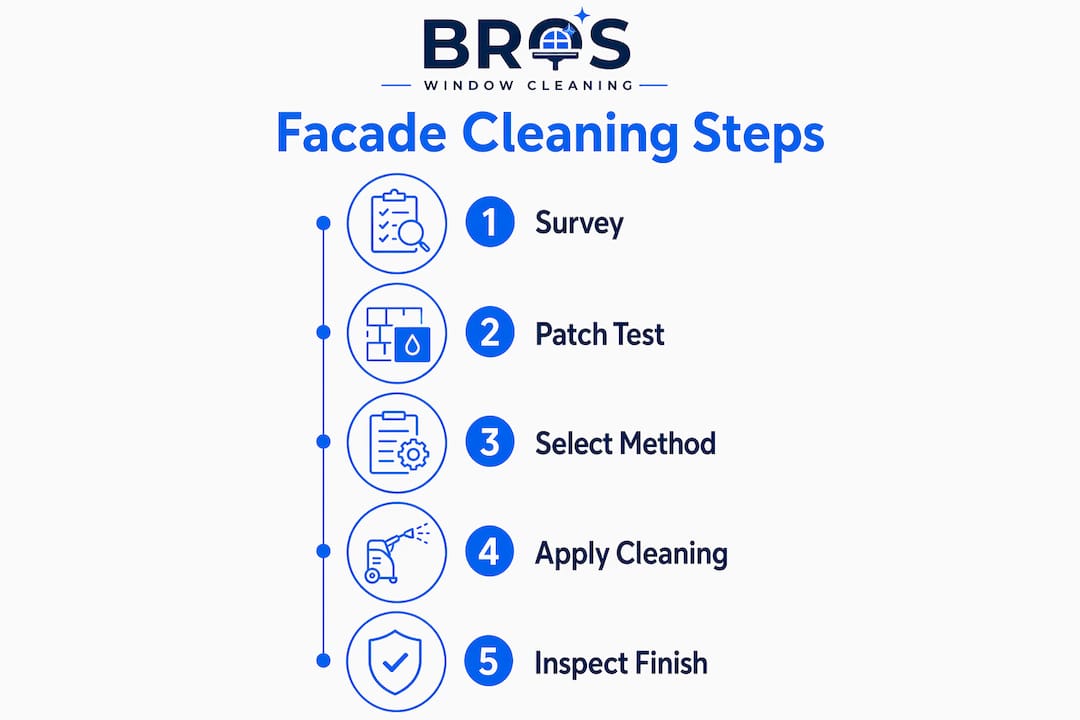
Conduct a detailed facade inspection. Walk the entire building perimeter and photograph all areas of soiling, damage, loose joints, cracked sealants, and drainage blockages. Note the facade material in each zone. This survey drives every subsequent decision.
-
Perform a risk assessment. Identify access challenges, overhead hazards, proximity to public areas, and any fragile or heritage elements. Document exclusion zones and confirm that your access method (scaffolding, rope, lift) is appropriate for each facade section.
-
Run test patches. Apply your proposed cleaning chemistry and pressure to a small, inconspicuous area. Wait the full dwell time, rinse, and inspect after 24 hours. Experienced teams confirm chemistry, dwell time, and runoff handling at this stage before scaling up.
-
Set up safe access. Erect scaffolding or rig rope access systems according to your safety plan. Establish ground-level exclusion zones. Brief all crew members on emergency procedures before work begins.
-
Clean in sections, working top to bottom. Apply chemistry or pressure from the highest point downward to prevent dirty runoff contaminating already-cleaned areas. Rinse thoroughly after each section to remove chemical residue.
-
Conduct a post-cleaning inspection. Walk the facade again with the same systematic approach used in step one. Compare photographs. Identify any areas requiring a second pass or spot treatment.
-
Apply sealant or protective coating where specified. On porous materials like sandstone or brick, a breathable water-repellent impregnant applied after cleaning significantly extends the interval before the next clean is needed.
-
Document and report. Provide the property owner or facility manager with a written record of methods used, areas treated, products applied, and any defects identified during inspection. This record feeds directly into the ongoing maintenance plan.
How do you maintain a facade to prevent deterioration?
Cleaning removes what has already accumulated. Maintenance prevents the conditions that accelerate deterioration in the first place. The two practices work together, and treating them as separate budgets is a false economy.
Deep facade cleaning is recommended every 3 to 5 years, with higher frequency for buildings near heavy traffic, construction activity, or coastal environments where salt deposits accelerate surface breakdown. Between deep cleans, annual maintenance tasks keep the facade in stable condition and catch problems before they become structural.
Key ongoing maintenance practices include:
- Annual light washing. Remove surface pollutants, bird deposits, and early biological growth before they bond to the substrate. Routine washing at least annually combined with drainage upkeep is critical to preventing efflorescence and spalling.
- Joint and sealant inspection. Failed sealant around windows, expansion joints, and cladding fixings is the primary entry point for water. Inspect and repoint or reseal annually.
- Gutter and drainage clearance. Blocked gutters overflow onto facade surfaces, creating persistent moisture zones that accelerate biological growth and staining. Clean gutters regularly to protect the entire building envelope.
- Early crack and spall repair. Small cracks in render or masonry allow water ingress. Filled early, they cost very little. Left for two winters, they can require full section replacement.
- Protective coating reapplication. Water-repellent impregnants on porous facades typically need reapplication every 5 to 10 years depending on exposure. Schedule this alongside deep cleaning cycles.
Facade longevity depends more on controlling moisture pathways than on visible dirt removal alone. A building that looks clean but has failed sealants and blocked downpipes is deteriorating faster than one with surface soiling and intact drainage. Maintenance planning should prioritize moisture control above cosmetic appearance.
For commercial properties, integrating facade maintenance into a broader exterior cleaning services program ensures nothing gets missed between major cleaning cycles.
Key takeaways
Effective facade cleaning requires matching the cleaning method to the specific material and contamination type, because the wrong approach causes permanent damage that no amount of rework can reverse.
| Point | Details |
|---|---|
| Survey before you clean | A pre-job inspection and patch test prevent costly damage and confirm the right chemistry. |
| Match method to material | Soft wash suits delicate substrates; pressure washing is for hard, dense surfaces only. |
| Safety planning is non-negotiable | Rope access work requires certified anchors, dual ropes, and practiced rescue plans. |
| Moisture control drives longevity | Maintaining joints, sealants, and drainage protects facades more than cleaning alone. |
| Schedule deep cleans every 3 to 5 years | High-traffic or coastal buildings need more frequent cycles to prevent accelerated deterioration. |
Why I think most facade cleaning projects fail before they start
After years of working on building exteriors across Orange County, the pattern I see most often is not bad technique on the scaffold. It is bad planning at the desk. Property owners call after the damage is done: etched limestone, stripped render, or a facade that looks worse after cleaning than before. Almost every case traces back to skipping the survey or assuming that what worked on one building will work on the next.
The other consistent failure point is treating facade cleaning as a one-time event rather than part of a maintenance cycle. A building cleaned perfectly in 2024 and then ignored until 2030 will cost far more to restore than one cleaned adequately every three years with joints and drainage checked annually. The math is not complicated, but the discipline to follow through on a maintenance schedule requires someone to own it.
I also push back hard on the idea that high-pressure washing is the default answer for everything. It feels productive. It looks dramatic. But on anything softer than engineering brick or dense concrete, you are trading a visible stain for invisible substrate damage that shows up two years later as spalling or water ingress. Soft washing and targeted chemistry take longer to set up and require more product knowledge, but they produce results that last and do not create new problems.
The pressure washing safety steps matter as much as the method itself. Pressure applied at the wrong angle or distance on a facade joint can force water behind cladding panels, creating exactly the moisture problem you were trying to prevent.
— nolan
Get professional facade cleaning support in Orange County

Broswindowcleaningoc brings over five years of hands-on experience cleaning and maintaining building exteriors across Orange County, CA. The team uses survey-led planning, material-appropriate methods, and fully insured operations to protect your property at every stage. Whether you manage a commercial building, a multi-unit residential property, or a single-family home with a complex exterior, Broswindowcleaningoc tailors every job to the specific surface and soiling type. Professional facade cleaning done right boosts curb appeal and property value measurably. Contact Broswindowcleaningoc to schedule a consultation or get a quote for Orange County cleaning services that cover facades, windows, gutters, and more.
FAQ
What is building facade cleaning?
Building facade cleaning is the process of removing dirt, biological growth, staining, and pollutants from a building’s exterior surfaces using methods matched to the specific material and contamination type. It protects structural integrity as well as appearance.
How often should a building facade be cleaned?
Deep cleaning is recommended every 3 to 5 years for most buildings, with annual light maintenance in between. Buildings near heavy traffic, construction, or coastal environments need more frequent cycles.
What is the difference between pressure washing and soft washing a facade?
Pressure washing uses 2,500 to 4,000 PSI of mechanical force and suits hard, dense surfaces like concrete and brick. Soft washing uses under 500 PSI combined with biocides to kill biological growth at the root, making it the correct choice for delicate or porous materials.
Can I pressure wash a stone or rendered facade myself?
Pressure washing stone or rendered surfaces without a prior patch test and material assessment risks permanent etching or coating removal. A professional survey and test patch are required before any cleaning method is applied to sensitive substrates.
What maintenance tasks prevent facade deterioration between cleans?
Annual light washing, joint and sealant inspection, gutter clearance, early crack repair, and reapplication of water-repellent coatings are the core tasks. Controlling moisture pathways through drainage and sealant upkeep protects facades more effectively than cleaning alone.