
A messy, inconsistent approach to commercial property cleaning doesn’t just look bad. It costs you tenants, erodes property value, and puts you in a constant state of catch-up. A well-structured business property cleaning workflow changes that. It turns reactive scrambling into a repeatable system your team can execute without constant supervision. This guide walks you through every phase: what to prepare before you start, how to design the actual workflow, what kills execution quality, and how to measure whether your system is actually working.
Table of Contents
- Key takeaways
- What you need before building a cleaning workflow
- Designing your step-by-step commercial cleaning process
- Common pitfalls in workflow execution
- Measuring success and improving over time
- My honest take on building workflows that last
- How Broswindowcleaningoc can support your cleaning workflow
- FAQ
Key takeaways
| Point | Details |
|---|---|
| Build before you execute | Document SOPs and gather tools before scheduling a single cleaning task. |
| Segment by building type | Standardize workflows by property category, not individual accounts, to scale without chaos. |
| Prioritize high-touch surfaces | Daily disinfection of keyboards, handles, and phones is non-negotiable for health compliance. |
| Use digital verification | Photo-verified inspections replace time-consuming walk-throughs and create client-ready records. |
| Treat recruiting as ongoing | High staff turnover is structural in this industry. Your hiring pipeline should never go cold. |
What you need before building a cleaning workflow
Most workflow failures start before anyone picks up a mop. The preparation phase is where business owners and property managers consistently cut corners, and it shows up immediately in execution quality.
People, equipment, and documentation
Start by auditing what you actually have. That means cataloging your cleaning staff and their skill levels, your equipment inventory, and your current supply stock. You need to know not just what you have, but what condition it’s in and how quickly you can replace it.
Your technology stack matters too. At minimum, you need a scheduling platform, a way to assign tasks digitally, and a method for tracking completion. Spreadsheets work at one or two properties. Beyond that, they become a liability.
The most overlooked piece is documentation. Templates by building type, like medical offices versus law firms, are what actually make workflows scalable. If your SOPs are written around individual accounts, you’re building a custom system every time you add a client. Build your standard operating procedures around building categories instead.
Here’s what your pre-workflow checklist should cover:
- Written SOPs for each building type you service (office, retail, medical, industrial)
- Equipment inventory log with maintenance schedules
- Approved cleaning product list with dilution ratios and surface compatibility notes
- Digital scheduling tool configured with your property list
- Emergency contact and escalation protocol for each site
- Security access documentation (keycodes, badge access, alarm instructions)
Pro Tip: Before finalizing your SOPs, walk each site yourself and photograph every area. Crews who have never seen a property perform significantly better when they have visual reference points alongside written instructions.
| Preparation item | Manual approach | Digital approach |
|---|---|---|
| Task assignment | Printed checklists, verbal briefings | App-based task cards with photos |
| Scheduling | Whiteboard or spreadsheet | Cloud scheduling with alerts |
| Quality control | Supervisor walk-through | Photo submission and scoring |
| SOP access | Binder in supply closet | Mobile-accessible digital library |
One financial note worth knowing: equipment deductions up to $2,500 per item help businesses budget for professional-grade tools without requiring financial statements. This changes what’s accessible when you’re building or upgrading your equipment inventory.
Designing your step-by-step commercial cleaning process
Once your preparation is solid, you’re ready to design the actual workflow. Think of it in three phases: intake, execution, and handoff.
Phase 1: Site intake
Every new property needs a structured intake process before cleaning begins. This includes a full site walkthrough to define scope, identify problem areas, document security protocols, and photograph baseline conditions. Without this step, you’re sending crews into an unknown environment and hoping for the best.
The site walkthrough should produce three outputs: a scope document listing every area and surface to be cleaned, a priority map showing high-traffic and high-touch zones, and a security access log.
Phase 2: Execution sequence
Structure your daily tasks around frequency and surface risk. Office desks harbor 400 times more bacteria than a toilet seat, which is why high-touch surface disinfection has to be a daily, non-negotiable task. Door handles, phones, keyboards, and shared equipment should be disinfected every shift.
Here’s a practical task sequence for nightly commercial cleaning:
- Walk the property and note any damage, spills, or issues before starting work
- Disinfect all high-touch surfaces (handles, switches, phones, keyboards)
- Empty trash receptacles and replace liners throughout the facility
- Clean and sanitize restrooms including fixtures, floors, and dispensers
- Vacuum or sweep all hard floors and carpeted areas
- Mop hard floor surfaces using the correct dilution for the floor type
- Wipe down communal surfaces in break rooms and conference areas
- Spot-clean glass surfaces, doors, and entry areas
- Restock paper products, soap, and hand sanitizer dispensers
- Complete your digital task checklist and submit photo verification
Pro Tip: Split your cleaning task frequency into three layers: daily tasks protect health and compliance, weekly tasks maintain appearance, and monthly tasks preserve assets like floors and fixtures. When you blur these layers, daily tasks get deprioritized and quality slides fast.
| Task category | Frequency | Examples |
|---|---|---|
| Health-critical | Daily | High-touch disinfection, restroom sanitizing |
| Appearance maintenance | Weekly | Floor buffing, window spot-cleaning, dusting |
| Asset preservation | Monthly | Deep carpet cleaning, grout scrubbing, vent cleaning |
| Specialty services | Quarterly or annually | Pressure washing, solar panel cleaning, roof debris removal |
Phase 3: Shift handoff
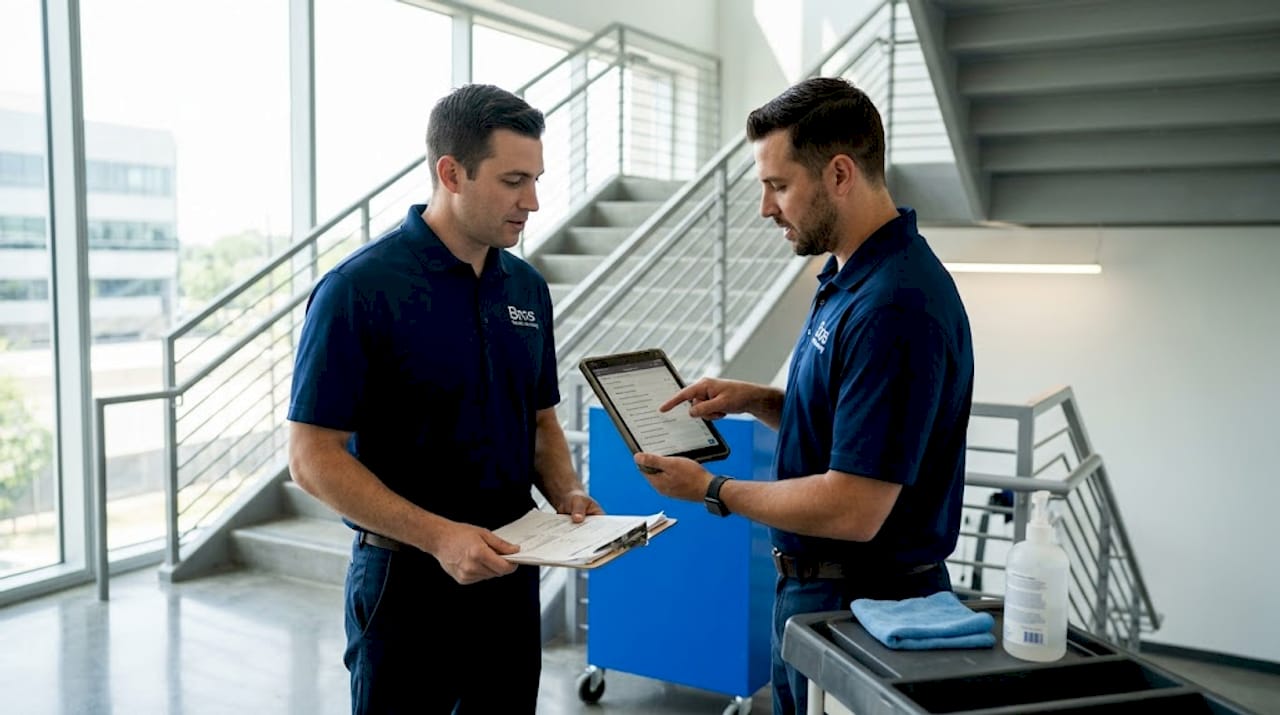
The handoff between shifts is one of the highest-risk moments in any cleaning operation. Communicate clearly in writing, not verbally. A documented shift summary that logs tasks completed, areas flagged, and supplies needing restock takes three minutes to produce and prevents hours of confusion.
Common pitfalls in workflow execution
Knowing how to design a workflow and actually executing it consistently are two different problems. Here’s where most operations break down.
Quality failures most often happen at three specific moments: when a new site is being onboarded, during shift handoffs, and when an experienced worker leaves. These aren’t random events. They’re predictable. That means you can build systems to catch them before they damage client relationships.
The staffing reality is brutal and worth stating plainly. Annual turnover in commercial cleaning can reach 200%, with replacement costs ranging from $1,000 to $5,000 per worker. If you’re treating recruitment as something you do when someone quits, you’re always behind. Recruiting has to be a continuous background activity, not a crisis response.
Scale introduces its own complexity. Operations managing five or fewer sites can often rely on direct supervisor oversight. Once you cross ten sites, that approach collapses. Centralized digital platforms for scheduling, communication, and quality control become the only way to maintain consistency without burning out your managers.
Here are the most common execution problems and how to address them:
- Undocumented SOPs: If procedures live only in someone’s head, they leave when that person leaves. Every procedure must be written and accessible digitally at the point of service.
- Over-reliance on verbal communication: Verbal briefings create ambiguity. Written task cards with photo references eliminate it.
- Skipping pre-clean inspections: A two-minute walk before starting work catches existing damage and prevents your crew from being blamed for it.
- No feedback loop: Crews who never hear whether their work was good or needs improvement have no reason to improve. Build in a regular feedback mechanism.
The best property management cleaning tip I can offer is this: your workflow is only as strong as its weakest handoff point. Audit those moments specifically, not the overall process.
Pro Tip: For outsourcing cleaning services for specialized tasks like exterior washing, window cleaning, or pressure washing, treat the vendor handoff the same way you treat an internal shift handoff. Document scope, photograph baseline conditions, and confirm outputs in writing.
Measuring success and improving over time
Designing a workflow and running it isn’t enough. You have to know whether it’s working. That requires deliberate measurement and a willingness to act on what the data shows.
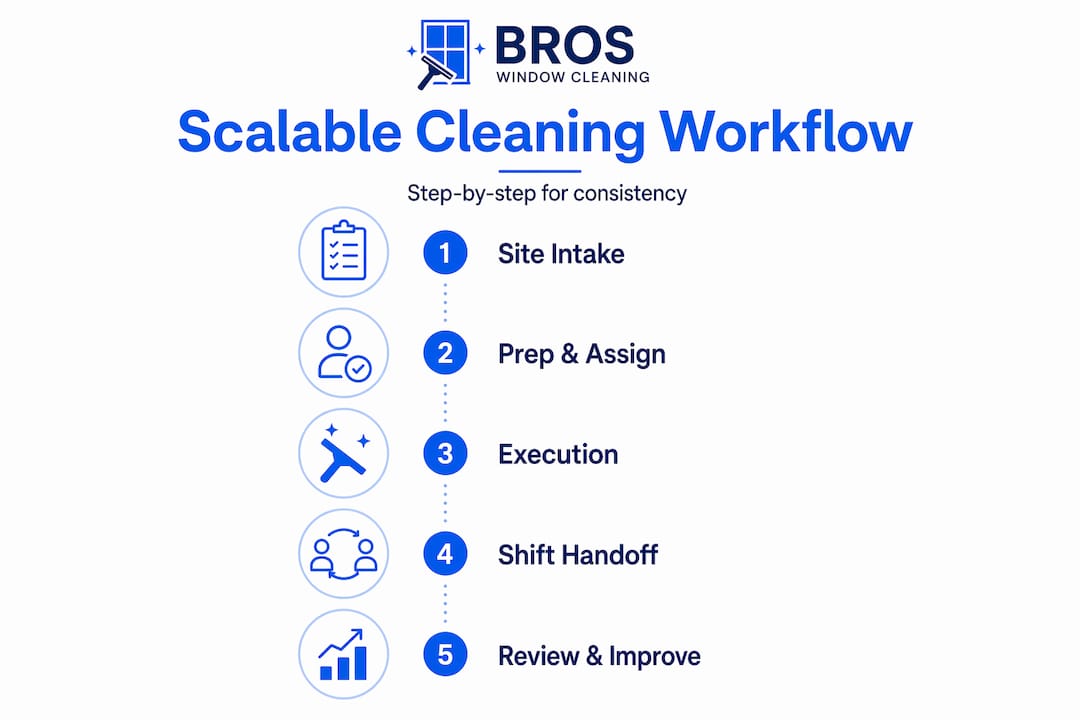
Photo-verified inspections completed in five minutes consistently outperform hour-long manual walk-throughs in multi-site operations. The reason is simple: photo evidence is objective, time-stamped, and transferable. Any manager can review it without being physically present. This matters enormously as your portfolio grows.
Set up a client reporting rhythm from day one. Monthly reports that include inspection scores, task completion rates, and flagged issues demonstrate transparency and give clients something concrete to evaluate. Documented verification and photo evidence directly correlate with client retention. Clients who can see the record of what was done are far less likely to question the value they’re receiving.
Here are the key metrics to track:
- Inspection scores per site on a weekly or bi-weekly basis
- Task completion rate from your digital checklists
- Response time to client-reported issues
- Gross margin per labor hour by property type
- Staff retention rate month over month
| Metric | Why it matters | Review frequency |
|---|---|---|
| Inspection score | Catches quality drift before clients notice | Weekly |
| Task completion rate | Identifies skipped steps and coverage gaps | Daily |
| Labor margin per site | Shows where pricing or efficiency needs adjustment | Monthly |
| Staff retention | Flags cultural or operational problems early | Monthly |
Advanced operations can layer in predictive maintenance from cleaning data. When your crews document what they observe during cleaning, that data can flag early signs of wear, leaks, or surface degradation before they become expensive repair bills. Most property managers don’t use cleaning data this way, which makes it a real competitive advantage for those who do.
My honest take on building workflows that last
I’ve seen a lot of cleaning operations that were built on the strength of good people rather than good systems. They work beautifully until a key person leaves, and then they crater. The hard lesson is that people are not a substitute for process documentation.
What I’ve learned from watching operations scale is that the tipping point hits earlier than most owners expect. You think you can manage ten sites the way you managed three. You can’t. The coordination complexity multiplies faster than the revenue does. Investing in digital tools and documented SOPs at five sites feels premature. At fifteen sites, it feels like the only thing keeping you sane.
The detail that never gets enough attention is how standardizing by building type transforms training. When you have a “medical office protocol” and a “retail protocol,” new hires learn a system rather than memorizing a one-off account. That single shift cuts onboarding time and dramatically reduces quality breaks during the first few weeks.
My take on professional cleaning tools: the equipment difference matters less than the system around it. A crew with mid-range tools and a clear workflow will consistently outperform a crew with premium equipment and no structure. Invest in both, but sequence it correctly. Build the system first.
— nolan
How Broswindowcleaningoc can support your cleaning workflow
If you manage commercial property in Orange County, getting the exterior components of your workflow handled by a specialist changes what your in-house team has to cover.
Broswindowcleaningoc delivers commercial window cleaning services alongside pressure washing, roof cleaning, solar panel cleaning, and gutter maintenance. These are exactly the specialty tasks that fall through the cracks of most internal workflows because they require equipment and expertise that general janitorial staff don’t have. Handing those off to a trusted Orange County cleaning team means your internal workflow covers what it’s built for, and the exterior work gets done by people who do it every day. Contact Broswindowcleaningoc to build a scheduling cadence that fits your property’s needs.
FAQ
What is a business property cleaning workflow?
A business property cleaning workflow is a documented, repeatable system that defines who cleans what, when, in what order, and how quality is verified. It covers daily tasks, shift handoffs, client reporting, and continuous improvement processes.
How often should high-touch surfaces be disinfected in commercial properties?
High-touch surfaces like door handles, keyboards, and phones should be disinfected daily. These surfaces can carry significantly elevated bacteria levels and pose compliance risks if not addressed every shift.
What causes the most quality failures in commercial cleaning operations?
Quality breaks most often occur during new site onboarding, shift handoffs, and when experienced workers leave. Documented SOPs and digital verification significantly reduce the risk at each of these points.
How do I scale a cleaning workflow beyond ten sites?
Managing more than ten commercial properties requires a centralized digital platform for scheduling, task tracking, and quality control. Manual coordination becomes a bottleneck at this scale and creates costly errors and coverage gaps.
Is it worth outsourcing specialty cleaning tasks like window or pressure washing?
Yes. Specialty tasks like window cleaning and pressure washing require equipment and technique that most in-house or general janitorial teams aren’t set up to handle. Outsourcing these tasks to a specialist keeps your core workflow focused and your property presentation consistent.