
Soft washing, low pressure with an algae-killing solution, is the right first choice for algae, moss, and general grime on asphalt shingles. Pressure washing usually does more harm than good on shingles and should be limited to durable surfaces like some metal roofs. Call a professional for steep pitches, multi-story homes, tile roofs, or any job where a mistake could void your shingle warranty.
TL;DR:
- Pressure washing is harmful to asphalt shingles because it strips protective granules, accelerating roof aging and increasing the risk of leaks.
- Soft washing uses low pressure and specialized biocidal solutions, making it the safest method for cleaning asphalt shingles without damaging the material.
- Mechanical moss removal should be combined with chemical treatment afterward, especially on tile roofs, to prevent rapid regrowth and spores reestablishment.
- Chemical options like sodium hypochlorite and oxygen bleach vary in speed and landscape safety, but proper landscape protection and runoff control are essential.
- Certification, proper process description, and landscape protection are critical when hiring professionals; DIY pressure washing on shingles is a risk that often voids warranties.
Table of Contents
- What Are the Main Roof Cleaning Methods?
- Is Pressure Washing Bad for Your Roof?
- How Do You Soft Wash a Roof Safely?
- When Do You Need Manual or Mechanical Moss Removal?
- What Chemical Mixes and Products Actually Work?
- What Safety and Warranty Risks Should You Know About?
- Should You DIY Roof Cleaning or Hire a Professional?
- How Often Should You Clean and Maintain Your Roof?
- Where Does Bros Window Cleaning Fit Into Roof Care?
- Which Roof Cleaning Method Should You Choose?
- The Gap Between Roof Cleaning Advice and Roof Cleaning Reality
- Get Your Roof Cleaned the Right Way
- Sources
What Are the Main Roof Cleaning Methods?
Five approaches cover almost every roof cleaning job, and picking the wrong one is how homeowners end up paying for a new roof years early.
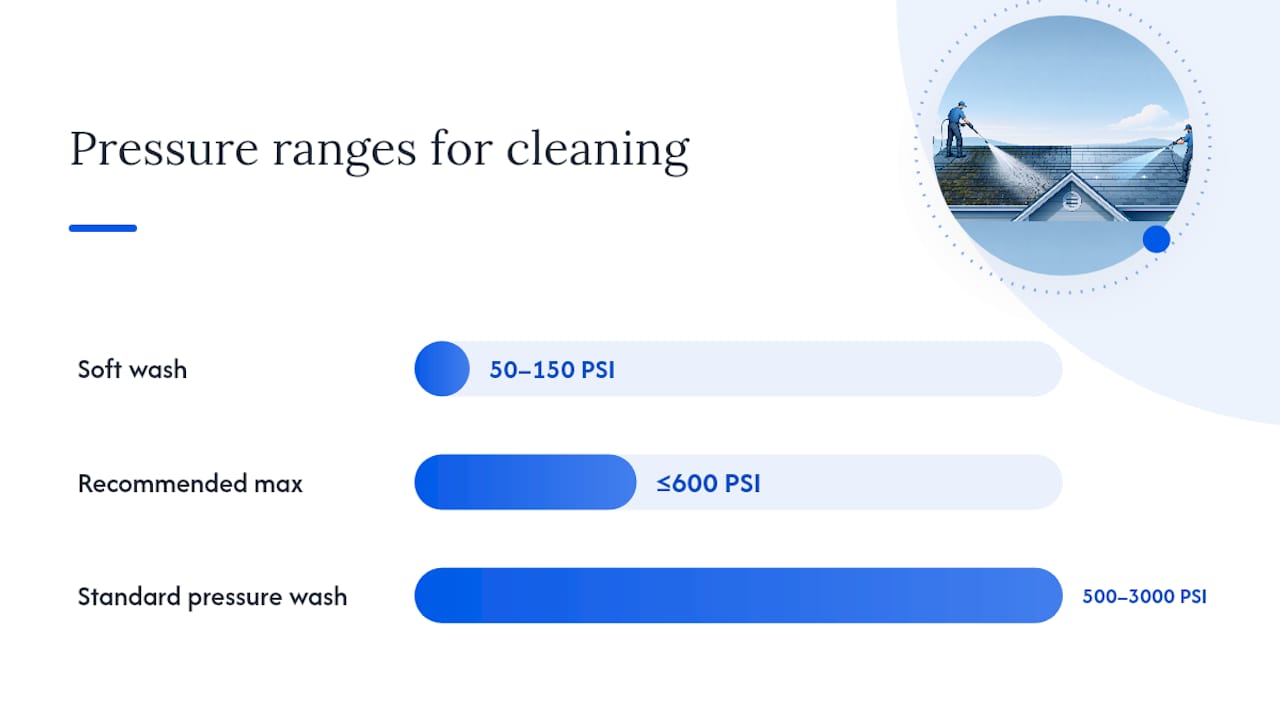
- Soft washing: low-pressure application (typically under 600 PSI) of a biocidal cleaner that kills algae, moss, and mildew at the root rather than blasting it off.
- Pressure washing: high-pressure water, sometimes up to 3,000 PSI, used mainly on hard, non-granular surfaces.
- Manual/mechanical removal: hand scraping, soft-bristle brushing, or leaf blowers for thick moss and debris buildup in valleys.
- Apply-and-leave chemical treatments: sprays that sit on the roof and work over weeks without a required rinse.
- Preventative zinc or copper strips: installed at the ridge to release metal ions that inhibit algae regrowth over time.
Algae shows up as dark streaking, moss as green cushioning near valleys and shaded slopes, and general grime as dulled color across the whole field of shingles. Each has a preferred fix, but material sensitivity matters more than the stain itself. Asphalt shingles lose their protective granules under force. Tile cracks under foot traffic. Metal usually tolerates more, but seams and coatings can still be at risk. Before choosing a method, check whether your shingle manufacturer’s documentation flags pressure washing because that single detail can decide whether a repair bill lands on you or on a warranty claim.
Is Pressure Washing Bad for Your Roof?
For asphalt shingles, yes, in most cases. Standard pressure washers operate at 500 to 3,000 PSI, while soft washing stays under 600 PSI and often runs as low as 50 to 150 PSI. That gap is the entire story: high pressure strips the protective granules embedded in asphalt shingles, and once granules are gone, UV rays and moisture reach the asphalt mat directly, aging the roof years faster than normal.
Pressure washing can also force water under shingle tabs, lifting them or driving moisture into the underlayment, which sets up rot that shows up months later as a ceiling stain. This Old House specifically warns against pressure washers on shingles for these reasons, and it’s a caution echoed by contractors and manufacturers alike.
Where does high pressure actually make sense? Some metal roofing, poured concrete tile, and certain masonry surfaces can handle it, provided the operator keeps the nozzle at a safe distance and angle. Even then, seams, fasteners, flashing, and painted coatings are vulnerable spots that a careless pass can damage.
- Never point a pressure washer directly at shingle edges or ridge caps.
- Avoid pressure washing on any roof older than 15 to 20 years, where granule loss has already begun.
- If a roof only needs light dust or leaf debris removed, a garden hose on a fan spray often does the job with zero risk.
If you’re set on pressure equipment for driveways, siding, or decks around the same property, a homeowner’s guide to pressure washing safely covers technique for surfaces that can actually take the force.
Pro Tip: If a contractor’s first suggestion for a shingle roof is a pressure washer, get a second opinion. That single detail tells you more about their process than anything else in the pitch.
How Do You Soft Wash a Roof Safely?
Soft washing uses low pressure, generally 50 to 150 PSI and never above 600 PSI, to apply a cleaning solution that kills algae and moss rather than scrubbing them off by force. The chemistry does the work; the water just carries it and rinses residue afterward.
The Asphalt Roofing Manufacturers Association recommends a diluted sodium hypochlorite solution for common algae and moss growth on shingles, and contractor guides like RoofScour lay out the practical steps most professionals follow:
- Mix the solution. A common starting point is a roughly 50:50 household-bleach-to-water mix, though pool-grade sodium hypochlorite is far more concentrated and needs a much heavier dilution to avoid overkill on the roofing material and surrounding plants.
- Apply with a pump sprayer or soft-wash rig set to low PSI, working the solution evenly across the affected area.
- Let it dwell. Fifteen to twenty minutes is a typical window, long enough for the biocide to kill algae and moss at the root without letting the solution dry on the shingle, which can leave streaking.
- Rinse from ridge to eave at low pressure, following the natural flow of water off the roof rather than fighting it.
- Apply a post-clean biocide treatment if you want to stretch the interval before the next full cleaning.
Older shingles need a lighter touch. If your roof is past the 15-year mark, reducing chemical strength and dwell time helps avoid compounding existing granule loss.
Sodium hypochlorite isn’t the only path. Oxygen bleach (sodium percarbonate) is gentler on plants and less likely to bleach nearby landscaping, though it usually needs a longer dwell time and may take a second application to match bleach’s results. Apply-and-leave products work on a completely different timeline, showing visible improvement over weeks rather than a same-day rinse.
A full walkthrough of equipment and technique lives in Bros Window Cleaning’s soft-wash guide, useful if you want to understand the process before hiring it out or attempting it yourself.
When Do You Need Manual or Mechanical Moss Removal?
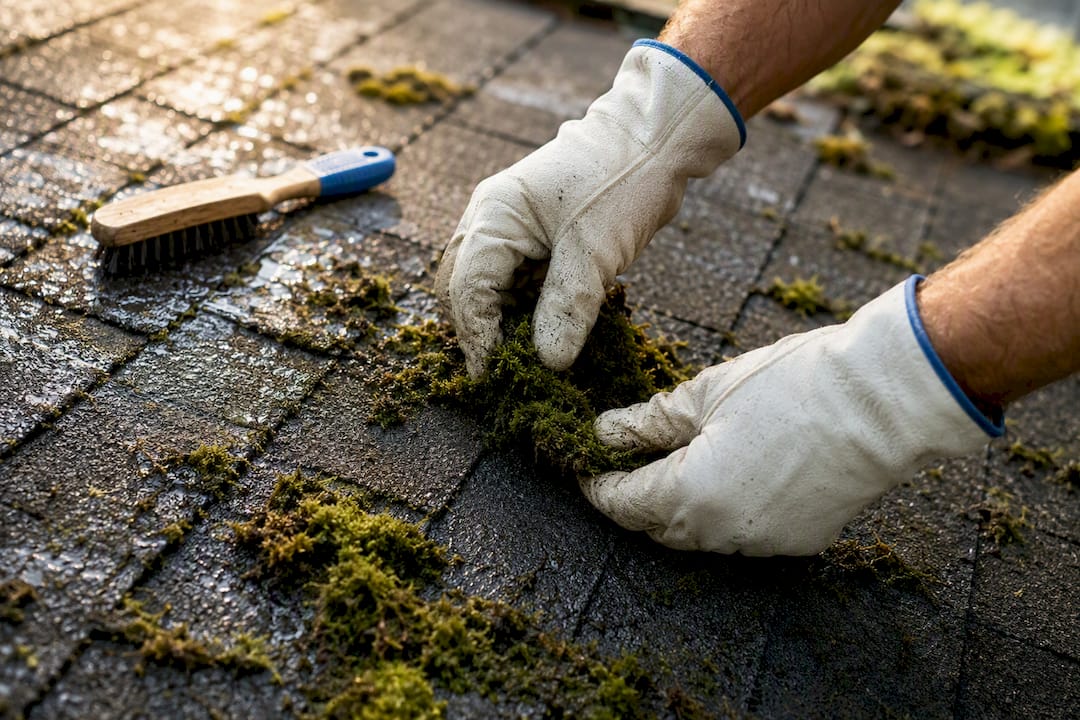
Chemical treatment alone won’t cut it when moss has built into thick, spongy mats or when valleys and gutters are packed with organic debris. That’s when hands, brushes, and blowers come into play before any liquid touches the roof.
- Use a soft-bristle brush to loosen moss without gouging the shingle surface.
- Clear loose debris with a leaf blower before applying any cleaning solution, since trapped organic matter holds moisture and feeds regrowth.
- Work ridge to eave, the same direction water naturally flows, to avoid forcing debris or moisture under shingle tabs.
- Hand-pull large moss clumps gently rather than scraping aggressively across the shingle face.
Tile roofs deserve a separate warning. Walking directly on tile is one of the most common causes of cracked and broken pieces, since foot pressure concentrates weight on a brittle surface never designed to bear it. Professional crews typically use aerial lifts or boom lifts instead of walking the roof, spreading access load away from fragile tile fields entirely.
Once the mechanical work is done, a follow-up biocide application matters more than people expect. Scraping or brushing removes visible moss but leaves spores and root structures behind, and skipping the chemical step afterward means the same moss patch reappears within a season.
Pro Tip: Never scrape moss off a dry roof. Lightly wet the area first, moss lifts away far more easily and you’re less likely to gouge the shingle underneath.
What Chemical Mixes and Products Actually Work?
The chemistry side of roof cleaning comes down to a short list of tested options, each with a different tradeoff between speed, strength, and how gentle it is on the yard around your house.
Sodium hypochlorite (household bleach) is the ARMA-backed standard. A roughly 50:50 mix with water handles most algae and moss cases on asphalt shingles, though the exact ratio should shift depending on whether you’re using standard household bleach or a far more concentrated pool-grade product, where over-dilution mistakes go the wrong direction fast. ARMA’s guidance also stresses low-pressure rinsing after the dwell period, never a pressure washer, to protect the shingle surface.
Oxygen bleach (sodium percarbonate) trades some speed for safety around landscaping. It’s less likely to scorch grass or shrubs that catch overspray, but it typically needs a longer dwell time and sometimes a repeat application to match what sodium hypochlorite does in one pass.
Apply-and-leave products, the Wet & Forget category of treatments, work on their own schedule. Results typically show up over weeks rather than within a day or two, but they skip the active rinsing step that rinse-required products demand, which some homeowners and property managers prefer for lower-maintenance jobs across multiple buildings.
Protecting the landscape around the roof matters as much as picking the right chemical:
- Pre-wet all plants, shrubs, and grass near the drip line before applying any bleach-based solution.
- Cover or relocate anything valuable, patio furniture, delicate plantings, pool equipment, before starting.
- Re-wet the same landscaping after rinsing to dilute any runoff that made it past the initial soak.
- Wear gloves, eye protection, and old clothing; bleach solutions splash more than people expect on a pitched surface.
- Direct runoff away from storm drains where local rules restrict chemical discharge.
If your property has extensive gardens or shared common areas, a contractor familiar with runoff control and general site protection, the kind of work covered by general contracting and cleanup services, can make the landscape side of the job far less stressful than handling it solo.
What Safety and Warranty Risks Should You Know About?
Roof cleaning carries two separate risk categories that homeowners tend to underweight: personal safety and manufacturer warranty language. Both deserve attention before the first drop of cleaner hits the shingles.
- Fall protection isn’t optional on a pitched roof. A harness anchored to a fixed point, slip-resistant footwear, and a properly secured ladder are the baseline. If the pitch is steep or the house has more than one story, that’s a strong signal to hire a professional with the right equipment rather than improvise.
- Chemicals affect more than the roof. Solar panels, in particular, can be etched or clouded by aggressive cleaning agents, so any nearby array needs to be covered or the treatment plan adjusted to avoid overspray.
- Warranties often have specific language about cleaning method. GAF and other manufacturers caution that improper cleaning, especially high-pressure washing, can void part of a shingle warranty. Read your documentation before any contractor sets foot on the roof.
- Runoff control isn’t just a courtesy. Many municipalities restrict what can legally drain into storm systems, so containing bleach-based runoff protects you from more than just an angry neighbor.
Checking a roof’s slope, age, and material against these four points before you start is the fastest way to avoid a cleaning job that costs more than it saves.
Should You DIY Roof Cleaning or Hire a Professional?
Some jobs are genuinely doable on a Saturday afternoon. Others turn into an insurance claim if you get them wrong. The line between the two usually comes down to four factors.
- Roof pitch and height: anything steeper than a gentle slope, or any multi-story home, shifts the risk calculus toward hiring out the work.
- Shingle age: roofs past 15 years need gentler chemistry and more careful handling, which is easier to guarantee with an experienced crew.
- Persistent moss or algae: if a DIY treatment hasn’t held for more than a season, a professional-grade approach and post-clean biocide may be the real fix.
- Warranty status: an active manufacturer warranty makes the cost of a DIY mistake much higher than the cost of hiring correctly.
Cost ranges vary by square footage, roof access, and how severe the buildup is, so get a written quote before committing to a specific contractor.
Before signing anyone, confirm they carry insurance, ask them to describe their process in plain language (soft wash versus pressure, chemical list, dwell time), and request how they plan to protect landscaping and solar equipment. A vague answer, or a hard push toward pressure washing on a shingle roof, is the clearest red flag you’ll get before the work starts.
How Often Should You Clean and Maintain Your Roof?
Most homes need a full roof cleaning every few years, with more frequent cleaning needed in humid climates or areas with heavy tree cover, both conditions that accelerate algae and moss growth.
- Trim overhanging branches to reduce shade and organic debris that feeds moss.
- Clear gutters and valleys in the fall to prevent moisture buildup against shingles.
- Consider zinc or copper ridge strips at your next roof replacement to inhibit algae regrowth.
- Apply a post-clean biocide after washing to extend the interval before the next major cleaning.
Routine debris and gutter maintenance measurably reduces algae and moss risk, and a post-clean biocide combined with ridge strips can stretch the interval between full cleanings from roughly one to two years out to two to three or more, depending on climate.
Spring and fall tend to be the best windows for a full cleaning, avoiding the heat that speeds up chemical drying and the freezing temperatures that make roof access dangerous. In wildfire-prone regions, keeping debris cleared matters even more, since dry organic buildup is fuel. In snow-heavy climates, timing cleaning before the first freeze prevents trapped moisture from turning into ice damage. For a deeper look at why consistent upkeep protects resale value, see why removing roof moss protects your property.
Where Does Bros Window Cleaning Fit Into Roof Care?
Some professional cleaning services handle roof cleaning alongside gutter cleaning and solar panel cleaning, three services that tend to need attention at the same time since debris, algae, and grime rarely stay confined to one surface. Many professionals follow soft-wash protocols rather than defaulting to pressure equipment on shingle roofs, which lines up with the ARMA and manufacturer guidance covered above.
What separates a good roof-cleaning appointment from a bad one usually isn’t the chemical, it’s whether the crew protects your landscaping, arrives when they say they will, and carries insurance that actually covers the work being done. Those are the operational basics a reputable cleaning company builds its reputation on, alongside a straightforward booking process for residential and commercial properties. For a fuller picture of what a professional cleaning actually addresses beyond curb appeal, the roof cleaning benefits guide breaks down the specifics.
Which Roof Cleaning Method Should You Choose?
| Problem | Recommended method | Material notes |
|---|---|---|
| Algae streaking on shingles | Soft wash with diluted sodium hypochlorite | Reduce strength on shingles 15+ years old |
| Thick moss mats | Manual removal, then biocide treatment | Never scrape dry; wet first |
| General grime, no algae | Low-pressure rinse or garden hose | No chemical needed in most cases |
| Hard, non-shingle surfaces | Pressure washing may be acceptable | Keep nozzle distance controlled |
| Tile roof cleaning | Soft wash only, aerial access | Never walk directly on tile |
Before starting any DIY job: wear eye protection and gloves, wet all nearby landscaping first, never point a pressure washer at shingle edges, and stop immediately if the roof pitch or height feels unsafe to work on. Before hiring anyone: confirm insurance, get the chemical list and process in writing, and ask for references on similar roof materials.
The Gap Between Roof Cleaning Advice and Roof Cleaning Reality
Most roof cleaning content online treats pressure washing and soft washing as interchangeable options, a matter of preference rather than a decision with real consequences for shingle life. That framing undersells the actual damage mechanism. Granule loss doesn’t announce itself the day the pressure washer runs; it shows up two winters later as a leak nobody can trace back to the cleaning appointment that caused it.
The conventional advice also tends to underweight shingle age. A 5-year-old roof and an 18-year-old roof shouldn’t get the same chemical strength or dwell time, yet plenty of DIY guides hand out one recipe for every roof. Adjusting for age isn’t a nice-to-have detail. It’s the difference between a treatment that restores a roof and one that quietly finishes the job pressure washing would have done faster.
What actually deserves more attention than it gets: post-clean biocide and ridge strips. Homeowners fixate on the cleaning event itself and ignore the prevention step that stretches years between cleanings. Get that part right, and the whole debate over which chemical or method to use next time becomes far less urgent.
— nolan
Get Your Roof Cleaned the Right Way
Reading about dilution ratios and dwell times is one thing. Standing on a ladder with a pump sprayer and a bottle of bleach, on a roof you’re not sure you should be climbing, is another. Some professional services offer Orange County homeowners and property managers a soft-wash service that follows the same low-pressure, ARMA-aligned approach outlined above, without the fall risk or the warranty gamble of doing it yourself.
Such crews often carry insurance, protect landscaping before any chemical touches the roof, and show up when scheduled, the kind of reliability that matters most when trusting someone with your roof’s warranty status. If your shingles are showing algae streaking, your tile roof needs aerial access instead of foot traffic, or you just want a quote before deciding between DIY and professional, get a look at the roof cleaning services page and request a quote for your property today.
Sources
- Algae discoloration of roofs | Asphalt Roofing Manufacturers Association (ARMA)
- How to get algae and moss off the roof | This Old House
- How to clean algae off roof shingles | RoofScour
- Annual maintenance and roofing tips for every homeowner | GAF