
Baseline: daily spot checks on entry doors and service glass, a weekly storefront cleaning for any restaurant with real foot traffic, a monthly interior deep clean, and a professional exterior deep clean each spring and fall. That cadence exists because grease and airborne particulates from a working kitchen build up faster than they would on a retail storefront or an office lobby. Restaurant window cleaning carries stricter constraints than typical commercial glass because inspectors read visible grime as a sanitation signal, not just a cosmetic one.
Time the deeper cleanings for off-hours, before open or after close, and schedule a professional pass one to two weeks ahead of any expected health inspection. If you manage a single location, assign one staff member to own the weekly check this week. If you’re overdue for a deep clean, book one now rather than waiting for a complaint or a citation.
- Daily: wipe entry doors, host stand glass, and POS-facing windows
- Weekly: full storefront wipe, interior and exterior where safe
- Monthly: frames, tracks, ledges, and a seal inspection
- Seasonal: professional exterior deep clean, spring and fall
Why it matters: monthly interior cleaning paired with twice-yearly exterior deep cleans is the common baseline across commercial properties, and restaurants that skip it tend to accumulate the kind of baked-on film that takes a professional degreaser to remove.
Key Takeaways
A restaurant window cleaning schedule works when daily spot-checks, weekly wipe-downs, monthly deep tasks, and seasonal professional cleanings are each assigned to a specific owner and logged.
| Point | Details |
|---|---|
| Baseline cadence | Daily spot checks, weekly storefront wipes, monthly deep tasks, and seasonal professional exterior cleans. |
| Adjust for restaurant type | Quick-service and drive-through locations need weekly exterior cleaning due to grease and exhaust exposure. |
| Adjust for climate | Coastal, urban, and desert locations often need monthly exterior cleaning to manage salt, pollution, or dust. |
| Time it around inspections | Book a professional clean one to two weeks before expected audits and keep dated logs and photos. |
| Bring in Broswindowcleaningoc for the hard parts | Broswindowcleaningoc handles seasonal deep cleans, pre-inspection work, and high-reach glass with insured, off-hours crews. |
Table of Contents
- How Often Should You Clean Restaurant Windows on a Practical Schedule?
- Adjusting the Schedule for Your Restaurant Type and Location
- Building an Operational Checklist That Doesn’t Disrupt Service
- Timing Your Cleaning Schedule Around Health Inspections
- Where Bros Window Cleaning Fits Your Restaurant’s Schedule
- Safety, Insurance, and Trusting the Crew on Your Property
- What to Do When a Window Gets Damaged or Stained Without Warning
- Keeping Records That Prove You’re Staying on Schedule
- Sources
How Often Should You Clean Restaurant Windows on a Practical Schedule?
A restaurant window maintenance plan works best when it’s broken into four cadences, not one blanket rule. Here’s how to structure it:
- Daily spot-cleaning. Hit high-touch glass, entry doors, service windows, and anything facing the register, with a microfiber cloth and a food-safe cleaner. This takes a host or busser under five minutes and it’s the single biggest lever against the “smudged glass” complaint that shows up in online reviews.
- Weekly full wipe-downs. Interior glass gets a complete pass, and exterior storefront glass gets cleaned wherever it’s safe to reach without a ladder or lift. Grease film near the kitchen or bar gets a degreaser pass, not just glass cleaner. Daily spot-cleaning paired with weekly wipe-downs is the pattern most practical restaurant cleaning guidance converges on.
- Monthly deep tasks. Frames, tracks, and ledges get scrubbed, and someone checks seals for cracking or gaps that let in dust and moisture. If buildup is visible despite the weekly wipe, that’s your cue to bring in a professional for the exterior rather than letting staff fight it with a squeegee.
- Seasonal professional deep cleans. Spring and fall are the two windows most operators use for a full exterior service, timed to strip mineral deposits, pollen film, and the grime that accumulates over a season. Screens, where present, get pulled and cleaned during this pass too.
Pro Tip: Keep two separate cleaning kits, one for glass and one for grease. A degreaser wiped onto glass with the same rag you used on a fryer hood will streak every window it touches, and staff will blame the cleaner instead of the technique.
Stock a squeegee, several microfiber towels, a food-safe degreasing solution, and an extension pole for any glass above eight feet. Skipping the pole is how you end up with staff on chairs, which is its own liability problem entirely separate from the windows.
Adjusting the Schedule for Your Restaurant Type and Location
Not every restaurant needs the same rhythm. A quick-service counter with a drive-through sees more exhaust and grease exposure per week than a white-tablecloth dining room, and drive-through enclosures accumulate exhaust particulates and grease faster than standard storefronts, which is why weekly exterior cleaning is the common recommendation for that format.
- Quick-service and drive-through: weekly exterior cleaning plus multiple daily spot checks at the pickup window and order glass
- Full-service dining: weekly or biweekly exterior cleaning, monthly interior deep cleans, with extra attention to bar mirrors and glass near an open kitchen
- Coastal locations: monthly exterior cleaning to cut through salt film before it etches the glass
- Urban, high-traffic corridors: monthly or biweekly cleaning to manage soot and pollution; high-pollution areas sometimes need several exterior cleanings per year just to keep smog film from becoming permanent
- Desert and dusty regions: monthly cleaning to prevent abrasive dust from scratching glass during routine wiping
Ground-level storefronts are easy to fold into a weekly staff routine. Second-story dining rooms or high-rise restaurant space usually need a pole system or a professional with the right lift equipment, and that’s typically where the schedule shifts from “assign a busser” to “book a vendor.”
Pro Tip: If your restaurant sits within a mile of the coast, don’t wait for visible haze to call it in. Salt film is often invisible until it’s etched, and by then a standard cleaning won’t fully reverse it.
Building an Operational Checklist That Doesn’t Disrupt Service
The best cleaning windows are the ones nobody notices: right after close or an hour before open, when there’s no dining room to work around and no kitchen line to dodge with a ladder. If you’re coordinating with an outside crew, confirm they’re comfortable working those hours and that someone on staff is there to unlock doors and flag any areas that need extra care.
- Assign daily and weekly tasks to specific shifts, not “whoever has time,” so the job doesn’t quietly disappear during a busy week.
- Log completion with a simple sheet or a quick photo taken on a phone. A photo takes ten seconds and gives you a dated record if a complaint or inspection ever comes up.
- Before any vendor starts work, confirm insurance coverage, their safety protocol for ladder or pole work, degreaser compatibility with your glass and frames, and whether the quote covers interior, exterior, or both.
- Set a 90-day review. Pull complaint notes and any visibility issues raised by staff or guests, and adjust frequency up or down based on what you actually see.
| Task | Owner | Frequency |
|---|---|---|
| Spot-clean entry and service glass | Front-of-house staff | Daily |
| Full interior/exterior wipe | Assigned shift lead | Weekly |
| Frames, tracks, and seal check | Manager or lead | Monthly |
| Professional exterior deep clean | Outside vendor | Seasonal |
An internal reference like a commercial cleaning checklist helps standardize this across multiple shifts so the routine survives staff turnover.
Timing Your Cleaning Schedule Around Health Inspections
Inspectors don’t grade windows directly, but visible grease film and grimy high-touch glass near the entrance or kitchen pass-through read as a sign of overall sanitation, fair or not. That perception matters more than most managers expect.
- Schedule a professional exterior and interior clean one to two weeks before any expected inspection or major audit, giving enough lead time to strip baked-on grease rather than just surface dust.
- Keep dated logs and photos of past cleanings on hand. Documented cleaning records help demonstrate proactive maintenance during inspections, and a folder of timestamped photos takes an inspector’s question from “prove it” to a five-second scroll.
- Treat pre-inspection cleaning as a supplement to your regular schedule, not a replacement for it. A rushed clean the week before an audit doesn’t undo months of buildup on frames and tracks.
Where Bros Window Cleaning Fits Your Restaurant’s Schedule
Bros Window Cleaning has spent over five years handling commercial and residential window cleaning across Orange County, alongside pressure washing, gutter cleaning, solar panel cleaning, and roof cleaning for the same properties. That range matters when a storefront needs more than glass work during a seasonal deep clean.
Every job runs on full insurance coverage and a safety-first approach to high-reach and pole work, which is exactly the coverage question you should be asking any vendor before they touch your storefront. The company’s own guides, including window cleaning tools for homeowners and its notes on how cleaning frequency affects complaints, reflect the same operational thinking behind this schedule.
- Bring in a professional for seasonal deep cleans, pre-inspection work, and any glass above standard reach.
- Keep daily and weekly tasks in-house where a microfiber towel and a degreaser handle the job cheaper and faster.
Pro Tip: Book seasonal deep cleans a few weeks before your slow season ends, not during it. Vendors have more flexible scheduling then, and you’ll want the glass done before traffic picks back up.
Safety, Insurance, and Trusting the Crew on Your Property
Anyone working above ground level on your storefront should carry liability insurance and, ideally, workers’ compensation coverage that protects you if they’re injured on your property. Ask for proof before the first job, not after something goes wrong. A vendor who hesitates to provide it is telling you something.
Ladder and pole work near a working kitchen adds another layer of risk: wet floors near entrances, staff moving quickly during service, and glass cleaner or degreaser that shouldn’t cross paths with food prep surfaces. A crew that’s done restaurant work before will time their approach around your service hours and know to avoid tracking equipment through areas guests can see.
Trust signals worth checking before you sign anyone on: how long they’ve operated commercially, whether they specialize in food-service properties or just handle them occasionally, and whether they’ll put a cleaning frequency recommendation in writing rather than a vague “we’ll take care of it.” A vendor confident in their process will usually offer a documented plan up front, covering scope, frequency, and what products they use near food-service glass.
Punctuality matters more in a restaurant than almost any other commercial setting. A crew that shows up during your lunch rush because they misjudged timing isn’t just inconvenient, it’s a liability risk with servers moving through the space. Off-hours scheduling should be a baseline expectation, not a special request.
What to Do When a Window Gets Damaged or Stained Without Warning
A cracked pane, a grease splatter from a delivery mishap, or a stubborn hard-water stain on the drive-through window doesn’t wait for your monthly schedule. Handle it the same day it happens, because a fresh stain comes off far easier than one that’s had a week to set.
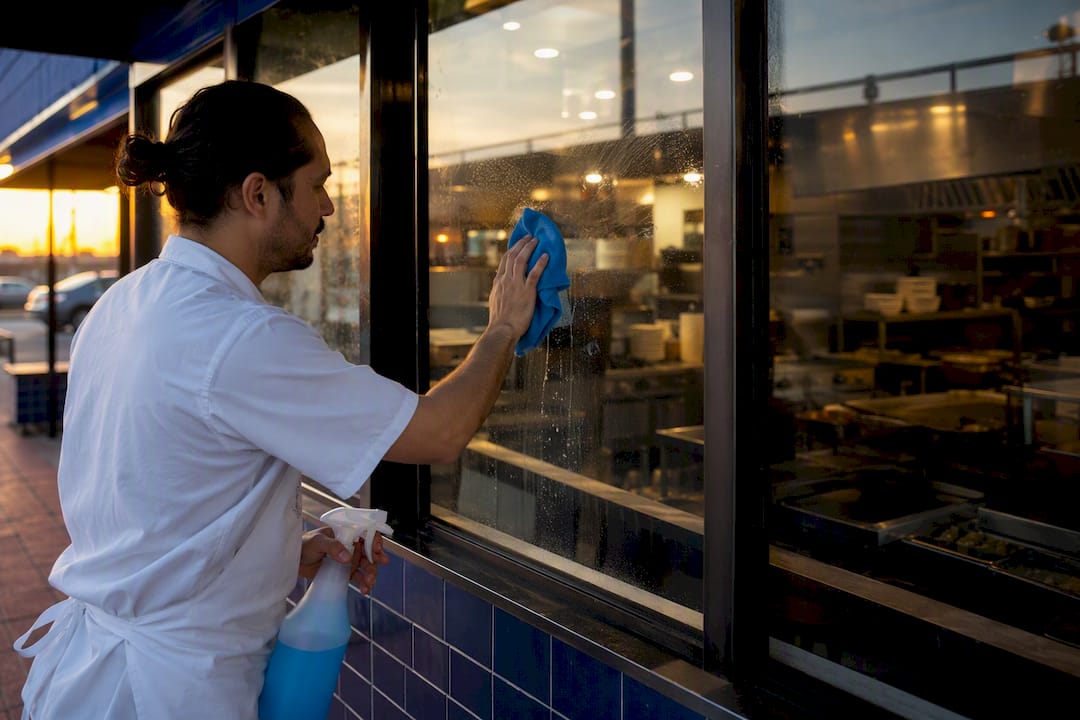
For grease or food splatter, a food-safe degreaser and a microfiber towel usually clear it in one pass. Don’t reach for an ammonia-based glass cleaner on a heavy grease stain first. It’ll smear the grease across more surface area before it cuts through it. For mineral or hard-water spotting, particularly common on drive-through windows exposed to sprinkler overspray, a vinegar-based solution or a dedicated hard-water remover works better than standard glass cleaner.
Cracked or chipped glass is a different category entirely. Tape off the area, keep guests and staff away from it, and call a professional the same day, both for safety and because a compromised pane can fail further under temperature swings or a stiff wind.
Keep a small emergency kit on-site: microfiber towels, a food-safe degreaser, a hard-water remover, and a squeegee. That covers the majority of unplanned messes without waiting on a scheduled visit.
Keeping Records That Prove You’re Staying on Schedule
A cleaning log doesn’t need to be complicated to be useful. A simple sheet with the date, task completed, and initials from whoever did it turns your restaurant window maintenance plan from a verbal habit into something you can point to.
Photos add a layer that a checkbox can’t. A dated photo of a freshly cleaned storefront window, taken on a phone and saved to a shared folder, gives you visual proof during an inspection or when a customer complaint needs a response. It costs ten seconds and pays off the one time you actually need it.

Digital tools work fine for this, but a printed log clipped near the back office works just as well for smaller operations. What matters is consistency: the same format, filled out the same way, every time. If you ever switch vendors or bring on a new manager, that log hands off the entire history of what’s been done and when, instead of relying on memory or word of mouth.
Review the log during your 90-day schedule check. If certain weeks are consistently skipped, that’s a staffing gap, not a scheduling problem, and it’s worth fixing before it shows up as a complaint or an inspection note.
One habit that keeps this schedule honest
Every Monday morning, before the lunch rush, I’d photo-log the exterior windows. It takes two minutes and it does something a checklist alone can’t: it forces you to actually look at the glass instead of assuming last week’s clean is holding up. Track guest comments and inspection notes against that log for 90 days and you’ll know fast whether your frequency is right or just convenient.
— nolan
Get a Recurring Window Cleaning Plan Built Around Your Hours
Broswindowcleaningoc is the alternative to juggling this schedule with whichever staff member has five free minutes. We run recurring plans, weekly, biweekly, or monthly, scheduled around your close or open, so a crew never crosses paths with your lunch rush or dinner service.
Every crew is insured, trained on grease-safe degreasing near food-service glass, and used to timing pre-inspection cleanings one to two weeks ahead of an audit without you having to chase the calendar yourself. For restaurants dealing with coastal salt film, urban grime, or drive-through exhaust buildup, that off-hours consistency is the difference between a schedule you manage and one that manages itself. If you want equipment guidance before your next in-house clean, the window cleaning tools guide covers what to stock. Ready to lock in a recurring plan or a one-time pre-inspection clean? Request a quote and we’ll build the schedule around your hours, not the other way around.
Sources
- Window Cleaning Services for Restaurants and Food Service — National Window Cleaning Authority
- How Often Should Windows Be Cleaned? — This Old House — 2024-11-06
- How Often Should You Clean Your Windows? — Unger USA
- Restaurant window cleaning — Clean My Restaurant