
Hire a professional window-cleaning service. It’s the fastest, safest way to restore clarity, protect Low-E coatings, and avoid the kind of glass damage that shows up as a repair bill months later. That covers exterior glass, frames, sills, tracks, and screens, not just the pane itself.
Pella recommends cleaning windows every one to two months to protect indoor air quality and keep energy-efficient coatings performing the way they were designed to. Commercial and high-rise work adds another layer: crews need to follow OSHA fall-protection standards whenever ladders, lifts, or rope access come into play. If you manage a home, a storefront, or a portfolio of rental units in Orange County, the right move is to request a written, itemized estimate or an on-site assessment from a local provider like Bros Window Cleaning before you commit to anything.
Key Takeaways
Hiring an insured local professional for regular window cleaning protects Low-E coatings, prevents costly etching, and keeps a property looking its best.
| Point | Details |
|---|---|
| Confirm scope in writing | Get an itemized estimate covering glass, frames, sills, tracks, and screens before booking. |
| Verify insurance and safety | Ask for proof of liability coverage and, for high-access jobs, a written safety plan. |
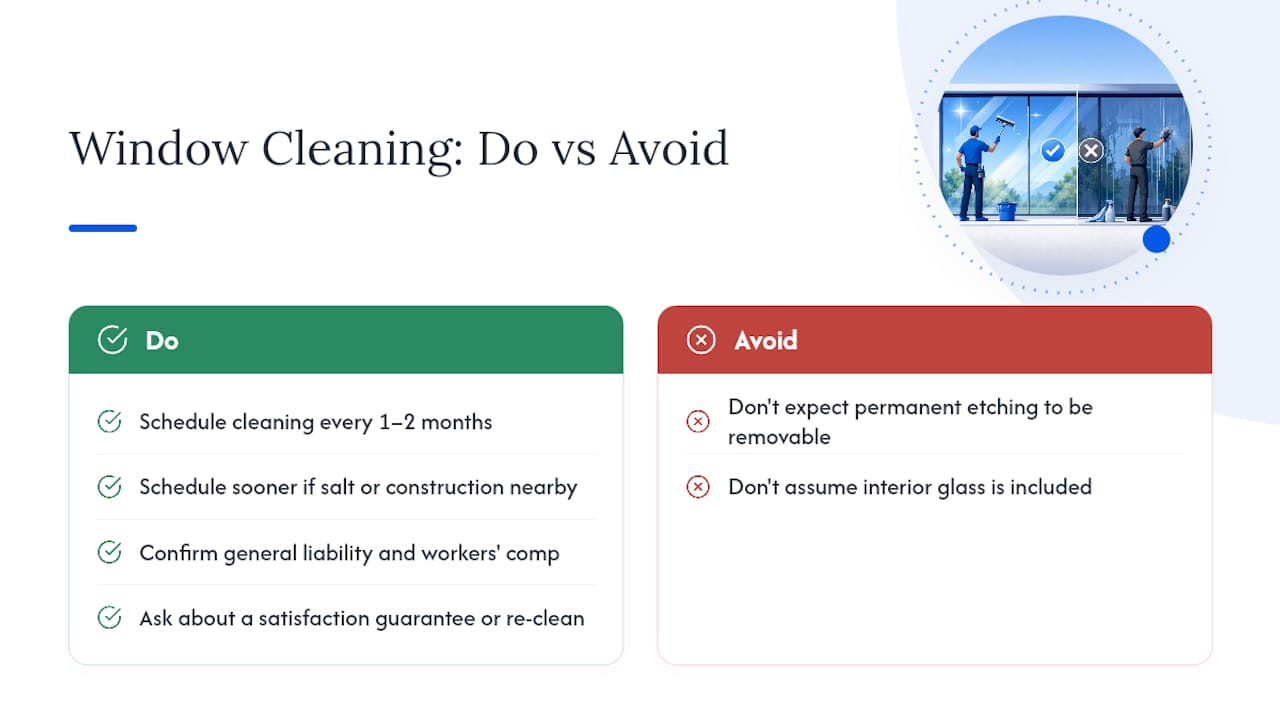
| Match frequency to conditions | Clean every one to two months as a baseline, more often near the coast or construction. |
| Ask about re-clean policy | A trustworthy provider fixes streaks or missed spots at no extra charge. |
| Book with Bros Window Cleaning | Request a free on-site estimate for insured window cleaning and bundled exterior services in Orange County. |
Table of Contents
- What Does Window Tint and Cleaning Actually Include?
- Is Professional Window Cleaning Worth the Cost?
- How Do Professionals Clean Windows Safely?
- What Determines the Price of Window Cleaning?
- How Do You Pick a Trustworthy Window Cleaner?
- How Should You Prepare for the Appointment?
- How Often Should You Really Clean Your Windows?
- What Are the Cancellation and Refund Terms?
- Are There Eco-Friendly Window Cleaning Options?
- A Note From Bros Window Cleaning
- How Bros Window Cleaning Makes Hiring a Pro Easy
- Frequently Asked Questions
- Sources
What Does Window Tint and Cleaning Actually Include?
A professional window-cleaning contract should spell out exactly what’s covered, not leave you guessing after the crew packs up. The industry term for this work is exterior and interior glass maintenance, and a solid scope of work touches more surfaces than most homeowners expect.
Standard service typically includes:
- Exterior glass cleaning on every accessible pane
- Interior glass wipe-down (when requested and access allows)
- Frame and sill cleaning to remove grime buildup
- Track cleaning, since dirt and debris there cause sliding windows to stick
- Screen removal, washing, and reinstallation
- General debris clearing from window wells and ledges
Add-on services fill in the gaps a standard visit doesn’t cover. Pressure washing handles siding and hardscape, gutter cleaning keeps water flowing away from your roofline, and solar panel cleaning restores output that dust and pollen quietly choke off. Hard-water spot treatment is its own category. A trained crew can lift mineral deposits that haven’t bonded to the glass, but permanent etching from years of untreated hard water often requires glass repair or replacement, not another round of cleaning.
| Scope Item | What It Covers | Typically Included? |
|---|---|---|
| Exterior glass | All accessible outward-facing panes | Yes, standard |
| Interior glass | Inside panes, on request | Often, ask upfront |
| Frames and sills | Wipe-down and grime removal | Yes, standard |
| Tracks and screens | Removal, cleaning, reinstall | Yes, standard |
| Hard-water spot treatment | Mineral deposit removal | Add-on |
| Pressure washing / gutters | Siding, hardscape, downspouts | Add-on |
Reputable contractors document all of this with a written scope checklist and before-and-after photos, so there’s no dispute over what “clean” meant when the invoice arrives.
Is Professional Window Cleaning Worth the Cost?
Clean glass does more than look good in listing photos. It protects the window itself. Low-E coatings, the microscopic metallic layer that reflects heat and blocks UV rays, degrade faster when mineral deposits and airborne pollutants sit on the surface for months at a time. Regular cleaning also prevents the kind of etching that turns a $15 cleaning problem into a $400 glass replacement.
Pella’s guidance on window maintenance ties cleaning frequency directly to performance: windows cleaned every one to two months hold onto their energy efficiency and indoor air quality benefits far better than those left to accumulate grime for a full season. Dust, pollen, and smoke film build up on glass just like they do on any other surface in your home, and every time a window is opened, that film migrates indoors.
The practical benefits stack up:
- Lower long-term repair and replacement costs by catching mineral buildup before it etches glass
- Better natural light and reduced allergen load indoors
- Stronger curb appeal that pays off at resale, with clean windows shown to meaningfully boost buyer perception
- Higher tenant satisfaction for property managers juggling multiple units
Pro Tip: If your home sits near the coast or a construction zone, salt spray and dust settle on glass faster than typical suburban grime. That usually means a shorter cleaning interval than the standard one to two months.
How Do Professionals Clean Windows Safely?
The method a crew uses tells you a lot about their experience level. Purified water systems paired with water-fed poles have become the standard for exterior work, especially on second stories and above, because they let technicians clean from the ground without a ladder, which cuts fall risk and usually leaves a streak-free finish since there’s no soap residue to rinse.
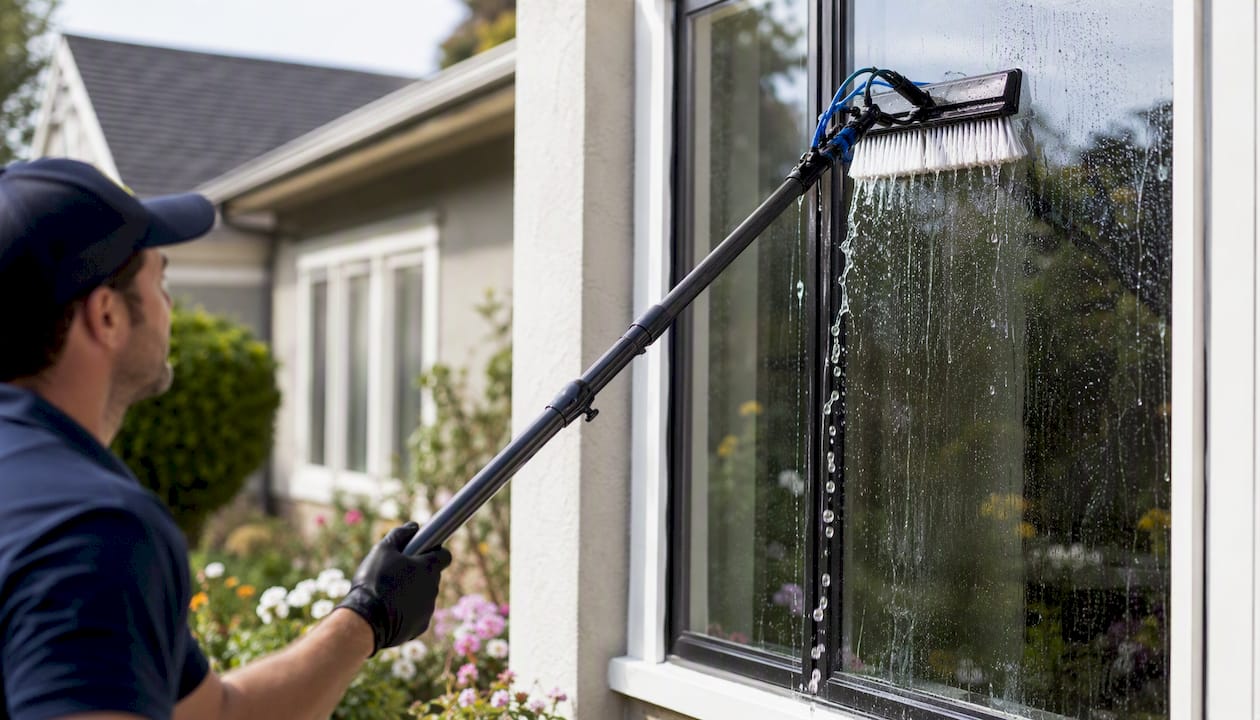
Traditional squeegee work still has its place for interior glass and smaller residential jobs, where a trained hand with a quality squeegee outperforms any automated tool. For commercial buildings and high-rise properties, crews may rely on suspended platforms, rope access, or aerial lifts, all of which require certified training and specialized insurance coverage.
Common tools of the trade include:
- Water-fed poles with onboard pure-water filtration
- Extension poles and industrial-grade squeegees
- Scrapers for construction residue or paint overspray
- Soft-bristle brushes and non-abrasive detergents for frames and sills
Safety compliance separates the pros from the side-hustle operators. Any commercial or high-rise job should follow OSHA fall-protection standards, and the crew should carry proof of general liability insurance and workers’ compensation. Larger commercial contracts often come with a written safe work method statement outlining exactly how the job gets done safely on that specific site.
What Determines the Price of Window Cleaning?
Cost comes down to a handful of measurable factors, not guesswork. Window count and total square footage set the baseline. A single-story ranch home with 15 windows costs far less than a two-story property with 40, simply because more glass means more labor hours.
Height and access complexity move the needle just as much. A single-story home lets a crew work entirely from the ground, while a three-story commercial building may require lifts or rope access, which adds equipment costs and insurance requirements. Commercial pricing reflects those added costs directly, along with the higher coverage limits commercial insurance policies demand.
| Cost Factor | Why It Matters |
|---|---|
| Window count / square footage | More glass equals more labor time |
| Building height | Upper floors need lifts, poles, or rope access |
| Glass condition | Heavy staining or hard-water spots add treatment time |
| Low-E coatings present | Requires non-abrasive methods to avoid damage |
| Bundled services | Pressure washing or gutters add to the visit but often save on a combined trip |
Scheduling patterns differ by property type. Homeowners typically book a one-off cleaning or a seasonal visit, while property managers tend to favor maintenance contracts with fixed pricing on a quarterly or monthly cadence. That predictability matters for budgeting and minimizes tenant disruption, since retail and office properties often need off-hours scheduling to avoid interrupting business.
Most single-family homes take two to four hours depending on window count and access. Commercial jobs scale with crew size. A larger team with proper access equipment set up ahead of time finishes faster, but weather can push a job back a day if wind makes ladder or lift work unsafe.
How Do You Pick a Trustworthy Window Cleaner?
Vetting a contractor takes ten minutes on the phone if you ask the right questions. Start with credentials, then move to specifics about the job itself.
- Confirm proof of general liability insurance and workers’ compensation coverage before anyone steps on your property.
- Ask for a valid business license and, for commercial or high-access work, written safety procedures or a safe work method statement.
- Get the full scope in writing: what’s included, what counts as an add-on, and whether frames, sills, and screens are part of the base price.
- Ask about equipment. Water-fed poles versus ladders tells you how they’ll handle upper stories and whether streaking is likely.
- Ask about warranty or re-clean policy if you’re unhappy with a section of the job.
- Request recent before-and-after photos and at least two references from similar properties.
Watch for red flags before you sign anything:
- Requests for a large cash-only deposit upfront
- No written estimate, just a verbal number
- No proof of insurance when asked directly
- Vague answers about scope or reluctance to name references
Choosing a residential-only cleaner for a commercial job is one of the most common mismatches property managers make. It often means insufficient coverage limits and equipment that isn’t rated for the access requirements of a larger building.
How Should You Prepare for the Appointment?
A little prep work speeds up the visit and protects your belongings. Move valuables and breakables away from interior sills before the crew arrives, and clear furniture blocking window access. Outside, trim back bushes or vines that might scratch the glass or slow the crew down, and flag any special coatings or aftermarket film so the technician uses the right method.
Aftercare matters just as much as the cleaning itself. Bros Window Cleaning’s post-service guidance recommends holding off on automatic sprinklers for 24 to 48 hours after a visit, since mineral-heavy irrigation water can undo the work almost immediately. Wiping down tracks and frames monthly keeps grime from building back up between professional visits.
The final walk-through should include an itemized checklist confirming what was completed, before-and-after photos for your records, and honest notes if the crew spotted a seal issue or early-stage etching that needs attention beyond cleaning.
How Often Should You Really Clean Your Windows?
The one-to-two-month window that Pella recommends works as a solid baseline for most homes, but local conditions shift that number in either direction. Coastal salt spray, heavy pollen seasons, and nearby construction dust all accelerate grime buildup faster than the national average accounts for.
Commercial properties follow a different cadence. Quarterly service is the minimum for most office and multifamily buildings, while storefronts and high-traffic retail façades often need monthly attention since smudges and street grime show up within days on ground-level glass. A quick monthly wipe of tracks and sills between full professional visits stretches the results and keeps sliding windows moving freely.
What Are the Cancellation and Refund Terms?
Reputable window-cleaning companies keep cancellation policies simple and clearly stated in the written estimate before any work begins. Most residential appointments allow rescheduling with reasonable notice, typically 24 to 48 hours, without a penalty, since weather and access issues come up on both sides.
A satisfaction guarantee or re-clean policy is the real safeguard to look for. If a streak or missed spot turns up after the crew leaves, a trustworthy provider sends someone back to fix it at no extra charge rather than treating the job as closed the moment they drive off. Ask about this policy explicitly during your estimate call, and get the answer in writing along with the scope of work.
Are There Eco-Friendly Window Cleaning Options?
Environmental impact comes down mostly to water use and chemical choice. Purified water systems used with water-fed poles clean glass using filtered water alone, without soap or chemical detergents, which means no runoff concerns for landscaping or storm drains nearby.
For frames, sills, and tougher grime, non-abrasive, biodegradable detergents get the job done without harsh chemical runoff. Ask your provider directly whether they use pure-water systems and low-impact cleaning agents, especially if you have edible gardens, pets, or a pool near the work area. It’s a fair question, and any established contractor should have a straight answer ready.
A Note From Bros Window Cleaning
We’ve spent more than five years cleaning windows across Orange County, and the properties that hold up best over time are the ones on a consistent schedule, not the ones that call us once after three years of neglect. Every job we run is fully insured, and our crews follow a documented safety protocol whether we’re on a ladder at a single-story home or working a commercial façade that needs specialized access.
If something isn’t right when we finish, we come back and fix it. That’s not a marketing line, it’s the re-clean policy we operate under on every job. If you’re weighing whether to book a professional visit, the best next step is simple: request an on-site estimate and let us walk the property with you before any work starts.
How Bros Window Cleaning Makes Hiring a Pro Easy
Bros Window Cleaning is the local alternative to guessing your way through DIY ladder work or gambling on an unlicensed crew off a classifieds ad. Our teams are fully insured, and beyond window cleaning we handle pressure washing and gutter cleaning as add-ons, so a single visit can cover more of your exterior maintenance list in one scheduled trip.
Every estimate we provide is written and itemized, so you know exactly what’s covered before a crew touches your property. We back every job with a satisfaction guarantee and re-clean policy, and we’re glad to share before-and-after photos and references from recent Orange County jobs. For property managers dealing with larger glass surfaces, our curtain wall cleaning guide walks through what commercial access and safety planning actually looks like.
Ready to see what your property needs? Request a free, no-obligation on-site assessment through our window cleaning services page and we’ll walk you through pricing, scheduling, and scope before you commit to anything.
Frequently Asked Questions
How often should professional window cleaning happen?
Most homes do well on a one-to-two-month cycle, per Pella’s guidance, though coastal salt exposure or nearby construction can shorten that interval.
What’s included in a standard professional cleaning visit?
Exterior glass, frames, sills, tracks, and screens are standard. Interior glass, pressure washing, and gutter cleaning are typically add-ons.
Does professional window cleaning remove hard-water stains?
Fresh mineral deposits usually come off with proper treatment, but glass with years of permanent etching may need repair rather than cleaning.
What insurance should a window-cleaning company carry?
General liability insurance and workers’ compensation, at minimum, with higher coverage limits expected for commercial or high-rise work.
How long does a typical window-cleaning job take?
Most single-family homes take two to four hours. Commercial jobs vary based on crew size, access setup, and building height.
What if I’m not satisfied with the result?
A reputable provider offers a satisfaction guarantee or re-clean policy, sending someone back to fix any missed spots at no charge.
Sources
- Benefits of Cleaning Windows | Pella