
Rain cleans solar panels sometimes, but not reliably. Whether rainfall keeps your system near peak output depends on three things: how often it rains where you live, how steeply your panels are tilted, and what kind of dirt has built up on the glass. Here is the quick decision rule:
- Climate: Regular rainfall (roughly every one to two weeks) in a temperate region gives rain a real shot at keeping panels reasonably clean.
- Tilt and drainage: Panels mounted at 15° or steeper drain well after rain. Flat or low-tilt arrays pool water, which evaporates and leaves mineral deposits behind.
- Soiling type: Loose dust washes off. Pollen film, bird droppings, coastal salt, and wildfire ash bond to the glass and typically survive multiple rain events.
After the next rain, pull up your inverter app on a clear day and compare output to a similar clear day before the rain. If the numbers are close, rain did its job. If output is still down, you need a manual clean.
Key Takeaways
Rain alone is not a reliable cleaning solution for solar panels: climate, panel tilt, and soiling type together determine whether rainfall maintains acceptable output or leaves bonded residue that only manual cleaning removes.
| Point | Details |
|---|---|
| Rain cleans selectively | Loose dust and soluble aerosols wash off; pollen, bird droppings, ash, and mineral films typically survive rain. |
| Tilt is the key variable | Panels at 15° or steeper self-clean far better than flat or low-tilt arrays, which pool water and trap deposits. |
| Use inverter data to decide | Compare output on matched clear days before and after rain; a persistent drop means manual cleaning is needed. |
| Climate sets your schedule | Temperate zones usually need one to two cleanings per year; arid or coastal zones need two to four, plus event-based cleaning. |
| Broswindowcleaningoc for Orange County | Insured professional cleaning with deionized water and before/after documentation for homeowners in Orange County, CA. |
Table of Contents
- Does rain clean solar panels, and how does the process actually work?
- Why rain often falls short: the real-world failure modes
- Which climates and tilts make rain sufficient versus insufficient
- How to tell whether rain has been enough
- Safe DIY cleaning: what to use, what to avoid, and how to do it
- When should you hire a professional instead?
- A research-backed checklist for when to rely on rain and when to act
- Solar panel cleaning in Orange County: get it done right
- Sources
Does rain clean solar panels, and how does the process actually work?
Rain removes loose particles through two mechanisms: physical runoff and dilution of soluble deposits. When rain hits a tilted panel, water sheets across the glass surface, picks up loose dust and fine aerosols, and carries them off the edge. Soluble compounds like sulfates and some organic particles dissolve into the water and drain away with it.
The glass on most modern panels is smooth and low-porosity, which helps. Water beads and runs rather than soaking in, so the shear force of flowing water does real work on loose material. Panel tilt amplifies this: a steeper angle means faster runoff and less time for water to sit and deposit minerals as it evaporates.
The U.S. Department of Energy notes that environmental factors including soiling and precipitation directly influence PV output, which is why manufacturers and installers factor precipitation into maintenance planning.
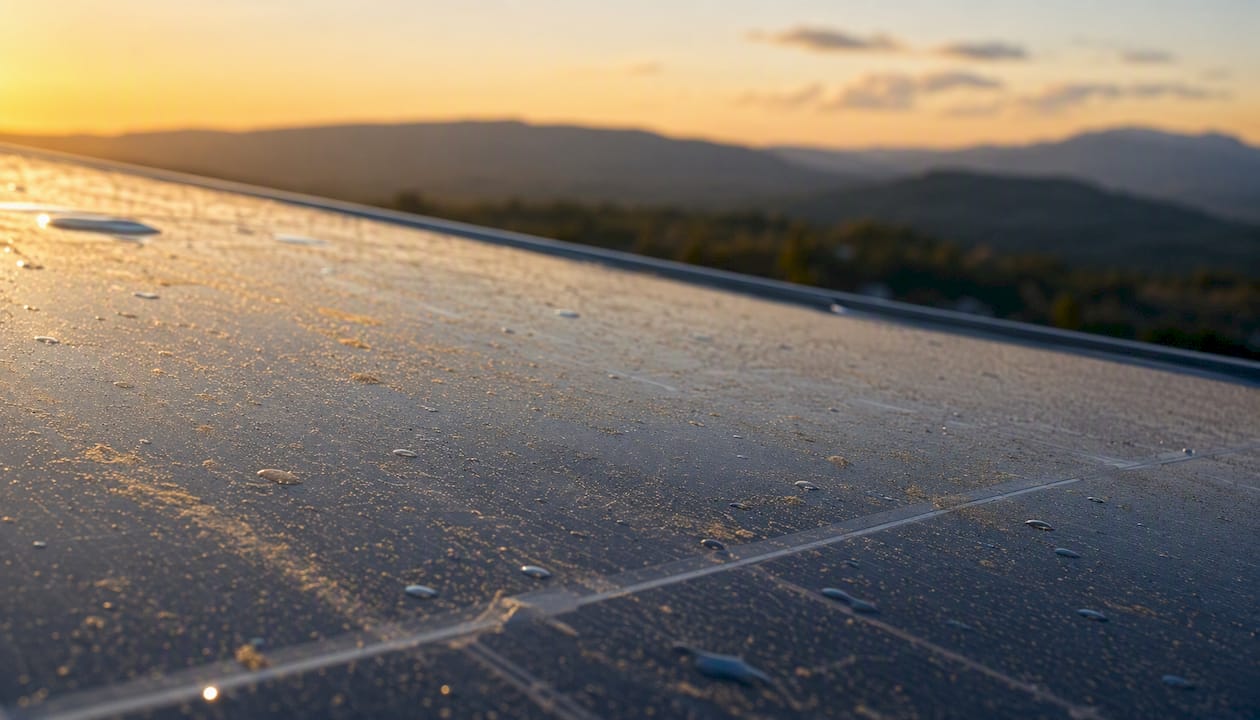
Rain is less effective on hydrophobic particles like black carbon and fine dust that have baked onto the glass under heat. Research modeling from DLR shows that hydrophilic aerosols such as sulfates and organics wash off more readily, while dust and black carbon resist removal even in moderate rain. The three-step picture: rain hits the panel, water sheets and runs off carrying loose particles, and bonded films stay behind.
Why rain often falls short: the real-world failure modes
Rain sounds like a free cleaning service, but several common conditions defeat it.
- Bird droppings: A single dropping shades the cells beneath it and causes localized output loss. The uric acid in droppings bonds aggressively to glass under heat. Rain rarely removes them.
- Pollen film: During spring pollen season, a sticky yellow-green film coats panels across much of the country. Rain can smear it and create streaks, but rarely lifts it completely.
- Coastal salt and traffic film: Salt spray and exhaust particulates from nearby roads form a thin, greasy film that water alone does not cut.
- Hard-water mineral residue: In areas with hard tap water or hard groundwater, rain leaves calcium and magnesium deposits as it evaporates, especially on low-tilt panels.
- Wildfire ash and smoke: Ash from wildfires creates a bonded layer that subsequent rain typically does not remove. This is a significant concern across California and the Southwest.
- Low tilt and pooling: Panels mounted below 10° retain standing water. As that water evaporates, it concentrates fine particles and minerals into a stubborn film.
Light mist is actually counterproductive. DLR experimental data shows that light rain or mist may redistribute dust and cause streaking rather than removing soiling. You need sustained, moderate-to-heavy rain to get meaningful runoff shear.
Pro Tip: Ground-mounted and low-tilt rooftop systems accumulate soiling faster and self-clean less effectively than steeply pitched arrays. If your panels are nearly flat, plan on inspecting them at least twice a year regardless of rainfall.
Which climates and tilts make rain sufficient versus insufficient
The honest answer is that geography and installation angle together determine whether you can rely on rainfall.
Usually adequate: Temperate climates with rain every one to two weeks, panels tilted at 15° or steeper, and no major bird roosts or overhanging trees nearby. In these conditions, rain handles loose dust well and keeps panels close to clean-state output. Industry guidance from Enphase suggests that one to two manual cleanings per year is typically enough in rainy climates, with rain handling the rest.
Marginal: Intermittent rain (monthly or less), moderate pollen exposure, or panels near a busy road. Rain helps but leaves enough residue that a semi-annual inspection and occasional spot cleaning makes sense.
Insufficient: Arid and desert climates, coastal zones with salt spray, any installation below 10° tilt, and areas with regular wildfire smoke. In desert regions, soiling can cut output by several percentage points per week without intervention. Sunny climates in particular need scheduled cleaning to maintain performance. Southern California sits squarely in this category for much of the year.
| Condition | Rain likely sufficient? | Recommended action |
|---|---|---|
| Temperate, rain every 1–2 weeks, tilt 15°+ | Usually yes | Annual inspection, clean after major events |
| Intermittent rain, moderate pollen, tilt 10–15° | Sometimes | Semi-annual inspection, spot clean as needed |
| Arid/desert, tilt below 10°, coastal salt | No | 2–4 cleanings per year, event-based cleaning |
| Post-wildfire ash, heavy pollen event | No | Immediate professional cleaning |
How to tell whether rain has been enough
The most reliable check is your inverter data, not a visual inspection from the driveway. Pull up your monitoring app and compare output on two clear days with similar sun angles and temperatures, one before a rain event and one after. If output on the post-rain clear day is meaningfully higher, rain did its job. If output is flat or still below your historical baseline for that time of year, the panels need attention.
Monitoring inverter output on comparable sunny days is the best practical test of whether rain has been sufficient. Most modern inverter systems, including those running Enphase or SolarEdge monitoring, log daily production data that makes this comparison straightforward.
Visual checks add context. From the ground, look for visible streaks, a yellowish pollen film, or white spots (mineral deposits). Bird droppings are usually visible from 20 feet. If you see any of these after rain, manual cleaning is warranted. A ladder inspection is worth doing once or twice a year, but only if you can do it safely from a stable position.
Certain events should trigger cleaning regardless of recent rainfall:
- Wildfire or smoke event in your area
- Visible ash or soot on the panels
- Heavy pollen season with a visible film
- Construction dust from nearby work
- A noticeable output drop on clear days that persists for more than a week
The troubleshooting sequence: observe the panels visually after rain, confirm with inverter data on the next clear day, inspect up close if numbers are still down, then decide whether a DIY rinse or a professional clean is the right call.
Safe DIY cleaning: what to use, what to avoid, and how to do it
Safety comes first. If your panels are on a steep roof or you are not comfortable working at height, skip the DIY route entirely and call a professional. A ground-based hose rinse with a gentle spray nozzle handles a surprising amount of loose soiling without any roof access.
What to use:
- Soft microfiber cloth or a soft-bristle brush with an extendable handle
- Mild dish soap (a few drops in a bucket of water) for spot cleaning
- Deionized or distilled water for the final rinse, especially in hard-water areas
- A low-pressure garden hose
What to avoid:
- Pressure washers: the force can crack panel glass, damage seals, or void your warranty
- Abrasive pads or scouring sponges: they scratch the anti-reflective coating
- Strong solvents or concentrated detergents: they can degrade seals and leave residue
- Hard tap water for the final rinse in mineral-heavy areas: it leaves deposits as it dries
On the Dawn dish soap question: a small amount of mild dish soap is generally acceptable for spot cleaning bonded deposits, provided you rinse thoroughly. The concern is not the soap itself but residue left behind, which can attract more dust. Avoid concentrated formulas and always follow with a clean-water rinse. Check your panel manufacturer’s warranty documentation first, since some specify approved cleaning agents.
Step-by-step DIY procedure:
- Wait until panels are cool, either early morning or late afternoon. Hot glass can crack with cold water.
- Rinse the panel surface with a gentle hose spray to remove loose dust.
- Apply a soft brush or microfiber cloth with a mild soap solution, working from top to bottom.
- Rinse thoroughly with clean water, ensuring no soap residue remains.
- In hard-water areas, follow with a deionized water rinse to prevent mineral spotting.
- Inspect from the ground after drying and check your inverter output the next clear day.
For a more detailed walkthrough, the solar panel cleaning guide covers safe methods and frequency recommendations in full.
When should you hire a professional instead?
Some situations genuinely call for a pro, and the cost is usually modest relative to the output you recover.
Benefits of professional cleaning: Trained technicians work safely at height with proper equipment. They use deionized water systems that leave no mineral residue. They can spot-treat bonded deposits with appropriate solutions, and they typically provide before-and-after photos that serve as documentation for warranty records and ROI tracking.
Situations that favor hiring a pro:
- Steep roof pitch or difficult access
- Heavy bonded soiling from wildfire ash, bird droppings, or pollen buildup
- Large arrays where DIY is impractical
- Warranty language that requires professional cleaning
- You want documented before-and-after production data
Ballpark US residential cost: Professional solar panel cleaning typically runs in the range of $100–$300 for a standard residential array, depending on array size, roof access difficulty, and your region. Some providers charge per panel. This is a general estimate; get quotes from insured local providers.
| Factor | DIY | Professional |
|---|---|---|
| Safety | Risk if roof access needed | Trained, insured access |
| Cleaning agents | Mild soap, garden hose | Deionized water systems |
| Bonded deposits | Limited effectiveness | Spot treatment available |
| Documentation | Self-documented | Before/after photos provided |
| Cost | Near zero (time + supplies) | ~$100–$300 typical residential |
| Warranty protection | Check manufacturer terms | Generally compliant |
Questions to ask before booking a pro: Are you licensed and insured? What cleaning method and agents do you use? Will this affect my panel warranty? Do you provide before-and-after photos? How do you price: per panel, per visit, or by array size?
A research-backed checklist for when to rely on rain and when to act
Use this checklist to make the call. Each trigger is grounded in field data and experimental findings.
- Inverter output drops on comparable clear days. If production on a clear day is consistently below your historical baseline for that season, rain has not been enough. Plant-scale analyses show post-precipitation production gains averaging around several percent in immediate before/after comparisons, with larger gains in some quarterly comparisons, confirming that rain does help but rarely restores full output on its own.
- Visible bonded deposits after rain. Bird droppings, pollen film, or white mineral spots that survive a rain event will not self-resolve. Clean within two weeks.
- Dry period exceeding three months. In arid climates, soiling accumulates rapidly. Schedule a cleaning after any dry stretch longer than three months.
- Wildfire ash or heavy smoke event. Ash creates a bonded layer that rain does not remove. Clean promptly after any nearby wildfire event.
- Heavy pollen season with visible film. If you can see a yellow-green film from the ground, rain has smeared rather than removed it.
On the science: no single rainfall amount guarantees complete cleaning. Effectiveness depends on rain intensity, duration, aerosol type, and how much soiling was already present. Experimental and statistical analysis shows cleaning completeness increases with rain intensity but remains location-dependent, with seasonal variation in minimum intensity thresholds.
Recommended check frequency by climate:
- Wet temperate zones: annual inspection, clean after major events
- Mixed/intermittent rain: semi-annual inspection
- Arid, desert, or coastal: 2–4 cleanings per year, plus event-based cleaning
Results vary by location. Use your own inverter data alongside these guidelines rather than relying on any single rule.
What field experience actually looks like in Orange County
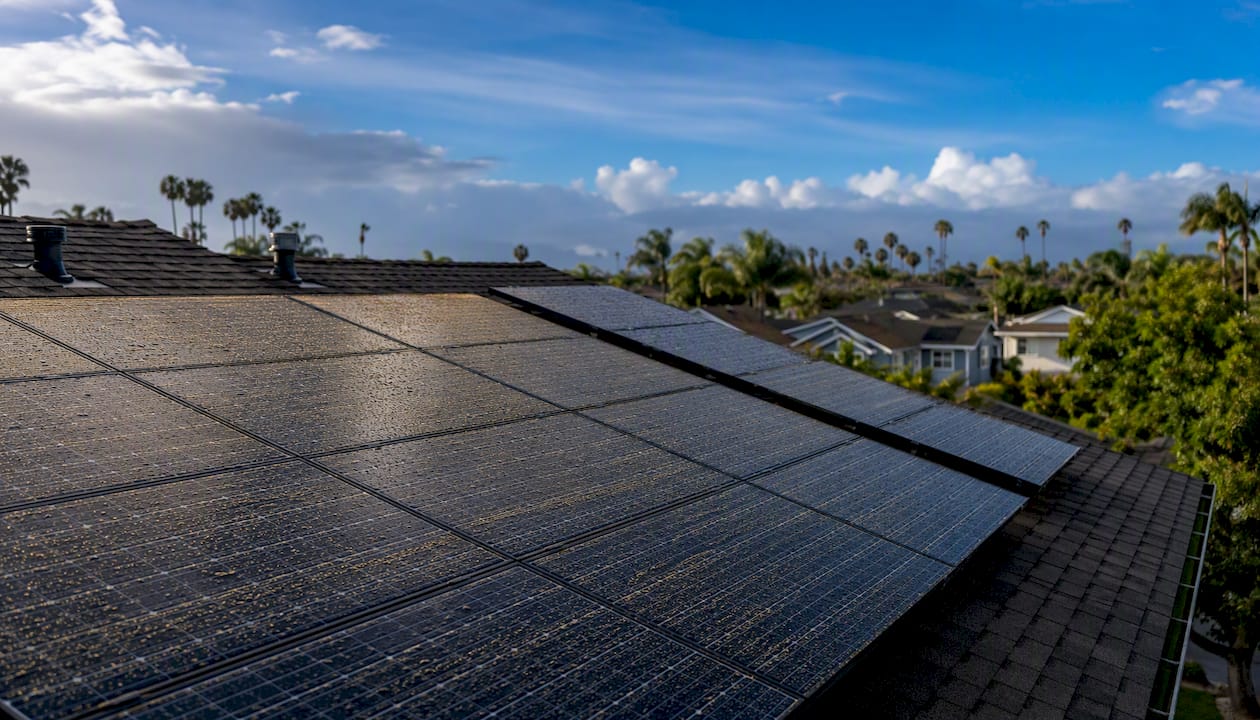
Pollen season in Southern California is a good example of where the rain-cleans-panels myth breaks down in practice. After a spring rain, panels often look cleaner from the street. The water has moved the pollen around and the glass appears less yellow. But the inverter numbers tell a different story: output is still suppressed because a thin, sticky film remains bonded to the glass. Rain redistributed the soiling rather than removing it.
The single most useful habit for any solar panel owner is documenting inverter output before and after a cleaning, whether that cleaning was done by rain or by hand. Those numbers are your proof of ROI, and they are also your warranty record if a panel ever underperforms and you need to make a claim.
Solar panel cleaning in Orange County: get it done right
Broswindowcleaningoc handles solar panel cleaning as part of a full exterior cleaning service for Orange County homeowners. The difference between a DIY rinse and a professional clean shows up in the inverter data: deionized water leaves no mineral residue, bonded deposits get spot-treated rather than smeared, and every job comes with before-and-after photos you can keep for your warranty records.

The team is fully insured, experienced with residential rooftop arrays, and familiar with the specific soiling patterns Orange County properties face, from coastal salt to wildfire ash to spring pollen. No pressure washers, no abrasive pads, no voided warranties.
Check your inverter output on the next clear day. If production is down from your seasonal baseline, book a solar panel cleaning with Broswindowcleaningoc and get your system back to where it should be.
Sources
- Cleaning effect of photovoltaic modules according to precipitation — field data analysis (MDPI Energies)
- Howtogosolar
- Solar panel cleaning and maintenance guide (Enphase)
- Effect of environmental factors on photovoltaic soiling: experimental and statistical analysis (Solideas / Energies)
Results vary by location, season, and installation. Cross-reference these findings with your own inverter data and local meteorological records for the most accurate picture of your system’s needs.