
Water-fed pole cleaning is an exterior window cleaning method that delivers purified water through a telescopic pole fitted with a soft brush, letting operators clean high windows safely from the ground. The industry standard term for this technique is “pure water window cleaning,” and both terms are used by professional cleaners across the United States. Unlike traditional methods that rely on ladders, squeegees, and chemical solutions, this system uses water purified through reverse osmosis (RO) and deionization (DI) to produce a spot-free, streak-free finish that air-dries without wiping. For property managers and homeowners researching what is water-fed pole cleaning, this guide covers how the system works, its real benefits, safety limits, and how to evaluate a provider.
How does water-fed pole cleaning work?
The core of the system is pure water chemistry, not the pole itself. RO/DI systems produce near-zero TDS water pumped through a hose inside the pole to the brush head. RO filtration removes 95–99% of dissolved solids. DI resin then strips the remaining ions, bringing the water to 0–5 TDS (total dissolved solids).
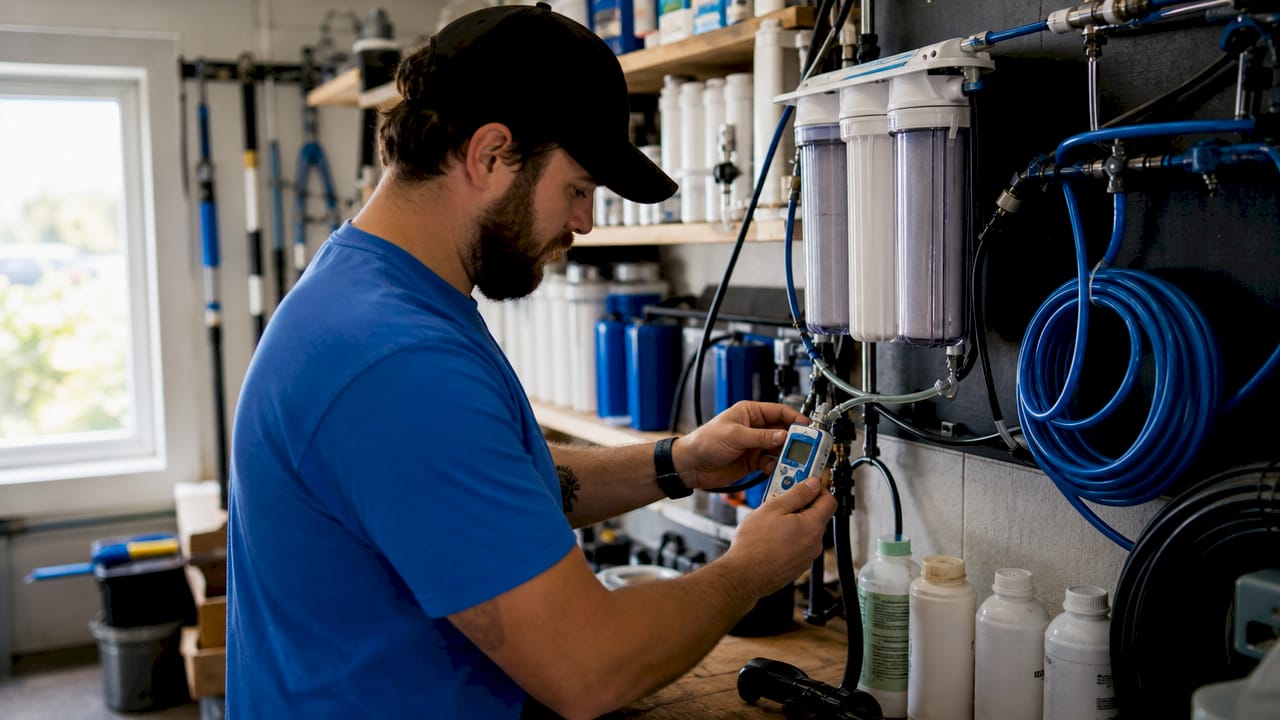
The pole itself is a lightweight telescopic structure, typically made from carbon fiber or aluminum. Carbon fiber poles are lighter and easier to control at full extension. Most professional setups reach windows up to 60–70 feet, which covers roughly 6–7 stories. That reach eliminates the need for ladders on the vast majority of residential and mid-rise commercial jobs.
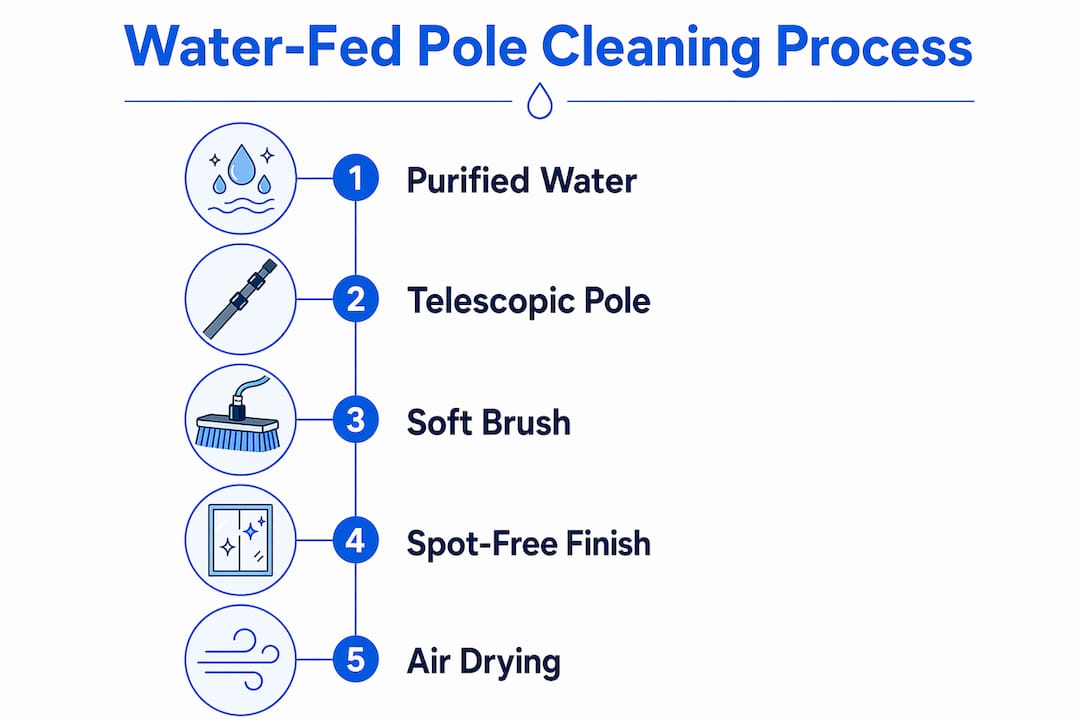
The cleaning sequence follows a specific order:
- Position the brush at the top of the window. Start high and work downward so dirty water flows away from already-cleaned glass.
- Scrub with the brush while water flows. The brush agitates dirt and grime while purified water loosens and lifts it from the surface.
- Rinse with a final pass of pure water. Purified water is the last contact with glass, flushing away all loosened debris.
- Let the glass air-dry. Because the water contains no dissolved minerals, it leaves no residue as it evaporates.
The air-dry step is what separates this method from tap water cleaning. Tap water carries calcium, magnesium, and other minerals that deposit on glass as water evaporates. Pure water leaves nothing behind.
Pro Tip: Ask your cleaner to show you their TDS meter reading before they start. A reading of 0–5 TDS confirms the system is producing genuinely pure water. Anything above 10 TDS increases the risk of spotting.
What are the benefits of water-fed pole cleaning vs. traditional methods?
The safety advantage is the most significant benefit for property managers. Ladder falls are one of the leading causes of workplace injuries in the cleaning industry. Operators staying on the ground removes that risk entirely on most jobs, which also reduces liability exposure for building owners.
The quality benefits are equally strong:
- Spot-free, streak-free finish. Removing dissolved minerals means no water marks after drying. Traditional squeegee methods can leave streaks if technique is imperfect.
- No chemical cleaners required. Pure water does the work. This reduces environmental impact and eliminates chemical residue on frames, sills, and surrounding landscaping.
- Frames and sills get cleaned too. The brush and water flow clean uPVC, aluminum, and painted frames in the same pass, not just the glass.
- Windows stay cleaner longer. Chemical residues from traditional cleaning attract dust and grime. Pure water leaves no residue, so surfaces repel dirt more effectively between cleans.
- Faster coverage on multi-story buildings. One operator with a pole can cover more windows per hour than a two-person ladder crew on many building types.
The environmental benefit deserves more attention than it typically gets. No detergents means no runoff into storm drains or garden beds. For Orange County properties near coastal areas or drought-sensitive landscaping, that matters. Streak-free results without chemicals represent a genuine upgrade over older cleaning methods.
What safety considerations and limitations exist?
Water-fed pole cleaning is safer than ladder work, but it carries its own specific risks that property managers need to understand before scheduling a job.
The most serious hazard is proximity to overhead electrical lines. Insulated poles do not eliminate electrical risk. Electricity can arc through air, and safety manuals specify minimum approach distances. For 50 kV lines, that minimum is at least 10 feet. Operators must conduct a site-specific risk assessment before extending any pole near power lines.
Key safety and operational limits to know:
- Overhead lines require physical distance, not just insulated equipment. Insulation reduces direct contact risk but does not prevent arc flash.
- Weather affects results. Cleaning in direct sunlight or high heat causes water to evaporate before it can rinse properly, leaving mineral traces even from pure water.
- Wind complicates control. Strong wind makes it harder to hold a pole steady at full extension, reducing cleaning quality and increasing operator fatigue.
- Architectural features can block access. Deep window recesses, overhanging balconies, or unusual frame profiles may limit brush contact with the glass.
- Very tall buildings exceed standard pole reach. Beyond 6–7 stories, rope access, scaffolding, or aerial work platforms become necessary.
Pro Tip: Schedule water-fed pole cleaning for overcast days when possible. Cloud cover slows evaporation, giving pure water more time to rinse the glass completely before drying.
How to evaluate and maintain a water-fed pole cleaning system
For property managers hiring a service, the most important question is simple: what is your water TDS at the point of use? Systems producing 0–5 TDS are the standard for spot-free claims. A provider who cannot answer that question or does not carry a TDS meter is not running a properly maintained system.
For those managing their own equipment, the filtration components need regular attention. Neglected filters and DI resin allow mineral content to creep back into the output water, causing spotting even when pole technique is correct. DI resin is exhausted when TDS climbs above 10 and needs replacement, not just rinsing.
| Evaluation factor | What to check |
|---|---|
| Water purity | TDS reading of 0–5 at the brush head |
| Pole material | Carbon fiber for reach above 30 feet; aluminum for shorter jobs |
| Brush type | Rinse bar brushes for smooth glass; fan jets for rinsing frames |
| Filter maintenance | RO membrane and DI resin replaced on schedule, not just when spotting appears |
| Operator technique | Steady pressure, top-to-bottom passes, pure water as final rinse |
Operator technique is the variable that separates good results from great ones. Steady brush pressure, controlled passes, and finishing with rinse jets reduce micro-spotting that even pure water can leave if technique is sloppy. When evaluating a provider, ask whether their operators are trained specifically on water-fed technique or simply handed a pole.
Pro Tip: Review the quality window cleaner guide before hiring any exterior cleaning service. It lists the specific questions that separate professional operators from those who own the equipment but lack the training.
Which properties and surfaces are suitable for water-fed pole cleaning?
Water-fed pole systems suit residential and commercial buildings up to about 6–7 stories, covering the vast majority of single-family homes, townhouses, apartment complexes, and low-rise office buildings. The method works on glass, frames, and sills made from uPVC, aluminum, and painted materials without causing damage.
Properties and surfaces that work well with this method:
- Single-family homes with two or three stories. Ground-level operation is fast and safe, with no need to move ladders around landscaping or fencing.
- Multi-unit residential buildings up to 6 stories. One operator can cover significant square footage per visit.
- Commercial storefronts and office buildings. Frames and signage surrounds can be cleaned in the same pass as the glass.
- Solar panels. Pure water cleaning is the recommended method for solar panels because it removes dust and mineral deposits without chemicals that could degrade panel coatings.
- uPVC, aluminum, and painted window frames. The soft brush and pure water are gentle enough for all standard frame materials.
Seasonal scheduling matters in Orange County. Spring and fall are ideal because temperatures are moderate and wind is lower. Summer heat accelerates evaporation, which can reduce rinse effectiveness on south-facing or west-facing windows during afternoon appointments.
Key takeaways
Water-fed pole cleaning delivers spot-free, chemical-free exterior window cleaning by combining RO/DI purified water with telescopic poles that keep operators safely on the ground.
| Point | Details |
|---|---|
| Pure water is the key factor | RO/DI systems must produce 0–5 TDS water for spot-free, streak-free results. |
| Safety is the primary advantage | Ground-level operation eliminates ladder fall risk on buildings up to 6–7 stories. |
| Electrical hazards still exist | Insulated poles do not prevent arc flash; maintain minimum distances from overhead lines. |
| Maintenance determines quality | DI resin and filters must be replaced regularly to keep TDS at effective levels. |
| Technique affects the finish | Top-to-bottom passes with pure water as the final rinse minimize micro-spotting. |
What I’ve learned from watching this method up close
The biggest misconception property managers carry into their first conversation about pure water window cleaning is that the pole is the technology. It is not. The pole is just a delivery mechanism. The real work happens in the filtration system, and a poorly maintained RO/DI unit with a carbon fiber pole will produce worse results than a well-maintained system on a basic aluminum pole.
I have also seen the electrical hazard issue underestimated more times than I can count. Operators sometimes assume that because their pole is labeled “insulated,” they can work near power lines without a formal risk assessment. That assumption is wrong and dangerous. Insulated poles reduce direct shock risk but do not prevent electrical arcs. Any property with overhead lines running near the building face needs a site-specific plan before work begins.
For property managers, my practical advice is to treat TDS verification the same way you treat proof of insurance. Ask for it before the job starts, not after you see spots on the glass. A provider who measures and shares their TDS reading is telling you something important about how they run their operation. One who cannot answer the question is telling you something equally important.
The environmental angle is genuinely underrated. No detergents, no chemical runoff, and windows that stay cleaner longer between visits. For commercial properties managing maintenance budgets, that last point has real cost implications. Fewer visits per year at the same quality level adds up.
— nolan
Professional water-fed pole cleaning in Orange County
Broswindowcleaningoc uses professional-grade RO/DI filtration systems on every exterior window job, producing water at 0–5 TDS for a guaranteed spot-free finish. The team serves residential and commercial properties across Orange County, CA, handling everything from single-family homes to multi-story buildings safely from the ground.

Beyond window cleaning, Broswindowcleaningoc offers pressure washing, gutter cleaning, solar panel cleaning, and roof cleaning, making it a single provider for complete exterior property maintenance. If you want to understand what separates a professional water-fed cleaning service from a basic one, the window cleaning terms guide breaks down the key differences in plain language. Scheduling is straightforward, and all services are fully insured. Visit Broswindowcleaningoc to get a quote for your property.
FAQ
What is the difference between water-fed pole cleaning and traditional window cleaning?
Water-fed pole cleaning uses purified water delivered through a telescopic pole to clean windows from the ground, with no ladders, squeegees, or chemical detergents. Traditional methods use ladders, squeegees, and soapy water, which can leave streaks and require working at height.
How do I know if a water-fed pole cleaning service is using genuinely pure water?
Ask the provider to show you their TDS meter reading before the job starts. A reading of 0–5 TDS confirms the system is producing water pure enough for spot-free results.
Is water-fed pole cleaning safe near electrical lines?
Insulated poles reduce direct contact risk but do not prevent electrical arcs. Operators must maintain minimum safe distances from overhead lines and conduct a site-specific risk assessment before working near them.
How often should water-fed pole cleaning be scheduled?
Most residential properties benefit from cleaning two to four times per year. Commercial properties with higher dust or pollution exposure may need more frequent visits to maintain appearance.
Can water-fed poles clean surfaces other than glass?
Yes. The brush and pure water effectively clean window frames, sills, and solar panels made from uPVC, aluminum, and painted materials without causing damage or leaving chemical residue.