
Most people assume a cleaner is a cleaner. You call someone, they show up, they mop and wipe, and you pay. The gap between certified and uncertified cleaning professionals is far wider than most homeowners and business leaders realize. Understanding why hire certified cleaning professionals matters comes down to three things: safety, legal protection, and quality you can actually count on. This article breaks down what certification really means, what it protects you from, and why it makes a measurable difference in your home or business.
Table of Contents
- Key takeaways
- Why hire certified cleaning professionals: what the credential really means
- Safety and legal compliance you cannot afford to skip
- Quality, consistency, and what operational excellence actually looks like
- Real benefits for your home, health, and property value
- My take on why this decision matters more than most people think
- Certified cleaning in Orange County starts here
- FAQ
Key takeaways
| Point | Details |
|---|---|
| Certification means structured competence | Certified cleaners complete formal training, exams, and management standards, not just on-the-job practice. |
| Safety and compliance are built in | Certified services document chemical risks, PPE use, and staff training, protecting you legally and physically. |
| Quality is consistent, not occasional | Management frameworks like ISSA CIMS drive repeatable, measurable cleaning outcomes across every visit. |
| Your property is better protected | Certified professionals know how to clean surfaces without causing damage that leads to costly repairs. |
| Health outcomes are measurable | Professional cleaning can reduce indoor allergens by up to 60% and save you 5 to 7 hours weekly. |
Why hire certified cleaning professionals: what the credential really means
The word “certified” gets thrown around loosely in the cleaning industry. Some companies print it on their vans after a weekend training session. Real certification is a different animal entirely.
The gold standard in the industry comes from organizations like ISSA, the worldwide cleaning industry association. ISSA’s Cleaning Management Institute runs the Certified Cleaning Technician program with both Basic and Advanced tracks. Technicians are tested on chemical properties, floor care, disinfection protocols, OSHA clean-up procedures, and current EPA guidelines. An 80% pass threshold is required. That is not a participation trophy.
At the company level, ISSA’s CIMS certification (Cleaning Industry Management Standard) sets the bar for organizational excellence. CIMS covers six management areas, including quality systems, service delivery, human resources, and health, safety, and environmental stewardship. When a company holds CIMS, it means their entire operation is structured around documented processes, not the judgment of whoever shows up that day.
Here is what certified programs typically include:
- Formal training modules on chemical safety, disinfection, surface care, and customer communication
- Written exams with minimum pass scores to verify actual knowledge
- Documentation requirements for staff training records and procedures
- Ongoing education to maintain certification status
- Management system reviews that evaluate the company’s operations as a whole
Pro Tip: When evaluating a cleaning company, ask specifically which certification body issued their credential and what it covers. A legitimate certified provider will answer that question without hesitation and offer documentation.
The practical difference is this: an uncertified cleaner might know what works from experience, and many do solid work. But certified professionals have their knowledge verified, documented, and embedded in a system that holds them accountable.
Safety and legal compliance you cannot afford to skip
Here is a fact that surprises most clients. Cleaning involves regulated hazardous materials. The products used to disinfect bathrooms, strip floors, and degrease kitchens are not benign. Misuse can harm the people doing the work and the people living or working in the space.
Regulated workplaces require serious chemical management. Duties include hazard registers, risk assessments tied to specific tasks, staff training records, PPE supply and verification, exposure surveillance, and regulatory inspections. That applies whether you are a commercial facility or a residential client hiring a professional service.
Certified cleaning services operationalize that compliance. Here is what that looks like in practice:
- Hazard communication documentation. Certified providers maintain Safety Data Sheets (SDS) for every chemical they use. You can ask to see them.
- Risk assessments per task. A certified cleaner does not just grab a bottle. The process, exposure potential, and protective measures are documented in advance.
- PPE verification. Staff are equipped and trained on the right protective gear for each cleaning scenario, with records showing it.
- Exposure monitoring. For chemical-intensive tasks, proper providers track worker exposure over time. That protects your staff and theirs.
- Documented training records. If a compliance question ever arises, certified companies can produce proof that their team was trained to handle specific situations.
“Certification is not just marketing. It operationalizes compliance by ensuring documented hazard communication, risk assessments, training, PPE use, and exposure controls are in place and verifiable.”
For business owners, this has real legal consequences. If an uncertified cleaner causes a chemical exposure incident on your property, your liability position is significantly weaker than if you had hired a provider with documented compliance systems. For homeowners, the stakes are more personal. You want the people working in your home to be safe, and you want the products being used around your family and pets to be handled correctly.
Certified cleaning also matters when you are dealing with pressure washing hazardous surfaces or any exterior work involving concentrated cleaning agents. The risks are real, and the right credentials confirm the risks are managed.
Quality, consistency, and what operational excellence actually looks like
Most people think quality in cleaning comes down to effort. A motivated cleaner works hard, and the results are good. That is partly true. But effort without a system produces inconsistent results, especially when you have multiple staff, multiple locations, or recurring service schedules.
Certified cleaning companies built around management frameworks like ISSA CIMS deliver something different. Certified companies aligned with management standards produce consistent quality and safety outcomes rather than results that depend on who showed up. The system does the heavy lifting, not just individual effort.
Here is a direct comparison between ad-hoc and certified cleaning programs:
| Factor | Uncertified cleaning | Certified cleaning service |
|---|---|---|
| Staff training | Informal, experience-based | Documented, exam-verified |
| Chemical use | Based on habit or preference | SDS-backed, risk-assessed |
| Quality control | Subjective, no benchmarks | Tracked metrics and procedures |
| Environmental impact | Unmonitored | Guided by H&S stewardship policies |
| Accountability | Difficult to enforce | Tied to management system standards |
ISSA CIMS also includes a dedicated management area for health, safety, and environmental stewardship, which means certified providers have written policies governing sustainability and risk control. For businesses with ESG commitments or property owners who care about the products used in their spaces, that matters.
Pro Tip: Ask potential cleaning providers for their quality control process. Certified companies should be able to describe specific metrics, supervisory review methods, and how they handle service complaints. If the answer is “we just make sure everything looks good,” that is a red flag.
You also get consistency across visits. One of the most common frustrations with cleaning services is the variance between appointments. You get one great session and then a mediocre one. Certified cleaning services use documented procedures that standardize the outcome regardless of which technician is on the job that day.
Real benefits for your home, health, and property value
The certification conversation can feel abstract. Training, documentation, management standards. Let’s bring it to ground level.
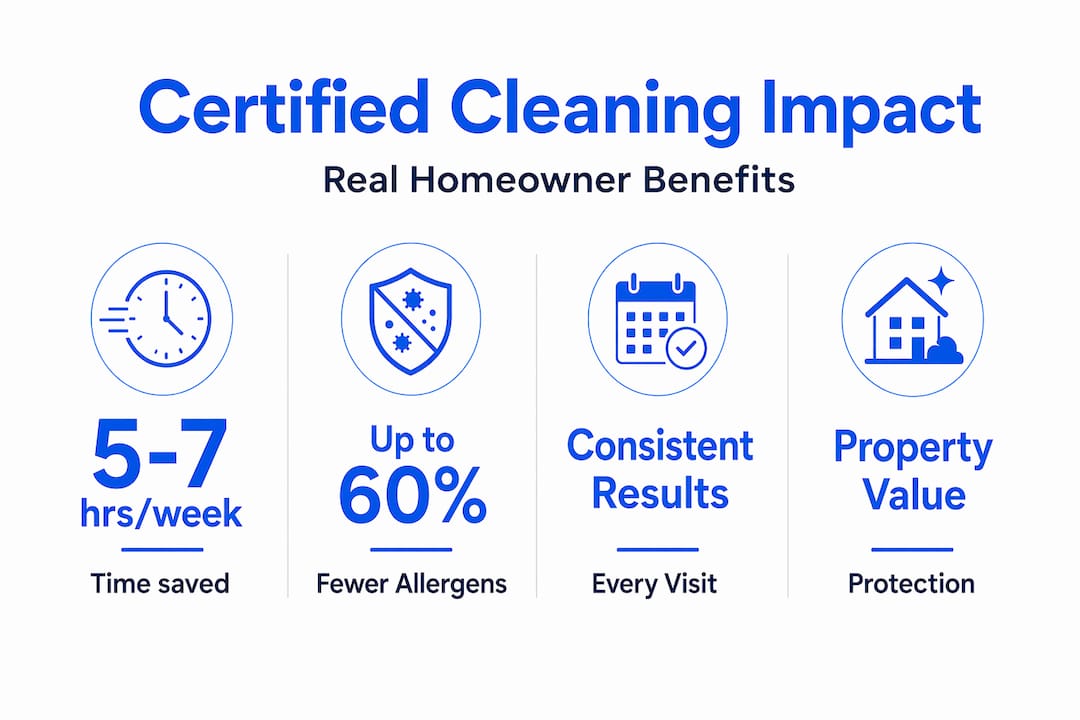
Booking professional cleaning services saves homeowners 5 to 7 hours per week and reduces indoor allergens by up to 60%. That is not a minor lifestyle upgrade. For anyone managing asthma, allergies, or small children, that allergen reduction translates directly to fewer sick days and better sleep quality. Professional equipment removes dust mites and mold spores that household vacuums simply cannot reach.
There is also the mental health angle, which gets underreported. Clutter and dirt increase cortisol levels, the stress hormone. A consistently clean environment is not just about appearances. It actively affects how calm and in control you feel in your own space.
Here is what certified cleaning services protect you from on the property side:
- Surface damage from incorrect chemicals. Uncertified cleaners often use the wrong product on the wrong surface. Natural stone, hardwood floors, and coated windows can all be permanently damaged by the wrong cleaner applied incorrectly.
- Long-term buildup that becomes structural. Soap scum, grease, and biological growth left untreated eventually require repairs. Regular certified cleaning prevents that progression.
- Solar panel and roof degradation. Improper cleaning methods on exterior surfaces accelerate wear. Certified professionals know the correct approach for each surface type.
For businesses, these benefits scale significantly. A commercial cleaning partnership built on certified practices reduces sick leave, improves the client-facing appearance of your facility, and demonstrates operational diligence to anyone who visits.
Understanding the property value impact of consistent certified cleaning goes beyond cleanliness. It is a maintenance discipline that protects your investment year over year.
My take on why this decision matters more than most people think
I’ve seen the full range of outcomes in this industry. Clients who hired the cheapest option available and spent three times as much repairing the damage. Business owners who assumed any insured company was equivalent to a certified one, only to find out mid-contract that neither documentation nor consistency was actually there.
In my experience, the single biggest mistake people make when hiring cleaning services is treating certification as a bonus feature rather than a baseline requirement. You would not hire an electrician without a license. Why would you hand over access to your home or business to someone whose chemical knowledge, safety practices, and quality standards have never been verified?
What I’ve learned from watching certified providers work is that the real value is not in the badge. It is in the systems behind the badge. A company using recognized management frameworks like CIMS has already asked and answered hundreds of operational questions that an uncertified company has not even considered. Who supervises quality? What happens when a product causes a reaction? How are training updates communicated to staff?
My honest advice: before you sign any cleaning contract, ask three questions. What certifications do your technicians hold? Can I see your chemical documentation? How do you handle a service quality complaint? The answers will tell you everything you need to know about whether you are dealing with a professional operation or a well-marketed gamble.
— nolan
Certified cleaning in Orange County starts here
Broswindowcleaningoc brings certified professional standards to every job it handles in Orange County, CA. Whether you need window cleaning that delivers proven ROI, exterior pressure washing, gutter maintenance, or solar panel care, every service is backed by over five years of experience, full insurance, and a commitment to documented, professional-grade practices.
Broswindowcleaningoc does not cut corners on safety or quality. Clients get reliable scheduling, transparent pricing, and the peace of mind that comes from working with a provider that takes certification and compliance seriously.
If you want a cleaning partner you can actually count on for your home or business, explore what expert cleaning tools and methods look like in practice, and reach out to schedule a consultation today.
FAQ
What does it mean to be a certified cleaning professional?
A certified cleaning professional has completed a formal training and testing program through a recognized body like ISSA’s Cleaning Management Institute, covering chemical safety, disinfection, floor care, and OSHA protocols. Certification is verified through exams requiring at least an 80% pass score.
How do certified cleaning services reduce health risks?
Certified cleaners use documented chemical controls and professional-grade equipment that removes allergens, mold spores, and pathogens that standard household cleaning misses. Studies show professional cleaning can reduce indoor allergens by up to 60%.
Why choose professional cleaning services over independent cleaners?
Professional certified services operate under management systems that guarantee consistency, documented safety practices, and accountability across every visit. Independent cleaners may do solid work, but without verified training or formal quality controls, outcomes are harder to predict.
What certifications should I look for when hiring cleaners?
Look for technician credentials from ISSA’s Cleaning Management Institute and company-level CIMS certification, which covers six management areas including service delivery, HR, and health and safety stewardship.
Can certified cleaning services protect my property value?
Yes. Certified professionals are trained to match products and methods to specific surfaces, preventing damage from incorrect chemical use. Regular certified maintenance also stops buildup that leads to costly structural repairs over time.