
Choosing the wrong cleaning tools costs you more than just time. It costs you results. For Orange County homeowners and business owners who care about curb appeal and property value, the gap between generic store-bought equipment and true professional-grade tools is significant enough to change outcomes. Generic tools wear out faster, clean less effectively, and often require repeated passes to get the job done. This guide breaks down the most effective commercial-grade cleaning equipment available today, what separates it from the consumer stuff, and how to choose tools that actually pay for themselves over time.
Table of Contents
- How to evaluate professional cleaning tools
- Commercial vacuums: Power, durability, and ROI
- Floor scrubbers: Disc vs. cylindrical and battery options
- Microfiber cloths: Color-coded for safety and hygiene
- The overlooked impact of professional tools on property value
- Upgrade your property with professional cleaning services
- Frequently asked questions
Key Takeaways
| Point | Details |
|---|---|
| Durability matters | Professional tools resist wear, saving you money and hassle over time. |
| Specialized scrubbers boost efficiency | Disc and cylindrical machines suit different floor types and dramatically increase productivity. |
| Color-coded systems improve safety | Microfiber cloths coded by area help prevent cross-contamination in homes and businesses. |
| ROI is achievable | Investing in commercial-grade tools delivers measurable returns, especially for property value. |
How to evaluate professional cleaning tools
Not all cleaning tools are created equal, and the label “heavy-duty” on a box at your local hardware store means very little without context. Before spending money on equipment, you need a clear framework for evaluating what you’re buying.
Why professional-grade tools matter
Professional tools are engineered for frequency and intensity. A residential vacuum is designed to run 20 to 30 minutes a few times per week. A commercial vacuum is built to run for hours every single day without overheating or breaking down. That’s a fundamentally different machine, even if the two products look similar on the shelf. Commercial vacuums outlast residential models by an average of seven years and reduce long-term maintenance costs significantly.
This durability difference applies across every category: floor scrubbers, microfiber systems, pressure washers, and window cleaning tools. Professional equipment uses higher-grade motors, better filtration systems, and more robust housings. The upfront cost is higher, but the total cost of ownership tells a very different story.
Key evaluation criteria to use before you buy
When shopping for professional cleaning tools, run each product through these four lenses:
- Durability: What is the rated motor life in hours? Does the manufacturer stand behind commercial use? Are replacement parts easy to source?
- Efficiency: How much surface area can the tool cover per hour? Does it reduce manual passes or labor time?
- Safety: Does the tool comply with OSHA or industry safety standards? Is it safe for the surfaces you’re cleaning?
- Return on investment (ROI): What is the projected service life? How does it compare to the cost of professional service or repeated replacement of cheaper models?
Residential vs. commercial: The real difference
Residential tools are designed for convenience and price point. Commercial tools are designed for performance and longevity. A residential floor cleaner might handle 1,000 square feet comfortably. A commercial unit can handle 10,000 square feet before needing attention. That ratio matters enormously for property managers, business owners, or homeowners with large square footage to maintain.
Understanding this distinction connects directly to boosting property value with professional teams, where consistent high-quality results from the right equipment make a visible, measurable difference.
Pro Tip: Before buying any commercial cleaning tool, ask the vendor for a documented ROI breakdown showing service life, expected maintenance costs, and comparable labor savings. If they can’t provide it, look elsewhere.
Commercial vacuums: Power, durability, and ROI
With a solid evaluation framework in hand, let’s start with one of the most commonly underestimated tools in any cleaning setup: the commercial vacuum.
What separates commercial vacuums from the rest
Commercial vacuums are built around three core performance specs that residential models rarely meet: airflow, air watts, and motor life. Commercial vacuums deliver airflow between 145 and 250 CFM (cubic feet per minute) and air watts exceeding 1,000, compared to 100 CFM and 500 air watts in most residential models. These numbers translate directly to suction power on carpet, hardwood, tile, and textured surfaces.
The motor life advantage is just as significant. Commercial motors are typically rated for 1,200 to 1,500 hours of use. Most residential motors tap out around 500 hours. For a business running daily cleaning operations, that’s years of additional service life built into one purchase.
Cost-saving potential over time
The ROI argument for commercial vacuums becomes clear when you do the math. A quality commercial vacuum running in a mid-size office building can eliminate the need for frequent replacement purchases and reduce the time staff spends on floor maintenance. Over a five-year window, the savings on labor and equipment replacement often exceed the initial price premium by two to three times.
Here’s a quick comparison to illustrate:
| Feature | Residential vacuum | Commercial vacuum |
|---|---|---|
| Motor life (hours) | 300 to 500 | 1,200 to 1,500 |
| Airflow (CFM) | 80 to 120 | 145 to 250 |
| Air watts | 400 to 600 | 1,000 and above |
| Average service life | 2 to 4 years | 7 to 10 years |
| Typical warranty | 1 year | 3 to 5 years |
| Cost range | $100 to $400 | $400 to $1,500 |
Features to prioritize when choosing a model
- Sealed HEPA filtration for allergen reduction in high-traffic spaces
- Metal or reinforced housing rather than lightweight plastic
- Easy-access debris chambers that don’t require tools to empty
- Replaceable brush rolls with clear usage indicators
- Cord length of at least 50 feet for commercial settings
Pro Tip: Prioritize models with a motor rating of at least 500 hours for any commercial application. For daily use in a business setting, aim for 1,200 hours or higher to avoid mid-contract replacement costs.
The performance gap between residential and commercial vacuums becomes unmistakably visible after just a few weeks of use on high-traffic surfaces. Once you’ve experienced the difference, it’s hard to go back.
Floor scrubbers: Disc vs. cylindrical and battery options
Floor care is one area where the right equipment choice delivers dramatic, visible results. The wrong scrubber can leave streaks, miss debris in grout lines, or take three times as long to do the job. Let’s break down your options.
Disc vs. cylindrical: Which design fits your floor type
These are the two dominant scrubber technologies, and the best choice depends entirely on your floor surface. Cylindrical scrubbers are better for grouted, textured, or uneven floors because they simultaneously sweep and scrub, pulling debris into the machine while cleaning the surface. Disc scrubbers work better on smooth, sealed floors where the primary goal is removing surface grime without disturbing loose debris.
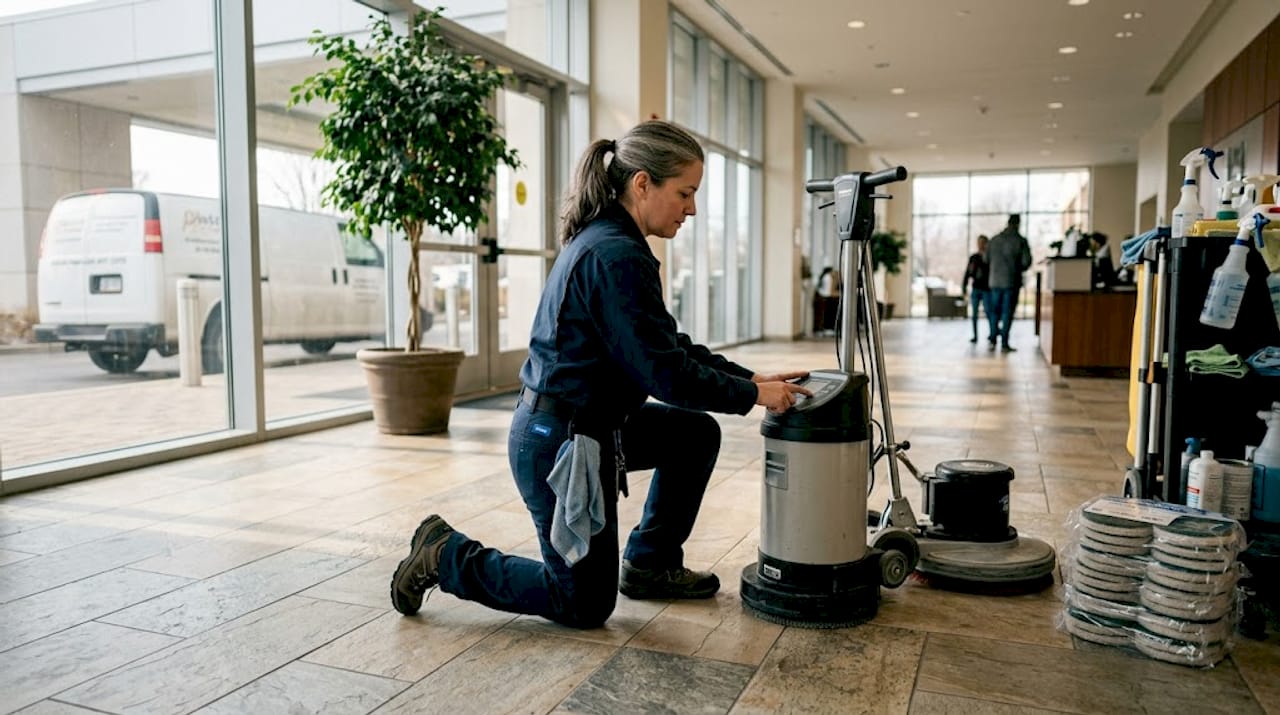
| Feature | Disc scrubber | Cylindrical scrubber |
|---|---|---|
| Best floor type | Smooth, sealed tile or epoxy | Grouted, textured, or uneven tile |
| Sweeping ability | No, pre-sweep required | Yes, built-in |
| Water usage | Moderate | Lower |
| Cleaning pressure | High on flat surfaces | Distributed across brush contact |
| Typical use case | Retail, warehouses | Hospitals, kitchens, outdoor areas |
Ride-on scrubbers and their productivity edge
For large commercial spaces, ride-on scrubbers are in a category of their own. These machines can cover 50,000 square feet per shift, representing a productivity increase of roughly 400 percent compared to a standard walk-behind unit. For shopping centers, parking garages, and large commercial properties in Orange County, that time savings translates directly to lower labor costs and faster turnaround between cleaning cycles.
Battery technology: Why lithium is winning
Battery-powered floor scrubbers have become the dominant choice in commercial settings, and lithium-ion technology is quickly overtaking traditional lead-acid batteries. Lithium battery scrubbers charge in just three to five hours compared to eight to twelve hours for lead-acid models. They also weigh significantly less, which reduces operator fatigue during long shifts and cuts down on wear to flooring during transport.
The total ownership cost advantage for lithium is considerable. Lead-acid batteries require regular watering, are sensitive to over-discharge, and lose capacity faster over time. A lithium battery in a well-maintained commercial scrubber can last three to five years with minimal performance degradation.
Key features to look for in a floor scrubber:
- Adjustable brush pressure settings for different floor materials
- Onboard solution tanks of at least 15 gallons for extended runs
- Easy brush replacement without special tools
- Traction drive systems for consistent speed on slopes
- Simple control layout that reduces operator training time
The right scrubber investment pays off quickly, especially for businesses that currently outsource all floor maintenance to expensive third-party contractors.
Microfiber cloths: Color-coded for safety and hygiene
With floors handled, it’s time to look at how professional cleaning tackles surfaces and sanitation at the detail level. Microfiber cloths are one of the most underrated tools in a professional cleaning system, and the color-coding approach is a game-changer for hygiene-conscious operations.
Why color-coding matters more than you think
Color-coded microfiber cloths reduce cross-contamination in commercial cleaning settings by creating a visible, easy-to-follow system that prevents germs and residues from one area being transferred to another. The standard professional system assigns red cloths to restrooms and high-contamination zones, while other colors like blue, green, and yellow are reserved for kitchens, general surfaces, and glass, respectively.
This isn’t just a nice-to-have. In settings like restaurants, medical offices, or schools, cross-contamination from cleaning cloths is a genuine hygiene risk. A kitchen counter being wiped with a cloth that was previously used in a restroom is exactly the kind of invisible problem that color-coding solves.
“Using a standardized color-coding system for microfiber cloths is one of the simplest, most cost-effective upgrades any cleaning operation can make. It removes guesswork, reduces liability, and makes staff training dramatically easier.”
How to implement a color-coded system step by step
- Assign colors by zone: Red for restrooms, blue for general surfaces, green for kitchens and food prep areas, yellow for glass and windows.
- Label your storage bins: Keep each color in a separate, clearly marked container to prevent mixing during restocking.
- Brief all staff or household members: Even in a home setting, a simple chart on the supply closet door eliminates confusion.
- Establish a wash and rotation schedule: Commercial-grade microfiber should be laundered separately from other cleaning rags, without fabric softener, which clogs the fibers.
- Replace cloths regularly: Professional microfiber holds up to 500 washes, but once fibers start breaking down visibly, replace the entire batch for that color.
For window and glass cleaning specifically, microfiber combined with the right technique makes a huge difference. You can learn more about the causes and solutions for surface contamination in our guide to window dirt causes and expert cleaning tips.
The cost of a complete color-coded microfiber system for a small business is often under $100. The hygiene and operational benefits far outweigh that investment, and it immediately elevates the professionalism of any cleaning routine.
The overlooked impact of professional tools on property value
Here’s something most generic cleaning guides completely skip over: professional tools aren’t just about cleanliness. They’re about how your property is perceived, valued, and experienced by everyone who walks through or past it.
Most people think of cleaning as a maintenance task, something you do to keep things from getting worse. But when you use commercial-grade equipment consistently, the results shift from maintenance to enhancement. Clean windows let in more natural light, which changes how interior spaces feel. Properly scrubbed floors reflect light differently and appear newer. These aren’t trivial cosmetic details. They affect how buyers, tenants, and customers perceive the value of a space.
We’ve seen this firsthand in Orange County. Properties that receive regular professional-grade cleaning hold their appeal longer and often command higher rental and sale prices. The window cleaning ROI in Orange County is a real, documented benefit, not just a selling point.
There’s also a health and safety dimension that gets overlooked. Commercial vacuums with sealed HEPA filtration remove allergens that residential models miss. Color-coded microfiber prevents pathogen transfer. Floor scrubbers eliminate bacteria-harboring residues that mops simply spread around. These tools don’t just clean. They create genuinely healthier environments. That’s a benefit your family, your employees, and your clients experience whether they realize it or not. Investing in the right tools is investing in the long-term quality of your property and the people inside it.
Upgrade your property with professional cleaning services
Ready to put advanced cleaning tools and expertise to work for your property? Knowing what the best equipment looks like is one thing. Having trained professionals deploy it efficiently is another level entirely.
At Bros Window Cleaning, we bring commercial-grade tools and over five years of hands-on experience to every job in Orange County. Whether you need spotless windows, clean building exteriors, or a full-scale exterior refresh, our team uses the same category of professional equipment covered in this guide to deliver results that hold up over time. Explore our pressure washing guide to see how we approach exterior surfaces, or learn how commercial pressure washing value translates directly into business appeal. If you’re new to professional cleaning terminology, our window cleaning terminology guide is a great place to start.
Frequently asked questions
What makes a cleaning tool “professional”?
Professional tools are designed for durability, efficiency, and safety, often featuring longer motor life and higher cleaning capacity. Commercial vacuums outlast residential models by approximately seven years and significantly reduce long-term operating costs.
How does color-coded microfiber prevent contamination?
Assigning specific cloth colors to different areas prevents the transfer of germs between surfaces, reducing hygiene risk in commercial and residential settings. Color-coded microfiber cloths are a proven strategy for cross-contamination control in commercial cleaning.
Are commercial vacuums worth the investment for homes?
Yes, especially in larger or high-traffic homes where durability and suction performance matter. Commercial vacuums provide airflow between 145 and 250 CFM and air watts exceeding 1,000, offering superior performance over residential models.
Which scrubber is best for uneven floors?
Cylindrical floor scrubbers are the right choice for textured or grouted surfaces because they sweep and scrub in a single pass. Cylindrical scrubbers perform better on grouted and uneven floors compared to disc models.
Do lithium battery scrubbers outperform traditional ones?
Lithium battery scrubbers are faster to charge, lighter in weight, and more cost-effective across their service life. Lithium scrubbers charge in three to five hours versus eight to twelve hours for lead-acid models, with lower total ownership costs overall.
Pingback: Property cleaning guide: choose the right service for your home
Pingback: What Is Sustainable Cleaning? Methods and Benefits