
Most Orange County homeowners think gutter problems start and end with leaves. In reality, the material building up inside your gutters is far more complex, and far more destructive, than a pile of fallen oak leaves. Gutter debris includes roof granules, silt, biological growth, and a thick organic slime that quietly destroys drainage systems from the inside out. When it’s ignored long enough, that buildup can push water back toward your foundation, rot your fascia boards, and turn a simple cleaning job into a several-thousand-dollar repair. This guide breaks down what gutter debris actually is, how it damages your home, and what you can do to stay ahead of it.
Table of Contents
- What is gutter debris? Types and where it comes from
- How gutter debris causes clogs and damage
- Common debris removal methods: What really works
- Gutter guards and overlooked maintenance needs
- The real secret to stress-free gutter care: Mind the small stuff
- Take the next step: Easy gutter and exterior care in Orange County
- Frequently asked questions
Key Takeaways
| Point | Details |
|---|---|
| Debris is more than leaves | Gutter debris also includes silt, moss, and roof material, all of which can block drainage. |
| Partial clogs cause damage | Even small amounts of debris can lead to water backups, slime buildup, and eventual property damage. |
| Cleaning methods matter | Match your cleaning approach to the debris type—what works for leaves may not work for sludge. |
| Gutter guards are not foolproof | Guards help, but regular inspections and maintenance are still needed for long-term gutter health. |
| Frequent checks save money | Spotting and clearing debris early prevents expensive home repairs and maintains property value. |
What is gutter debris? Types and where it comes from
With the risks outlined, let’s break down exactly what counts as gutter debris, and why it’s more than meets the eye.
Gutter debris is the material that accumulates in gutters, typically leaves, twigs, moss, silt, and sometimes roof-loss material, that can be washed or blown in and create blockages. That’s the textbook answer. But for Orange County homeowners, the picture is more specific and, honestly, more alarming.
Here’s a breakdown of the main debris types you’re likely to encounter in this region:
| Debris type | Primary source | Why it matters |
|---|---|---|
| Leaves and twigs | Eucalyptus, oak, and palm trees | Bulk accumulation; blocks water flow quickly |
| Roof granules | Asphalt shingles wearing down | Fine granules settle into sludge at gutter base |
| Silt and dust | Dry season winds, nearby grading | Fine particles reduce flow even without visible clog |
| Moss and algae | Moisture and shade on roof | Biological growth holds water and adds weight |
| Mortar and tile chips | Concrete tile roofs common in OC | Heavy fragments can crack or dent gutter channels |
| Pine needles | Conifer trees | Needle mats are notoriously hard to flush out |
| Seed pods and grass | Wind-blown from surrounding landscapes | Pack tightly and decompose into sticky layers |
Orange County’s climate creates a specific cocktail of debris types. Santa Ana wind events, which push warm, dry air across the region at high speeds, strip trees of leaves and small branches in a matter of hours. One windstorm can undo months of clean gutters. During dry months, fine dust and silt settle into your gutters slowly and invisibly. Then, when the first winter rains arrive, that dust turns to paste and restricts drainage at the worst possible moment.
It’s also useful to think about debris in two categories: solids and fine sediments. Solid debris like leaves, sticks, and tile chips creates visible physical blockages. You can often see or feel them during a quick visual check. Fine sediments like silt, granules, and decomposed organic matter are trickier. They don’t look like much from the ground, but they reduce your gutter’s carrying capacity gradually, like plaque building up in an artery. Understanding why regular cleaning matters becomes much clearer once you realize it’s not just about clearing the visible stuff.

How gutter debris causes clogs and damage
Understanding the ingredients of gutter debris sets the stage for why it’s a serious problem. Here’s how those materials create real property risks.
The process isn’t sudden. It’s slow, sequential, and easy to miss until the damage is already done. Here’s how it typically unfolds in an Orange County home:
- Debris entry. Leaves, silt, and granules wash or blow into open gutter channels. Initial accumulation seems minor.
- Gradual buildup. Material layers over weeks and months. A first storm pushes it toward the downspout opening.
- Partial blockage. The debris doesn’t fully seal the downspout, but it slows water movement significantly. This is the most deceptive stage.
- Stagnant water pools. Standing water sits on top of the debris mat, especially in flat or low-pitch gutter sections.
- Organic decomposition. Leaves and organic matter break down in the standing water, creating a thick, sticky slime.
- Full blockage or overflow. Either the downspout seals completely or water overflows the gutter edge, directing water straight toward your foundation, walls, or landscaping.
“When debris partially clogs gutters or downspouts, it can trap water; that stagnant moisture helps organic material mix and settle into slime/sludge/silt that further impedes drainage.”
The danger of step three is why so many homeowners are caught off guard. A partially clogged gutter still moves some water, so it doesn’t trigger obvious warning signs during light rain. But during a heavy storm, that partial blockage becomes a complete one. Water backs up, overflows, and soaks the fascia boards, roof edge, and the ground directly adjacent to your foundation.
Orange County homes with concrete tile roofs face an added complication. Mortar used to secure ridge and hip tiles slowly weathers and flakes off. Those fragments drop into gutters, mix with organic debris, and form a concrete-like slime at the base of your downspout elbows. Standard flushing won’t always dislodge it. Learning the detailed cleaning methods specific to this type of buildup is essential if you have a tile roof.
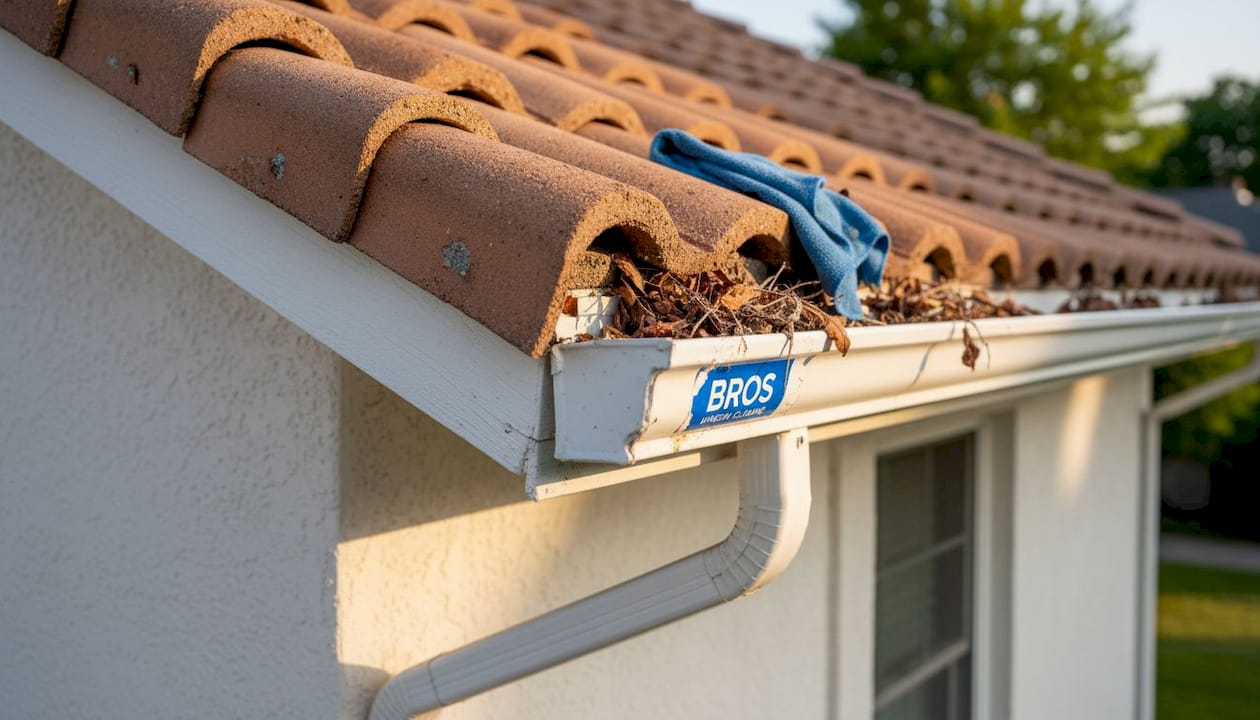
Pro Tip: Even if your gutters look mostly clear from the ground, check the downspout elbows and outlet points. These bends are where debris mats compress and form the tightest blockages, and they’re almost never visible without a direct inspection.
Common debris removal methods: What really works
Knowing how debris causes damage might prompt the question: which cleaning methods are best for your situation?
There are multiple common gutter cleaning methodologies: manual scooping and hand cleaning, blower-based clearing for dry debris, and wet-vacuum or hydro-flush methods that reduce ladder exposure while verifying flow. Each has a place, but choosing the wrong method for the wrong debris type wastes time and leaves the real problem behind.
Here’s a side-by-side comparison to help you decide:
| Method | Best for | Limitations | Safety | Cost level |
|---|---|---|---|---|
| Manual scooping | All debris types; compacted sludge | Labor-intensive; ladder required | Moderate risk | Low (DIY) |
| Blower/air clearance | Dry leaves, pine needles | Useless on wet or compacted debris | Lower risk with extensions | Low to moderate |
| Wet vacuum | Wet debris, sludge, silt | Slower; requires equipment setup | Lower risk | Moderate |
| Hydro-flush | Full system verification; downspout clearing | Mess from expelled debris | Lower risk | Moderate to high |
A few practical notes on each:
- Blowers are excellent after dry Santa Ana wind events when gutters are filled with loose, dry leaves. They’re fast and effective. But the same tool pushed against a wet sludge mat does almost nothing except scatter debris onto your roof or landscape.
- Manual scooping is the only reliable method for gutters with heavy, compacted organic buildup or mortar fragments from tile roofs. It’s slower, but it’s thorough. Pair it with a gutter scoop tool and a heavy-duty bucket to avoid mess.
- Hydro-flushing (using a garden hose with a gutter wand or a pressure washer with a safe attachment) is the best way to verify that your downspouts are actually clear all the way through. You can scoop a gutter clean and still have a blockage 10 feet down the downspout elbow.
When it comes to the best gutter cleaning tools for the job, matching the tool to the debris type is just as important as the technique itself.
For DIY cleaners, keep these safety points in mind:
- Always use a fiberglass or aluminum ladder with a standoff bracket to avoid resting weight on the gutter itself.
- Never lean out beyond your shoulder width from the ladder. Reposition the ladder instead.
- Wear thick rubber gloves. Gutter sludge frequently contains sharp granules, decomposed material, and sometimes wasp nests.
- Do your cleaning during dry, calm weather. Wet gutters and wet ladders are a dangerous combination.
For homeowners with two-story homes, steep rooflines, or tile roofs, protecting home value often means calling in a professional rather than adding unnecessary risk to the DIY approach.
Gutter guards and overlooked maintenance needs
The cleaning method is only half the story. Many homeowners look to gutter guards for relief, so what’s the real impact?
Gutter guards generate a lot of enthusiasm, and for good reason. They block large debris from entering the channel and can meaningfully reduce how often you’re dragging out a ladder. A survey by This Old House found that 42% of homeowners saved four to eight hours annually after installing gutter guards. That’s a real benefit. But fine debris and biological growth can still accumulate on top of or underneath guard systems and reduce flow over time. Guards reduce frequency, not need.
Here’s what still demands attention even on guarded gutters:
- Fine silt and granule buildup. Fine particles pass through or around most guard designs and settle at the base of the gutter channel.
- Moss and algae growth. Biological matter grows on top of guards, especially in shaded areas, and eventually restricts water from entering the gutter at all.
- Debris bridging. Pine needles and small leaves can lay flat across micro-mesh guards and form a physical mat that sheds water over the side of the gutter rather than into it.
- Downspout blockages. Guards protect the gutter channel, but anything that gets past the guard still travels toward the downspout. Those bends still need periodic flushing.
- Guard integrity checks. Guards can warp, shift, or separate from fasteners after storms. A guard that’s lifted even slightly becomes a trap for debris rather than a barrier.
Pro Tip: After every significant storm in Orange County, walk your roofline from ground level and look for standing water or overflow marks on the fascia. These are early warning signs that even guarded gutters are starting to back up. For a closer look at what to check, inspecting gutters with guards gives you a practical framework for what to look for and when.
The bottom line on guards: they’re worth it for most Orange County homes, especially those near heavy tree cover. But framing them as a “set it and forget it” solution leads to the exact kind of hidden buildup that causes real damage.
The real secret to stress-free gutter care: Mind the small stuff
Here’s what most guides on gutter maintenance leave out, and it’s the thing we’ve noticed matters most after years of cleaning gutters across Orange County properties.
The blockages that actually cause expensive water damage rarely look dramatic. They’re not dramatic piles of leaves sitting in plain sight. They’re a thin film of silt at the base of a gutter, a half-inch of slime at the downspout elbow, or a fine mat of decomposed organic material that has been quietly building for two seasons. None of these things look like emergencies. All of them restrict drainage enough to send water toward your fascia, your walls, or your foundation.
The visual inspection from the top of a ladder is not enough on its own. Looking into a gutter channel and seeing mostly clean aluminum gives a false sense of security. The real test is running water through the system and timing how fast it clears the downspout. If it pools before draining, you have a flow restriction somewhere below the visible surface.
What we’ve found is that homeowners who stay consistent with regular gutter cleaning on a predictable schedule, even if each cleaning is shorter and simpler, dramatically outperform those who wait for visible signs of a problem. Orange County’s mild climate fools people into thinking they have more time than they do. A dry summer followed by a first heavy November rain is exactly the scenario where partially silted gutters fail fast.
The homeowners who spend the least on repairs over time are not the ones with the most expensive guards. They’re the ones who do quick flow tests twice a year and take fine sediment seriously, not just the leaf piles.
Take the next step: Easy gutter and exterior care in Orange County
With a clear plan and real awareness of what to watch for, protecting your property from gutter-related damage becomes straightforward rather than overwhelming.
At Bros Window Cleaning, we’ve spent over five years helping Orange County homeowners manage exactly the kind of hidden debris buildup this article describes. Our Orange County gutter cleaning guide walks you through what a professional cleaning actually covers, from scooping and flushing to downspout verification.

Whether you need a one-time cleanout before the rainy season or a regular schedule to keep fine silt and sludge from silently compressing into your downspouts, our team handles it safely, thoroughly, and on time. We understand the specific debris challenges Orange County’s roof types and tree species create. Our gutter maintenance services are built around those realities, not a generic approach copied from a different climate. Ready to stop guessing and start protecting? Explore all our professional exterior cleaning options and get a quote today.
Frequently asked questions
What is the most common type of gutter debris in Orange County?
Leaves, small twigs, and roof material fragments are the most frequent culprits. Common debris types include moss, pine needles, silt, roofing mortar, broken tile fragments, grass, and weeds, all of which are prevalent in OC’s landscape.
Do gutter guards completely eliminate cleaning needs?
No. Guards reduce how often large debris accumulates, but fine debris and biological growth can still build up and restrict water flow, requiring periodic inspection and maintenance regardless of guard type.
How often should I check my gutters for debris?
Inspect gutters at least twice a year, once in late fall and once in early spring. After Santa Ana wind events or heavy rains, verify downspout outlet flow to catch partial blockages early before they become full clogs.
What’s the best method for removing compacted sludge in gutters?
Manual scooping combined with a thorough hydro-flush works best. Blowers are limited on wet or compacted sediment, while wet-vacuum or hydro-flush systems are far more effective at clearing sticky buildup from gutter channels and downspout elbows.
Can gutter debris lead to water damage inside my home?
Absolutely. Trapped debris causes clogs and overflow that can soak fascia boards, seep behind siding, and channel water directly toward your foundation, leading to structural damage and costly interior repairs if left unaddressed.
Pingback: 9 Warning Signs Your Gutters Need Cleaning Now