
Yes, bird droppings on solar panels can meaningfully cut output and, left alone, create localized hotspots that stress individual cells. Peer-reviewed testing and Enphase’s own maintenance guidance both back that up. If you can see droppings on a panel right now, spot-clean them with a soft cloth and water within a few days. If the deposits are baked on, high up, or covering a large section of the array, call a professional instead of climbing onto the roof yourself.
TL;DR:
- Power losses from bird droppings on panels can reach nearly 24% with heavy accumulation, significantly reducing energy output.
- Droppings are highly adhesive, often baked on after days or weeks without rain, requiring prompt, careful cleaning to prevent long-term damage.
- Regular monitoring of system output relative to expected performance is a more effective trigger for cleaning than fixed dates.
- DIY cleaning is suitable only for small, fresh deposits on low-slope panels, with safety precautions, or else professional service is recommended.
- Installing physical deterrents like mesh skirts, spikes, or removing nearby perches effectively reduces bird droppings and nesting risks long-term.
Table of Contents
- Bird Droppings on Solar Panels: How They Cut Output and Cause Hotspots
- When Should You Clean Solar Panels With Bird Droppings?
- How to Safely Remove Bird Droppings Yourself
- When to Hire a Professional Solar Panel Cleaner
- Preventing Bird Droppings on Solar Panels Without Voiding Your Warranty
- How Bros Window Cleaning Approaches Bird Droppings on Panels
- Environmental and Health Considerations of Bird Droppings on Solar Panels
- Does the Type of Bird Dropping Affect Panel Damage?
- Long-Term Damage From Repeated Bird Dropping Exposure
- Legal Rules Around Bird Deterrence and Nest Removal Near Solar Panels
- What This Guide Gets Right That Most Advice Skips
- Get Professional Solar Panel Cleaning Services
- Sources
Bird Droppings on Solar Panels: How They Cut Output and Cause Hotspots
A single dropping doesn’t sound like much of a threat to a system generating several kilowatts. But droppings don’t behave like ordinary dust. They’re opaque, they clump, and they sit directly on the cell surface, blocking sunlight from reaching that spot entirely rather than just dimming it.
That total blockage is what makes bird droppings different from dust, pollen, or leaf litter. When a solar cell is fully shaded while its neighbors keep producing current, the shaded cell can’t pass along the electricity the rest of the string is generating. It ends up absorbing that excess energy as heat instead, sometimes reaching temperatures far above the surrounding glass. Engineers call this a hotspot, and repeated hotspot cycling degrades the cell and the encapsulant around it over time, not just the day’s output.
The numbers on how much power this actually costs vary by test conditions, but they’re not trivial. Experimental work published through IEEE’s QPAIN 2025 proceedings measured output losses ranging from roughly 3.7% for light, scattered droppings up to nearly 24% for heavier accumulation, with some heavy localized coverage scenarios pushing losses even higher in controlled tests.
Statistic Callout: Controlled studies on bird-dropping contamination report power losses ranging from about 4% for light soiling to nearly 24% for heavy accumulation on a single module, with hotspot formation adding long-term degradation risk on top of the immediate output drop.
Why doesn’t rain just wash this off? Because droppings aren’t loose grime. Research in Case Studies in Thermal Engineering found bird droppings are among the most adhesive forms of panel soiling, thanks to digestive fluids that bond to glass as they dry. A light shower often beads up around a dropping without dissolving it. Only sustained, heavy rain reliably breaks that bond, and by the time that happens, the dropping has usually already baked on for days or weeks.
A few things make the damage worse than a casual glance suggests:
- Droppings tend to land in clusters near favorite perch spots, so the shading isn’t evenly spread, it’s concentrated on a handful of cells.
- Dark, dense droppings absorb more heat than they block light, intensifying the hotspot effect compared to lighter debris.
- Panels mounted at low tilt angles collect and hold droppings longer because gravity does less of the cleaning work for you.
- Strings wired in series mean one badly shaded cell can throttle the output of every panel connected to it, not just the one it’s sitting on.
None of this means your system is in immediate danger from a single dropping. It means small deposits are worth addressing before they multiply, bake on, or land somewhere hard to reach.
When Should You Clean Solar Panels With Bird Droppings?
The honest answer is: let your monitoring app tell you, not the calendar. Every modern inverter or monitoring portal tracks daily production, and most let you compare current output against expected output for that time of year. That comparison is the real trigger, not a fixed date circled on the fridge.
EnergySage’s guidance puts it plainly: cleaning a significantly soiled array typically recovers somewhere between 5% and 25% of lost generation. If your monitoring shows a sustained dip in that range compared to a clear-sky baseline, cleaning is worth the trip. If it’s within normal day-to-day noise, hold off.
Here’s a simple way to work through it:
- Pick a clear, sunny day and note your system’s output around midday, when production is most predictable.
- Compare it to the same time last month or to the manufacturer’s expected output curve for your location and tilt.
- Look for a pattern, not a blip. A single low day could be clouds or a faulty reading. A drop that persists for a week or more, with no weather excuse, points to soiling.
- Walk the yard or use binoculars to visually confirm droppings, dust buildup, or debris on the array before you assume it’s soiling and not a wiring or shading issue.
- Schedule cleaning once you’ve confirmed both, a visible deposit and a sustained output dip.
Frequency depends heavily on where you live. Enphase recommends once or twice a year for most residential systems in average climates. Coastal, desert, or heavily dusty areas often need it every two to three months, since salt spray and grit accelerate both dirt buildup and dropping adhesion. Add an extra visual check after any major storm or a stretch of heavy bird activity, like nesting season in spring.
Pro Tip: Keep a phone photo log of your panels every few months. Side-by-side shots make it much easier to spot a slow accumulation trend than relying on memory alone.
Our guide on solar panel cleaning frequency breaks down specific schedules by climate zone if you want a more detailed starting point than the general rule above.
How to Safely Remove Bird Droppings Yourself
For small, fresh, and easily accessible deposits, DIY spot-cleaning is reasonable. For anything else, it usually isn’t.
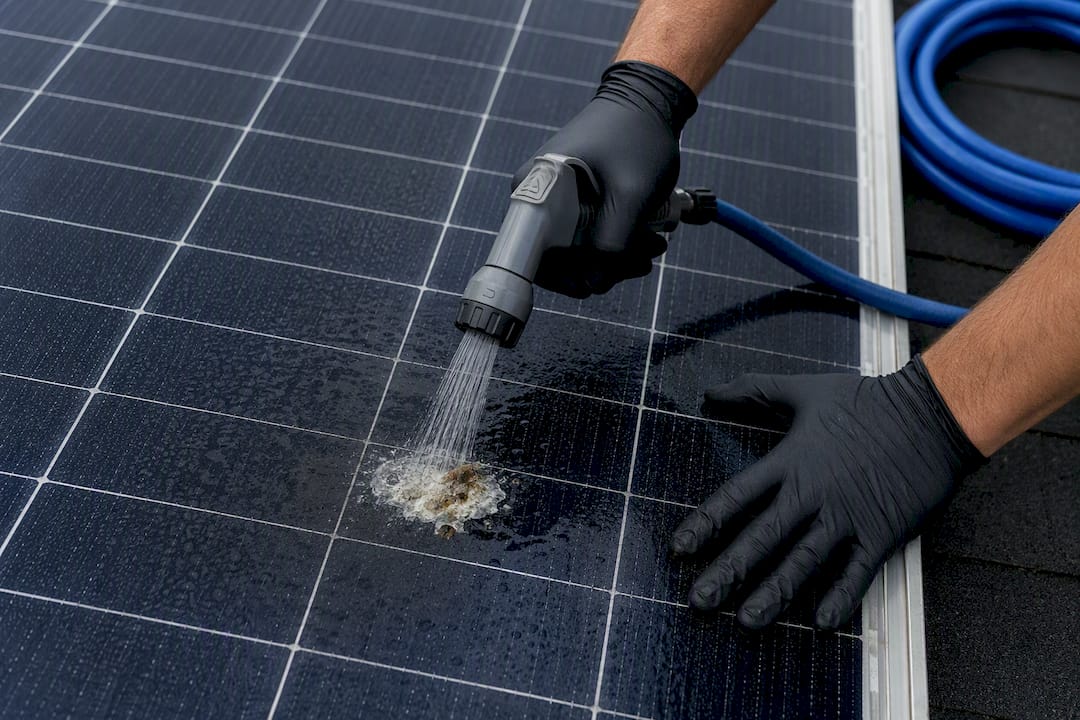
Start by cleaning early morning or evening, never at midday. A hot panel surface flash-dries water and cleaning solution before you can wipe it away, and it can also cause thermal shock if cold water hits sun-baked glass. Once the panel has cooled:
- Rinse the dropping with plain water first to loosen it rather than scrubbing dry residue directly into the glass.
- Use a soft cloth, sponge, or a soft-bristle brush designed for solar glass, never a scouring pad, steel wool, or anything abrasive.
- If the spot resists water alone, add a small amount of mild dish soap diluted in water, then rinse thoroughly to avoid leaving a soapy film that attracts more dust.
- For deposits that have hardened over several days, let plain or deionized water sit on the spot for a few minutes before wiping. Consumer testing from Popular Mechanics recommends this dwell-time approach over aggressive scrubbing, which can scratch anti-reflective coatings.
- Avoid spraying water directly at the underside of the panel or near junction boxes and wiring connectors.
- Skip pressure washers entirely. Most framed residential modules aren’t rated for high-psi spray, and forcing water past seals is a common cause of moisture intrusion that voids warranties.
Safety matters more than the cleaning technique itself. Never walk directly on panels. The tempered glass can handle foot traffic in theory, but it’s slick, especially when wet, and a slip on a pitched roof is a fall risk you don’t need to take for a chore this small. If you’re using a ladder to reach a low-slope roof edge, use proper fall protection and never work alone. Some installers also recommend checking with your inverter manufacturer about whether to de-energize the system before any water contacts the array. It’s a reasonable question to ask, even for light cleaning.
Stop and call a professional if you’re looking at baked-on guano that doesn’t respond to a gentle soak, droppings spread across a large section of the array, panels on a steep or high roof, or any uncertainty about whether cleaning might affect your manufacturer warranty. Our full step-by-step cleaning guide covers the process in more depth if you’re tackling a larger DIY job.
When to Hire a Professional Solar Panel Cleaner
Professionals bring three things most homeowners can’t easily replicate: proper de-energizing protocols, full-array equipment, and a trained eye for damage that isn’t obvious from the ground.
A legitimate solar cleaning visit typically includes a check of the inverter or shutoff procedure before any water touches the array, a full rinse using soft brushes or water-fed poles designed not to scratch glass or frames, and a visual inspection for hotspots, cracked cells, or loose mounting hardware while they’re already up there. That last part matters more than most homeowners realize. A cleaner who’s trained to spot early hotspot discoloration can flag a developing problem months before it shows up as a meaningful production drop on your monitoring app.
Before hiring anyone, ask a short list of direct questions:
- Are you insured for rooftop work, and can you provide proof?
- What cleaning agents or equipment do you use, and are they safe for the specific panel coating on my system?
- Can you show examples or references from past solar cleaning jobs, not just window or gutter work?
- What safety measures do you follow for fall protection and electrical isolation?
- Will your process affect my manufacturer warranty in any way?
On cost and payoff, let your monitoring data do the arguing. If your app shows a persistent 10% to 15% shortfall against baseline, and a cleaning service quote is a fraction of what that lost generation would cost you over a year, the math tends to favor cleaning. EnergySage’s analysis frames this as the right way to evaluate the expense, comparing dollars lost to dollars spent rather than cleaning on a fixed schedule regardless of actual need.
Pro Tip: Ask any cleaner whether they’ll take before-and-after monitoring screenshots. It’s a small ask, and it gives you hard proof the visit paid for itself.
Preventing Bird Droppings on Solar Panels Without Voiding Your Warranty
Prevention beats repeated cleaning, but not every deterrent on the market is worth the money or the installation risk.
Short-term deterrents, like owl decoys, reflective tape, or ultrasonic repellent units, sometimes reduce perching for a few weeks before birds figure out nothing about them actually threatens harm. They’re cheap and easy to try, but treat them as a stopgap, not a permanent fix. Moving decoys around every week or two extends their effectiveness slightly, since birds habituate fastest to anything stationary.
Physical barriers do more heavy lifting long term:
- Rail-mounted spikes attach to the panel racking rather than the glass or frame itself, discouraging perching along the array edges without touching the module surface.
- Mesh skirts installed around the perimeter of the array block birds from accessing the gap underneath the panels, which is the real prize for nesting birds looking for a sheltered, predator-free spot.
- Any mesh or skirt should mount to the roof or rail structure rather than clip directly to panel frames, and it needs enough clearance to preserve the airflow underneath that keeps panels running efficiently in heat. OEM guidance from manufacturers like First Solar specifically flags ventilation-blocking mesh as a risk to both performance and warranty coverage.
- Trimming overhanging branches near the roofline removes a favorite staging perch that birds use right before landing on the array.
If birds have already nested under your panels, don’t disturb the nest yourself. Many native species are protected once eggs or chicks are present, and removing an active nest can carry legal consequences depending on the species involved. Call a wildlife control professional to assess it, and only address prevention once the nest is naturally vacated. Checking under panels periodically for early nesting activity, alongside a broader look at roof debris that shouldn’t be there, is a better long-term habit than waiting for a full nest to form.
How Bros Window Cleaning Approaches Bird Droppings on Panels
We treat solar arrays the same way we treat every glass surface we service: inspect first, clean carefully, document the result. A typical solar cleaning visit starts with a look at panel access, mounting condition, and any visible hotspot discoloration before a drop of water goes on the glass. We’ve also written directly about how rain does and doesn’t clean panels for homeowners trying to figure out whether a recent storm actually did the job for them.
Here’s what a typical visit looks like, start to finish:
- Initial inspection of the array for soiling patterns, droppings, and mounting hardware condition.
- Soft-tool cleaning using methods that won’t scratch anti-reflective coatings or force water into junction boxes.
- Before-and-after photos so you have a visual record, not just a verbal assurance the job got done.
- Scheduling built around your availability, with insurance documentation available on request.
| What to track | Before your visit | After your visit |
|---|---|---|
| Monitoring app output | Note current daily output vs. expected baseline | Compare output 3 to 5 days post-cleaning |
| Visible soiling | Photograph affected panels | Photograph same panels for comparison |
| Any hotspot discoloration | Flag for inspection | Confirm whether it’s addressed or needs follow-up |
Tracking those three things gives you a real before-and-after picture instead of a guess about whether the visit was worth it.
Environmental and Health Considerations of Bird Droppings on Solar Panels
Bird droppings on a roof aren’t just a performance issue, they’re a hygiene one. Accumulated droppings can harbor bacteria and fungal spores, and dried droppings can release particles into the air when disturbed, which is one more reason not to dry-scrape a panel without wetting it first. Anyone cleaning an array with a heavy accumulation of droppings should wear gloves and avoid creating dust by dry brushing.
There’s also a runoff angle worth knowing. Rainwater that washes droppings off a roof carries nitrogen-rich waste into gutters and eventually into yard soil or storm drains. In small residential quantities this isn’t a serious environmental hazard, but it’s a good reason to avoid letting droppings accumulate for months at a time, especially near vegetable gardens or rain collection systems.
For the birds themselves, deterrents matter too. A poorly designed barrier, like sticky gel repellents or improperly spaced spikes, can injure birds rather than simply redirect them, which is both an animal welfare problem and, depending on the species, a potential legal one. Sticking to spacing-based deterrents like mesh and rail spikes avoids that risk entirely, since they work by denying access rather than causing discomfort or harm.
The practical takeaway: treat droppings as a hygiene task, not just an efficiency one. Gloves, prompt cleaning, and humane deterrents cover both the panel’s output and the health side of the equation at the same time.
Does the Type of Bird Dropping Affect Panel Damage?
Not all droppings are created equal, and the acidity difference matters more than most people assume. Bird droppings, unlike mammal waste, contain uric acid rather than urea, which makes them notably more corrosive to surfaces over time, including glass coatings and painted metal racking.
Species matters too. Larger birds like pigeons and gulls tend to produce larger, denser deposits that hold moisture longer and cover more surface area per dropping, meaning more shading per incident and a longer dwell time for the acidic compounds to interact with the glass coating. Smaller songbirds leave smaller, less damaging deposits individually, but they tend to visit more frequently and in greater numbers, so the cumulative exposure can rival what a single large bird leaves behind.
Diet plays a role in acidity level as well. Birds that eat mostly fruit or seed tend to produce less corrosive waste than birds with a heavier animal-protein diet, since protein breakdown produces more concentrated uric acid. This is one reason coastal properties near gull populations often report more aggressive glass etching over time compared to inland properties with mostly songbird traffic.
None of this changes the cleaning advice much. Regardless of species, prompt removal before the deposit dries and bonds to the glass coating limits acid exposure time, which is the variable you actually control.
Long-Term Damage From Repeated Bird Dropping Exposure
A single cleaned dropping is a non-event. Years of uncleaned, repeated exposure in the same spots is a different story.
The anti-reflective coating on most solar glass is thin, and it’s the first layer that takes damage from prolonged acidic contact. Once that coating starts etching or degrading in a localized spot, that section of the panel loses some light transmission permanently, not just while the dropping sits there. Cleaning removes the dropping but can’t restore coating that’s already been chemically worn down.
Framing and mounting hardware take a slower hit too. Runoff loaded with dropping residue tends to pool at frame edges and mounting clips, and over years that can accelerate corrosion on aluminum framing or galvanized racking, particularly in coastal air that’s already working against those materials. It’s a slow process, usually measured in years rather than months, but it’s a real factor in why panels in heavy bird-traffic areas sometimes show frame corrosion earlier than panels on cleaner roofs of the same age.
The hotspot risk mentioned earlier compounds this. A cell that’s repeatedly shaded and overheated in the same location doesn’t fully recover between incidents. Each cycle adds a small amount of thermal stress to the cell and its encapsulant, and that stress accumulates. This is the strongest argument for treating droppings as a recurring maintenance item rather than an occasional annoyance. The panels most likely to need early replacement or show reduced output as they age are often the ones that sat under a favorite perch spot for years without regular attention.
Legal Rules Around Bird Deterrence and Nest Removal Near Solar Panels
Deterring birds from landing on your panels is generally unrestricted. Spikes, mesh, decoys, and reflective tape are all standard, legal options almost anywhere in the United States, since they don’t harm birds, they just make your roof a less appealing perch.
Nests are where the legal line actually sits. Many native bird species in the US are protected under the Migratory Bird Treaty Act, which makes it illegal to disturb, remove, or destroy an active nest containing eggs or chicks without a permit, regardless of where that nest happens to be. This applies even when the nest is inconveniently located under your solar array. Removing an empty, inactive nest outside of nesting season is typically fine, but if you’re not sure whether a nest is active, the safer move is to wait and check periodically rather than disturb it.
Local ordinances can add another layer, particularly in cities with municipal codes covering wildlife nuisance complaints or protected local species. If you’re dealing with an active nest under panels and you need it addressed sooner rather than later, contacting a licensed wildlife control operator is the appropriate route. They can assess whether the species is protected, whether a permit applies, and handle relocation or removal in a way that keeps you on the right side of both federal and local rules.
What This Guide Gets Right That Most Advice Skips
Most articles on this topic treat cleaning frequency as a fixed calendar item, twice a year, done. That advice isn’t wrong exactly, it’s just incomplete. The research on monitoring-driven cleaning makes a stronger case: your inverter data is a better trigger than a date on the calendar, because soiling doesn’t happen on a schedule, birds don’t either.
What gets consistently underrated is the hotspot angle. Homeowners fixate on the percentage output loss because it’s the number they can see on an app, but the more expensive long-term risk is cumulative cell stress from repeated localized shading in the same spots. That’s a slower, quieter problem, and it’s exactly why prompt spot-cleaning of small deposits matters even when the overall output dip looks minor.
If there’s one thing worth prioritizing above all the rest, it’s building the habit of checking monitoring data against a real baseline rather than trusting gut feel. Everything else, cleaning method, prevention hardware, hiring a pro, follows naturally once you know whether there’s an actual problem to solve.
— nolan
Get Professional Solar Panel Cleaning Services
Professional solar panel cleaning services offer a safer alternative to climbing onto a hot, slick roof to chase down bird droppings yourself, using soft-tool, panel-safe methods designed for glass surfaces. There is a specific risk with solar arrays: a wrong move with a pressure washer or an abrasive pad can cause coating damage that outweighs the benefits of the cleaning in recovered output.
If your monitoring app shows a persistent output dip, or you notice droppings accumulating on panels that are hard to reach, it may be the right time to bring in a professional cleaning service. Professionals can handle the inspection, safe cleaning, and provide documentation so you have clear before-and-after proof the visit was effective, beyond just a clean-looking roof from the ground. Check our solar panel cleaning frequency guide for your climate zone, then reach out to get a visit scheduled before those droppings have a chance to bake on.
Sources
- Solar panel cleaning and maintenance guide — Enphase
- Do you need to clean solar panels? — EnergySage
- Experimental analysis on impacts of soil deposition and bird droppings — Case Studies in Thermal Engineering (2023)
- Yes, dirt on your solar panels can zap their power. Here’s how to clean them — Popular Mechanics (2025)