
Customer satisfaction in cleaning services is defined as a client’s measured perception of whether a provider met or exceeded their expectations for cleanliness, reliability, and communication. The role of customer satisfaction in cleaning services goes far beyond a simple rating. It determines whether a provider improves, retains clients, and builds a reputation worth having. The janitorial industry scores a CSAT of 89 out of 100, yet still loses 15% of clients annually. That gap between high scores and real churn reveals a critical truth: satisfaction must be actively managed, not assumed.
How does customer satisfaction shape cleaning service quality?
Customer satisfaction functions as the primary feedback signal that tells a cleaning provider what is working and what is not. Without it, quality decisions are made on guesswork. Tools like HappyOrNot kiosks, CSAT surveys, and Net Promoter Score (NPS) questionnaires give providers structured data to act on. These are the industry’s standard measurement instruments, and they matter because they turn subjective impressions into trackable metrics.
The importance of client feedback in cleaning extends beyond catching problems. Feedback is a proactive quality control tool, not just a reactive measure for problems. When a provider collects input after every visit, they spot patterns before a client ever considers leaving. A recurring complaint about missed baseboards or inconsistent scheduling becomes visible weeks before it becomes a cancellation.
Providers who act on feedback and then communicate those changes to clients see a measurable lift in loyalty. Closing the feedback loop by informing clients about changes made based on their input leads to higher advocacy. Clients who feel heard become the most reliable source of referrals.

How do feedback systems improve cleaning quality?
Structured feedback systems are the operational backbone of any cleaning business that improves over time. The method and timing of feedback collection determine how useful the data actually is.
The most effective feedback methods include:
- Automated post-service surveys sent via SMS or email within 2–4 hours of service completion
- Instant feedback kiosks (such as HappyOrNot terminals) placed in commercial facilities for real-time input
- Follow-up messages from account managers that invite open-ended responses
- Scheduled check-in calls at 30, 60, and 90 days for new commercial contracts
Timing matters more than most providers realize. Surveys sent within 2–4 hours post-service capture higher response rates than next-day surveys. The client’s experience is fresh, and their emotional state is at its most positive. Waiting until the next morning means competing with a full inbox and faded memory.
Automation also multiplies volume. Automated post-service surveys increase review collection rates 4x compared to verbal or ad hoc requests from crews. More reviews mean more data, and more data means faster quality corrections.
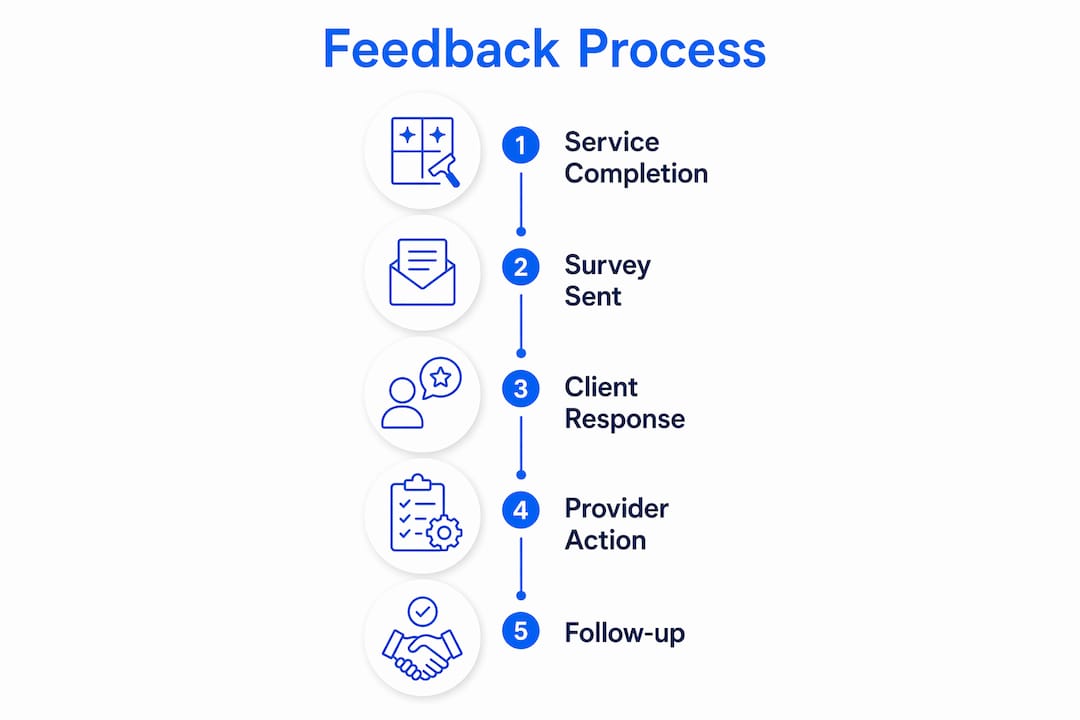
Service recovery is the other side of the feedback equation. When a client reports a problem, the speed of resolution directly affects whether they stay or leave. Resolving complaints quickly increases the likelihood of a customer recommendation by 2.5 times. A fast, genuine response to a missed spot or a scheduling error can turn a frustrated client into a loyal advocate.
Pro Tip: Set your survey automation to trigger exactly 3 hours after a service is marked complete in your scheduling software. That window consistently produces the highest open and response rates.
Does customer satisfaction affect client retention and loyalty?
The connection between satisfaction and retention is direct, but the numbers reveal a more complicated picture than most owners expect.
The janitorial industry’s 15% annual churn rate persists even with high satisfaction scores. Pricing drives 32% of that churn, poor service accounts for 28%, and competitor switching explains 40%. This means satisfaction alone does not guarantee retention. Providers must combine quality delivery with competitive pricing and proactive relationship management.
The financial case for retention is strong. Consider what loyalty actually produces over time:
| Year | Client Spending Behavior |
|---|---|
| Year 1 | Baseline spend established |
| Year 2 | Retained clients spend 67% more than in year one |
| Year 3 | Spending rises to 2.3x the original amount |
These figures explain why customer loyalty in cleaning services is worth investing in structurally, not just through good service delivery. Loyalty programs and membership models formalize that investment. Cleaning businesses with structured loyalty programs see repeat booking rates rise 50–70%. A client enrolled in a monthly maintenance plan is far less likely to shop around than one who books on demand.
The risk of losing clients is also asymmetric. 69% of cleaning customers will switch providers after just two negative service experiences. That is not a wide margin for error. Two bad visits, without a recovery response, can erase months of goodwill.
For home and business owners evaluating providers, this data points to one clear signal: ask your cleaning company how they handle complaints. A provider with a defined recovery process is a provider who takes retention seriously. You can also review residential cleaning package structures to understand what service tiers typically include and what guarantees are standard.
Common misconceptions about satisfaction in cleaning services
Several persistent myths prevent both clients and providers from managing satisfaction well. Understanding them helps you avoid the traps.
Misconception 1: Feedback is only needed when something goes wrong.
Most clients only speak up after a major failure. The reality is that most service contracts fail due to accumulated minor experience gaps rather than catastrophic failures. A slightly dusty corner, a missed trash bin, a crew that arrived 20 minutes late three times in a row. None of these trigger a formal complaint. All of them erode trust quietly.
Misconception 2: One survey at onboarding is enough.
A single survey captures a snapshot. Regular structured feedback detects quality decline early, allowing providers to address issues while trust remains intact. Ongoing feedback is the mechanism that keeps quality from drifting.
Misconception 3: High satisfaction scores mean the relationship is secure.
A score of 89 out of 100 sounds excellent. The industry’s 15% churn rate proves it is not a guarantee. Scores measure a moment. Retention requires consistent performance across every visit.
Misconception 4: The first few months do not require extra attention.
The first 90 days of a cleaning contract are the highest-risk period. A 90-day stabilization plan focusing on proactive communication is critical for contract retention. New clients form lasting impressions fast. Providers who check in regularly during this window retain far more contracts than those who assume silence means satisfaction.
Pro Tip: If you have just hired a new cleaning service, schedule a brief 15-minute call at the 30-day mark. Ask one direct question: “Is there anything we should be doing differently?” That single question surfaces issues before they compound.
How can you improve satisfaction with your cleaning provider?
Home and business owners have more influence over cleaning outcomes than most realize. Satisfaction is not something that happens to you. It is something you help create through clear communication and consistent engagement.
Here are the most effective practices for building a productive client-provider relationship:
- Set written expectations before the first visit. Provide a checklist of priorities, access instructions, and any areas requiring special attention. Verbal instructions get forgotten. Written ones get followed.
- Give feedback promptly after each service. Proactive communication about service status is viewed positively by 90% of cleaning customers. The same principle applies in reverse. Providers who hear from you quickly can correct course before the next visit.
- Use ongoing feedback, not one-time surveys. A single review after the first clean tells a provider very little. Consistent input over three to six months gives them the data to genuinely improve.
- Acknowledge excellent work explicitly. Recognizing a crew member by name for outstanding work motivates repeat performance. It also signals to the company that you are an engaged client worth prioritizing.
- Request a written service summary after each visit. Many commercial providers offer digital logs. Reviewing them takes two minutes and creates accountability on both sides.
For commercial property managers, building a scalable cleaning workflow that incorporates regular feedback checkpoints is the most reliable way to maintain consistent standards across multiple facilities.
Key takeaways
Customer satisfaction in cleaning services drives quality, retention, and revenue only when providers collect feedback consistently, act on it visibly, and communicate those actions back to clients.
| Point | Details |
|---|---|
| High scores do not prevent churn | The industry’s 89/100 CSAT still produces 15% annual client loss, so scores alone are not enough. |
| Timing feedback correctly multiplies its value | Surveys sent 2–4 hours post-service collect 4x more responses than next-day requests. |
| Fast complaint resolution builds advocates | Resolving issues quickly makes a client 2.5x more likely to recommend the provider. |
| The first 90 days are the highest-risk period | Proactive communication during onboarding stabilizes contracts and reduces early churn. |
| Loyalty programs convert satisfaction into revenue | Retained clients spend up to 2.3x more by year three than they did in year one. |
What i have learned about satisfaction in cleaning services
After spending years reviewing how cleaning businesses operate and where client relationships break down, one pattern stands out above all others. The providers who lose clients are almost never the ones who did something catastrophically wrong. They are the ones who stopped paying attention.
The feedback loop is not a customer service formality. It is an operational discipline. The businesses that treat it that way, collecting input after every visit, acting on what they hear, and then telling the client what changed, are the ones that retain accounts for years. The ones that treat feedback as an optional extra tend to discover problems only after the cancellation email arrives.
For home and business owners, the practical takeaway is this: do not wait for your cleaning provider to ask how things are going. Tell them. A two-sentence message after a service visit gives a provider more useful information than a quarterly survey ever will. The best client-provider relationships I have seen are the ones where both sides communicate like partners, not like vendor and customer.
The factors influencing client satisfaction in cleaning are mostly within your control as the client. You set the expectations. You provide the feedback. You decide whether to acknowledge good work or stay silent. Providers who receive that kind of engagement consistently deliver better results. That is not a coincidence.
— nolan
See how Broswindowcleaningoc puts satisfaction first
Broswindowcleaningoc has served Orange County homeowners and businesses for over five years with window cleaning, pressure washing, gutter cleaning, solar panel cleaning, and roof cleaning. Every service is backed by a commitment to punctuality, safety, and results you can see. If you want to understand exactly what professional cleaning involves before you book, the window cleaning terms guide breaks down industry language in plain English so you know what to expect and what to ask for. Ready to schedule a service or get a personalized cleaning plan for your property? Contact Broswindowcleaningoc today and get a quote built around your specific needs.
FAQ
What is the role of customer satisfaction in cleaning services?
Customer satisfaction in cleaning services measures whether a provider met client expectations for cleanliness, reliability, and communication. It directly influences service quality, client retention, and a provider’s ability to grow through referrals.
Why do cleaning companies lose clients despite high satisfaction scores?
The janitorial industry averages a CSAT of 89 out of 100 but still experiences a 15% annual churn rate. Pricing, competitor switching, and accumulated minor service gaps drive most cancellations, not single catastrophic failures.
How does client feedback improve cleaning quality?
Regular structured feedback detects quality decline early, before clients consider leaving. Automated surveys sent 2–4 hours post-service collect 4x more responses and give providers actionable data to correct issues between visits.
When should i give feedback to my cleaning provider?
Give feedback as soon as possible after each service, ideally within a few hours. Prompt input allows providers to address issues before the next visit and reinforces what is working well.
How does fast complaint resolution affect customer loyalty?
Resolving a complaint quickly makes a client 2.5x more likely to recommend the provider. Slow or absent responses to problems are among the leading causes of switching after just two negative experiences.