Commercial building cleaning procedures are standardized, documented methods that specify what to clean, how to clean it, when to do it, and who is responsible, producing consistent hygiene and visual results across every shift. Without that structure, even a hardworking crew delivers uneven outcomes because each person follows a different mental sequence. Property managers and business owners who formalize these procedures reduce complaints, cut rework, and satisfy OSHA sanitation requirements under 29 CFR 1910.141. The difference between a building that looks clean and one that is clean comes down to defined chemical use, verified dwell times, and documented inspection standards. This guide walks through every layer of that system.
What are the key steps in commercial building cleaning procedures?
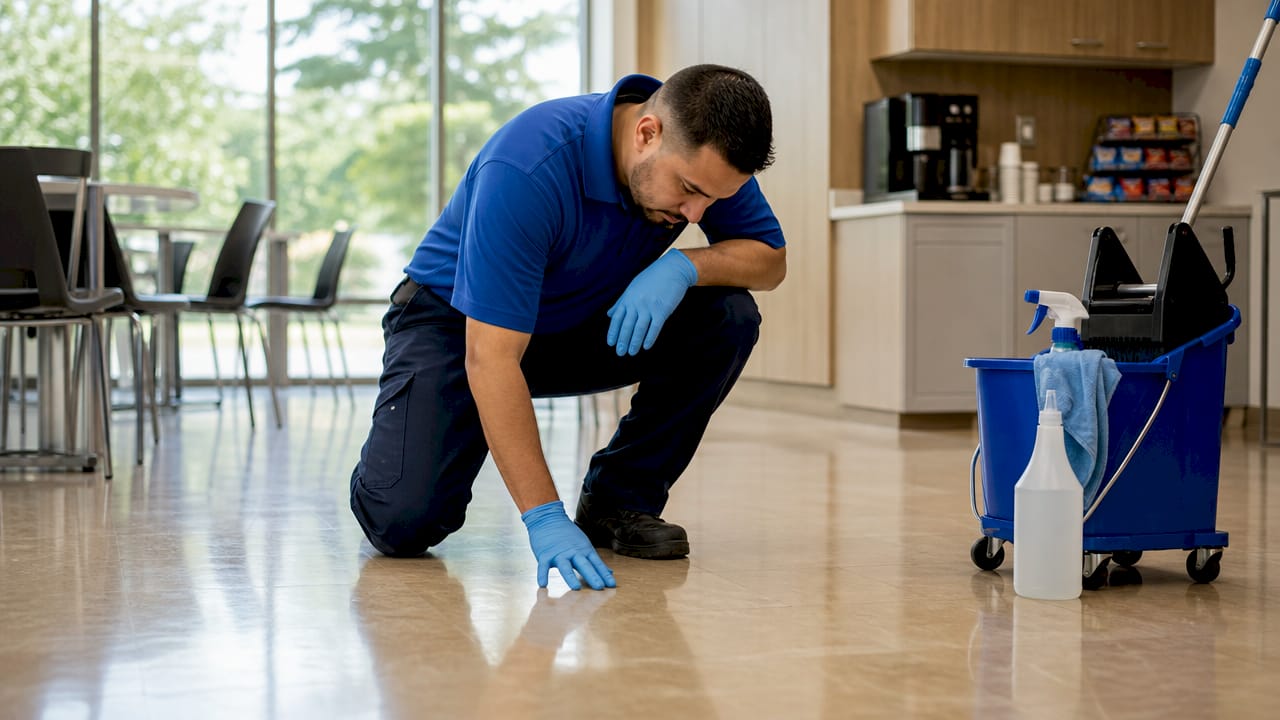
Effective commercial room cleaning follows a dry-to-wet 7-step sequence: trash removal, high dusting, damp wiping of surfaces, restocking of supplies, dust mopping or vacuuming, inspection, and finally wet mopping. That order is not arbitrary. Dry tasks always precede wet tasks so that dust and debris do not turn into muddy smears on freshly mopped floors. Skipping steps or reversing the sequence is the single most common cause of rework in commercial facilities.
Here is the sequence broken down with task-level detail:
- Remove trash and soiled materials from all receptacles, including under desks and in restroom stalls.
- High dust ceiling vents, light fixtures, and the tops of partitions before touching any horizontal surface.
- Damp wipe all horizontal surfaces, door handles, light switches, and shared equipment using a microfiber cloth and an appropriate cleaner.
- Restock paper products, soap dispensers, and liners so supplies are ready before the space is used again.
- Dust mop or vacuum all floor areas to collect debris loosened during the earlier steps.
- Inspect the entire space for missed spots, streaks, or areas needing disinfection before committing to the final step.
- Wet mop floors as the last action, working from the farthest corner toward the exit.
Inspection before wet mopping is a key lever for operational consistency because it allows corrective action before an irreversible step locks in any missed areas. In restrooms, this means checking grout lines and fixture bases before the mop water spreads contamination. In lobbies, it means confirming that glass partitions and reception counters are streak-free before the floor reflects them.
Pro Tip: Apply EPA-registered disinfectant to restroom surfaces immediately after damp wiping, then complete the remaining steps in that room before returning to wipe. This naturally builds in the required dwell time without adding extra minutes to the schedule.
How to organize cleaning schedules by frequency and area priority
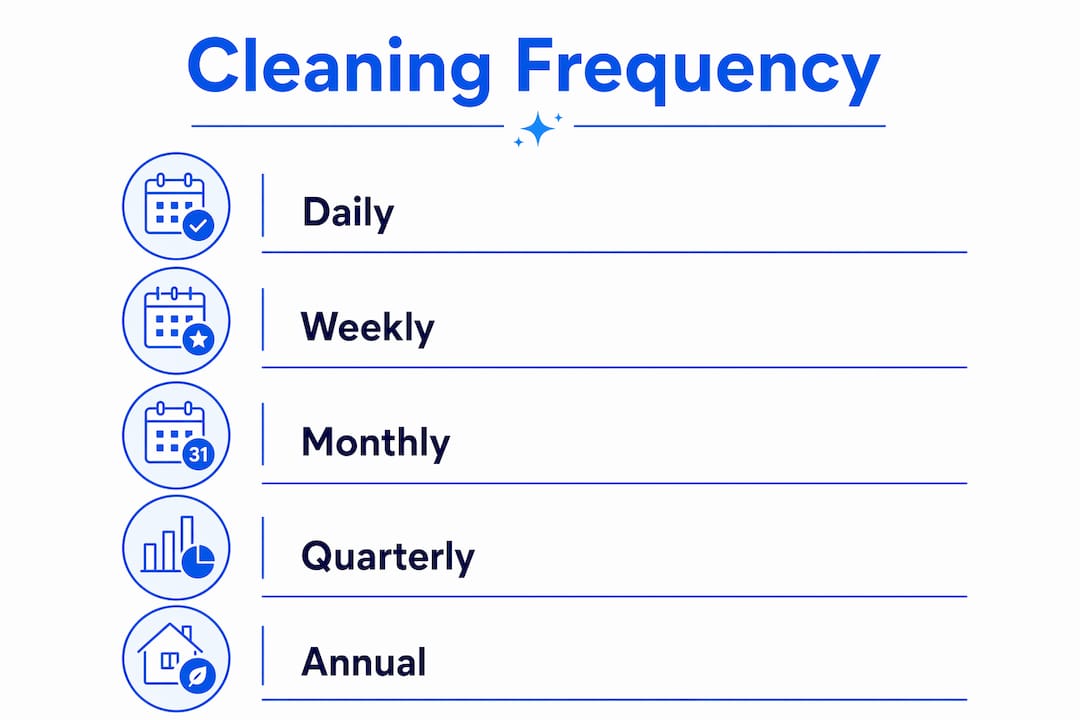
A tiered scheduling approach aligns cleaning frequency with actual usage patterns and hygiene risk rather than guesswork. Commercial cleaning schedules use four tiers: daily, weekly, monthly, and quarterly. Most facilities run weekly detail tasks on rotating shifts and push quarterly work like carpet extraction into low-traffic periods such as holiday weekends.
| Frequency | Typical tasks | Zone examples |
|---|---|---|
| Daily | Trash removal, restroom sanitation, high-touch disinfection, lobby sweep | Restrooms, lobbies, break rooms, elevators |
| Weekly | Detail dusting, deeper restroom scrubbing, glass cleaning, spot carpet care | Offices, conference rooms, stairwells |
| Monthly | Vent cleaning, baseboard scrubbing, floor stripping or buffing | Back-of-house, storage areas, corridors |
| Quarterly | Carpet extraction, upholstery cleaning, exterior window washing | All zones on rotation |
Zone priority drives daily task assignment. High-touch, high-traffic areas like restrooms, lobbies, and elevator banks demand daily attention and often need mid-day patrols. Lobby and washroom patrol intervals in multi-tenant buildings typically run every 60 to 90 minutes during peak hours, with elevators checked multiple times daily. Back-of-house areas and private offices carry lower frequency because occupant exposure and contamination risk are lower.
Key principles for building your schedule:
- Assign each zone a risk tier (high, medium, low) based on occupant load and surface contact frequency.
- Use condition-based frequency for restrooms. OSHA requires facilities to be clean and sanitary but does not mandate a specific hourly interval, so frequency should match actual usage.
- Build daytime porter coverage into the schedule for high-traffic facilities. A porter module with defined patrol routes and spill response protocols prevents buildup between scheduled cleans.
- Review and adjust frequency quarterly as occupancy patterns change, especially after tenant turnover or seasonal shifts.
Which cleaning products and methods ensure effective disinfection?
Cleaning, sanitizing, and disinfecting are three distinct actions, and confusing them is a costly mistake. Cleaning removes visible soil. Sanitizing reduces microbial counts to safe levels. Disinfecting kills a defined spectrum of pathogens on a surface that has already been cleaned. Using a disinfectant on a visibly soiled surface reduces its effectiveness because organic matter blocks chemical contact.
EPA-registered disinfectants require surfaces to remain visibly wet for label contact times, commonly 3 to 10 minutes, to achieve effective disinfection. If the surface dries before that window closes, the product must be reapplied or replaced with a formula that has a shorter contact time. This is the most frequently violated step in commercial cleaning, and it is also the hardest to audit without direct observation.
Common disinfectant categories and their contexts:
- Quaternary ammonium compounds (quats): Widely used for general office surfaces, restrooms, and break rooms. Low odor and compatible with most materials.
- Sodium hypochlorite (bleach solutions): Effective for high-risk restroom surfaces and blood-borne pathogen response, but corrosive to metals and fabrics.
- Accelerated hydrogen peroxide: Broad-spectrum with a short contact time, suitable for healthcare-adjacent commercial spaces.
Safety requirements are non-negotiable. COSHH-compliant method statements include dilution control, task-specific PPE, chemical storage and labeling standards, Safety Data Sheet access, and a documented spill response procedure. Mixing bleach with ammonia-based cleaners produces toxic chloramine gas. Dilution errors in either direction either reduce efficacy or create chemical hazards for staff and building occupants.
Pro Tip: Structure your cleaning workflow so that disinfectant is applied at the start of each zone visit and wiped at the end. This approach embeds dwell time into the natural task sequence without requiring staff to watch a clock.
How to develop SOPs for your commercial cleaning team
A Standard Operating Procedure for commercial cleaning is a written document that specifies tasks, their order, responsible roles, frequency, approved chemicals, required dwell times, and inspection criteria. Repeatable cleaning SOPs include product choice, required contact time, and final inspection criteria for every space type. An SOP without inspection criteria is just a task list. Inspection criteria are what make it auditable.
Follow this process to build SOPs your team will actually use:
- Write from the crew’s perspective. Use direct, plain language. “Apply product X to toilet bowl, wait 5 minutes, scrub, flush” beats “ensure adequate dwell time is observed.”
- Attach a checklist to each SOP. The SOP explains the method; the checklist confirms completion. Both are required for accountability.
- Assign roles explicitly. Each task should name who is responsible: lead cleaner, porter, or supervisor. Ambiguity produces gaps.
- Link SOPs to training records. Every new team member should sign off on each SOP they are trained on. This creates a compliance trail.
- Build in audit cycles. Schedule monthly supervisor walkthroughs using the same inspection criteria written into the SOP. Track pass rates and complaint frequency as performance metrics.
Cleaning SOPs as compliance documents reduce performance disputes and improve safety by clarifying expectations for both staff and clients. For multi-tenant buildings, adapt SOPs by zone rather than writing one universal document. A lobby SOP and a restroom SOP will differ significantly in chemical selection, frequency, and inspection criteria.
| SOP component | Purpose |
|---|---|
| Task list with sequence | Prevents skipped steps and rework |
| Chemical and dilution specs | Ensures efficacy and safety compliance |
| Dwell time requirements | Guarantees pathogen kill rates |
| Inspection checklist | Creates auditable quality standard |
| Corrective action protocol | Defines response when standards are not met |
What causes inconsistent cleaning quality and how do you fix it?
A building can appear clean but still be poorly cleaned if procedures lack defined chemical use, dwell times, and standardized inspections. This distinction matters because appearance-based quality control misses microbial contamination, chemical residue buildup, and slow-developing surface damage. Property managers who rely on visual checks alone will eventually face tenant complaints that seem to come out of nowhere.
The most common failure modes in commercial cleaning operations include:
- Skipping the pre-mop inspection. Once the floor is wet, missed debris becomes embedded and surfaces must be re-cleaned.
- Wiping disinfectant too early. Premature removal before the label contact time means the product never achieves its rated kill rate.
- Inconsistent product use. Staff substituting one cleaner for another without checking compatibility or dilution rates creates both safety and efficacy gaps.
- No daytime coverage in high-traffic zones. Scheduled cleaning at night cannot address spills, supply shortages, or restroom conditions during peak daytime hours.
- Treating all zones identically. A back-office corridor does not need the same frequency as a public restroom. Over-cleaning low-risk areas wastes time that should go to high-risk zones.
A building that looks clean but lacks defined procedures is one complaint away from a compliance problem. The fix is not more cleaning hours. It is better procedure design.
When quality problems persist despite good effort, the answer is usually a scalable cleaning workflow with defined patrol routes, response intervals, and corrective action steps. Specialty services like post-construction cleaning or floor restoration also require separate SOPs because standard procedures do not address the debris loads or surface conditions involved.
Key takeaways
Effective commercial building cleaning procedures require a documented system of sequences, schedules, chemical protocols, and inspections rather than effort alone.
| Point | Details |
|---|---|
| Follow the dry-to-wet sequence | Complete all dry tasks before wet mopping to prevent rework and surface contamination. |
| Tier your schedule by risk | Assign daily, weekly, monthly, and quarterly tasks based on zone traffic and hygiene exposure. |
| Respect disinfectant dwell time | Keep surfaces visibly wet for 3 to 10 minutes per label instructions to achieve rated kill rates. |
| Write auditable SOPs | Include task order, chemical specs, dwell times, and inspection criteria so quality is measurable. |
| Inspect before irreversible steps | A pre-mop inspection catches missed areas before wet mopping locks in errors across the entire floor. |
Why procedure design matters more than cleaning hours
I have seen facilities with large cleaning budgets and poor results, and smaller operations running tight schedules that consistently pass audits. The difference is never the number of hours. It is whether the team has a documented sequence they follow every single time, with inspection points built in before the steps that cannot be undone.
The insight that changed how I think about commercial cleaning is this: most quality failures happen in the last 20% of a task. Staff rush the inspection step, wipe disinfectant before the dwell time is up, or skip the pre-mop check because the floor looks fine. Those shortcuts are invisible until a tenant complaint or a health inspection surfaces them. The commercial cleaning checklist is not the procedure. It is the verification that the procedure was followed.
My advice to property managers is to treat your cleaning program the way you treat any other operational system. Set measurable standards, audit against them monthly, and track complaint frequency as a lagging indicator of procedure quality. When complaints spike, the root cause is almost always a skipped inspection step or a dwell time violation, not a lazy crew. Fix the procedure, and the results follow.
— nolan
Professional cleaning services for your commercial property
Maintaining a commercial building to a consistent standard requires more than good intentions. It requires trained staff, documented procedures, and the right equipment for every surface type. Broswindowcleaningoc brings over five years of experience serving commercial properties across Orange County, CA, with fully insured services that include window cleaning, pressure washing, gutter cleaning, solar panel cleaning, and exterior care. Every service is backed by defined procedures and a commitment to showing up on schedule. If your building’s exterior needs the same level of attention you are applying indoors, Broswindowcleaningoc is ready to help you protect your property’s value and keep occupants satisfied year-round.
FAQ
What is the correct sequence for cleaning a commercial room?
The proven sequence is dry-to-wet: trash removal, high dusting, damp wiping, restocking, dust mopping or vacuuming, inspection, then wet mopping last. This order prevents debris from contaminating freshly cleaned surfaces and reduces rework.
How often should commercial restrooms be cleaned?
OSHA requires restrooms to be maintained in a clean and sanitary condition, with frequency determined by occupant load and usage rather than a fixed hourly schedule. High-traffic facilities typically require patrols every 60 to 90 minutes during peak hours.
What is dwell time and why does it matter?
Dwell time is the period a disinfectant must remain visibly wet on a surface to achieve its rated pathogen kill rate, commonly 3 to 10 minutes for EPA-registered products. Wiping the surface before that window closes means the disinfection step has not been completed.
What should a commercial cleaning SOP include?
A complete SOP specifies the task list and sequence, approved chemicals with dilution ratios, required dwell times, responsible roles, inspection criteria, and a corrective action protocol. Without inspection criteria, an SOP cannot be audited or enforced.
When should you use specialty cleaning services?
Specialty services like post-construction cleaning, carpet extraction, or deep cleaning commercial premises are needed when standard procedures cannot address the debris load, surface condition, or contamination level present. These situations require separate SOPs and often specialized equipment beyond routine cleaning tools.